HVAC in Mill Valley, CA
Ongaro & Sons has installed and serviced heating and cooling in the North Bay since 1932, working out of our Petaluma headquarters. We are Diamond Certified, we hold a C-20 HVAC license and a BBB A+ Rating, and our Google rating stands at 4.8 stars across 2,756 reviews. We are a Mitsubishi Diamond Contractor Elite and a Trane Comfort Specialist, which matters here because the two most common answers in this town come from opposite ends of the equipment catalog.
On this page
What you are actually deciding
The real decision has four parts, and they arrive together whether or not anyone names them.
Repair or replace. Whether the failure is one component on an otherwise sound system, or the first visible symptom of a pattern.
Keep burning gas, or stop. Whether the house gets another gas furnace, or converts to a heat pump that heats and cools with one piece of equipment.
How big. Whether the replacement is sized to the house or sized to whatever was there, which in this climate are usually different numbers.
Where it physically goes. This is the one homeowners never anticipate and the one that most often rewrites the other three, because Mill Valley's houses sit on slopes, in canyons, over shallow crawl spaces and under low attics, and the city has published rules about what a serviceable installation looks like.
Get those four in the wrong order and you buy equipment that cannot be installed where you assumed, or that cannot be legally serviced once it is.
Three questions, in order
We answer these in order on every Mill Valley replacement.
Access. Can the equipment get to the location, and can a technician work on it there afterward. On a canyon lot this is a design input rather than a logistics detail.
Size. What the house actually requires on a design day, calculated room by room rather than copied from the old data plate.
Power. What the electrical service will carry, and what the gas supply and venting will support if combustion stays in the picture.
Answer them in that sequence and the equipment list narrows itself. Answer them backward and you get a change order.
| Path | When it is the right call | What it does not solve | Which question stops it |
|---|---|---|---|
| Repair the existing system | Parts are current, the failure is a single component, and the system is not past its design life | An undersized or badly ducted system, which keeps behaving the same way afterward | Usually none, which is why it is correct more often than replacement quotes suggest |
| Gas furnace replacement | Venting and gas piping are sound, ducts are usable, and you are not adding cooling | Cooling, and the direction the code is moving | Access, when the location cannot meet the city's service access rules |
| Ducted heat pump | Sound duct exists or can be corrected, and you want heating and cooling from one system | Duct that was undersized from the start, which it will expose rather than fix | Power, because it adds a substantial 240-volt load |
| Ductless heat pump | No usable duct, a shallow crawl space, an addition the central system never reached, or a room-by-room comfort problem | Whole-house filtration and ventilation strategy, which needs separate thought | Access, in reverse: it is often the answer because the ducted route cannot be reached |
Service access usually decides it
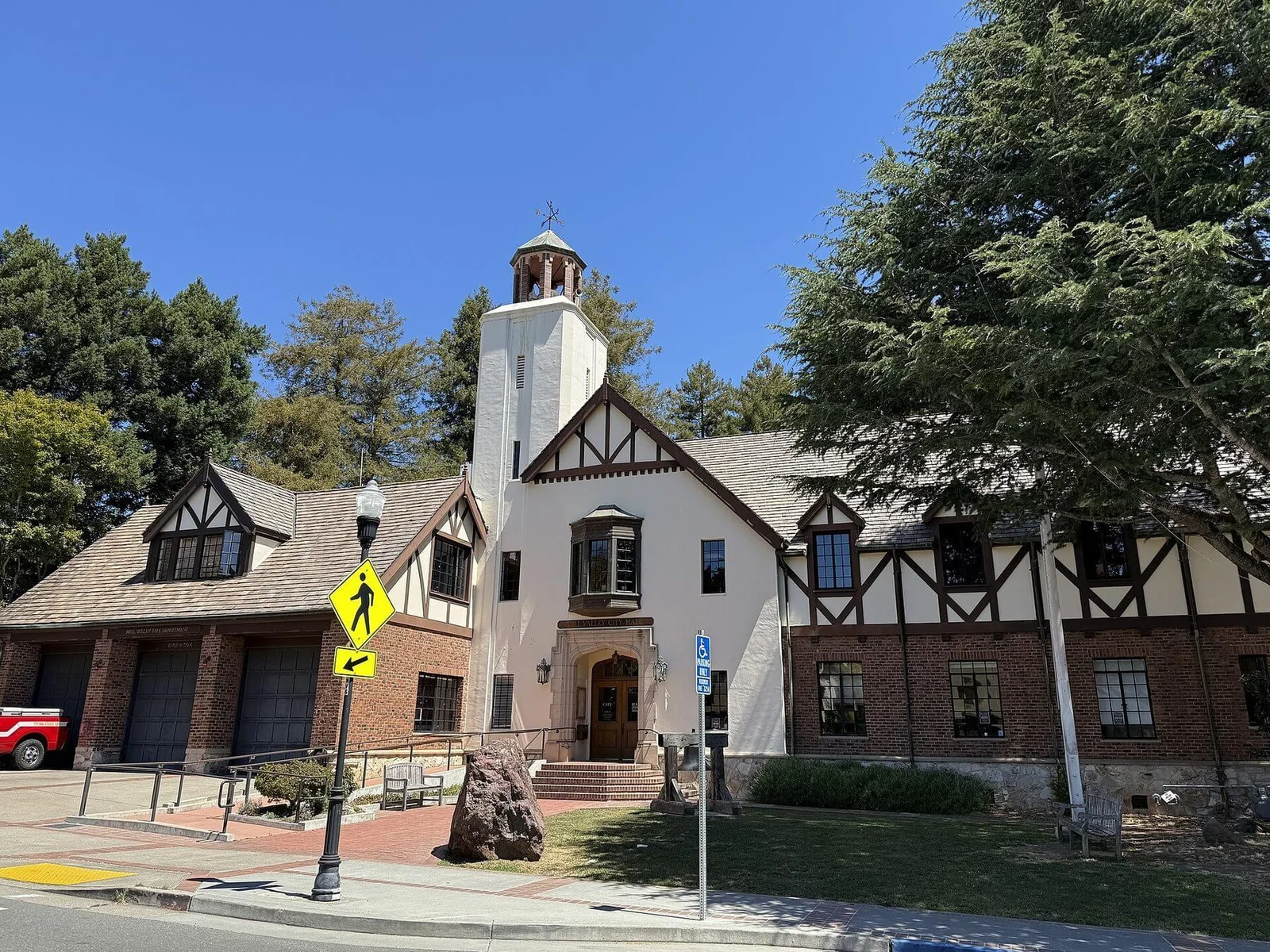
Mill Valley publishes its own residential furnace requirements handout, based on the 2022 California Mechanical Code, and reading it is the fastest way to understand why two houses on the same street get different recommendations. Start with the flat statement at the top: "A Permit is required for all furnace replacements."
Then read the access provisions, which is where canyon houses run into trouble.
The city requires that the "access opening shall not be less than the largest component of the appliance and a minimum of 22" X 30"." For appliances in underfloor or attic spaces there must be "a level working platform or grade surface not less than 30" by 30" provided in front of the service side of the appliance." And where a passageway is under six feet high, "the distance from the passageway access to the appliance shall not exceed 20' measured along the centerline of the passageway for both attics and underfloor spaces."
Now picture the housing. Sloped-lot construction here routinely gives you standing room at the downhill end of a crawl space and eighteen inches at the uphill end. A furnace sitting forty feet in along a four-foot passageway is not a serviceable location under those rules regardless of how long it has sat there, and relocating it can cost more than the appliance. That constraint is exactly why ductless equipment is so often the better answer in this town rather than the fallback, and why we crawl the space before quoting rather than after.
Two more provisions from the same handout come up on nearly every job here. Underfloor furnaces supported by the ground must sit "on a concrete slab not less than 3" above the adjoining ground level," and where the location is in a floodplain "the entire crawl area shall provide minimum 12" clearance between the bottom of the furnace and the ground," which matters on the creek-adjacent parcels. Attic and underfloor furnace locations "shall be provided with an electric outlet and lighting fixture at or near the furnace," with a switch by the access opening, and we find that missing more often than not on older installations.
Combustion air is the other one. The city notes that "in buildings of unusually tight construction all combustion air must be obtained from outside of building (nearly all modern homes)." A house that has been tightened up with new windows and insulation since its furnace went in may no longer be able to feed that furnace from indoor air, which is a real safety finding rather than an upsell.
Nick Neilson evaluated a large commercial hvac system for the Multicultural Center of Marin as professionally as I have seen in 50 years' practice as architect and property owner.
The A.
Sizing runs smaller here than people expect
Nothing gets replaced here without a room-by-room load calculation behind it. Floor area times a coefficient is not a calculation, and neither is reading the old data plate, because that plate frequently records somebody else's guess, doubled at the following replacement.
The local conditions push the result down. Wooded canyons stay shaded, so solar gain is limited in a way it simply is not on an open Novato or Windsor lot. Summers are mild, winters are damp rather than deeply cold, and plenty of houses here have never had cooling at all. The right box in this climate is usually smaller than people picture, and oversizing costs more here than it would somewhere with real winters. Too much capacity hits the setpoint before the house has evened out, so the temperature swings, the damp never gets pulled out of the air, and the compressor racks up starts it should never have made.
Sizing also has to respect that Mill Valley has several microclimates. A north-facing canyon house under heavy redwood canopy and a Strawberry house with open afternoon exposure toward Richardson Bay are different calculations even at the same square footage. We run the numbers per house rather than per zip code.
Because the design heating temperature here is mild, a correctly sized heat pump generally carries the whole heating load on its own. Where we fit auxiliary electric heat, it is a backup element rather than the thing the house depends on all winter, and that changes the electrical scope in your favor.
The electrical question, and the gas question
A gas-to-heat-pump conversion adds a substantial 240-volt load, and the load calculation is the thing that decides whether that is a breaker or a project. On the older streets and up the canyon roads we routinely find services sized for a much shorter appliance list, panels with no free space for a two-pole breaker of any size, and sub-panels added across several decades. None of that is a defect until something new asks to join the list.
Three routes out, and they are not equivalent. A service upgrade raises the ceiling and is the clean answer when the entrance gear is old anyway. A subpanel adds spaces without adding capacity. Load management hardware lets two large loads share an allocation by preventing simultaneous operation, which can be the right answer where an upgrade would mean a long trench up a hillside. That work is scoped on our Mill Valley panel upgrade page, and because we hold the C-10 license as well, it happens inside the same project rather than through a second company on a separate schedule.
If combustion stays, the gas side has its own requirements: supply line sizing for the appliance going in, a vent that matches the equipment category, and the combustion air provision above. A high-efficiency condensing furnace vents differently from what it replaces and needs a condensate path, which in a crawl space means somewhere for that condensate to legally go.
Permits and code in Mill Valley
Two authorities issue permits to addresses that all say Mill Valley on the mail. Work inside the city limits goes to the Building Division. Marin County's own permit site lists Mill Valley Homestead Valley, Mill Valley Strawberry and Mill Valley Tamalpais Valley among unincorporated Marin, so those parcels are reviewed and inspected by Marin County Building and Safety instead. Since January 1, 2026 the county no longer accepts paper plan submittals.
Inside the city, the timeline is published and worth knowing before you plan around it. The city's permit application process page states that "some minor permits are issued automatically to licensed contractors upon application," lists express permits at "1 - 3 Business Days," minor permits that receive review and corrections at "7 - 10 Business Days," and standard residential plan check at a "4 - 6 Week Minimum." A straight equipment changeout and a project that trips plan check are therefore different calendars, not just different prices.
Above the city sit three code layers.
Title 24 energy compliance. California's 2025 Building Energy Efficiency Standards took effect January 1, 2026, and the documentation is part of the permit package. The city's furnace handout adds a duct-specific trigger worth planning around: "any new ducts must be insulated minimum R-6 and sealed (no HERS verification required unless replacing more than 40 linear feet of duct)." Cross that threshold and an independent HERS rater verifies the work, which belongs in the schedule and the quote rather than in a conversation after the inspection. The handout also states plainly that "a setback thermostat must be installed."
Air district appliance rules. Mill Valley is fully inside the Bay Area Air Quality Management District, with no partial-boundary question. Rule 9-4, which covers fan-type residential central furnaces, sits on a later phase. Nothing requires you to remove a working gas furnace today, and we confirm the current requirement when we quote rather than repeating what was true last year.
Refrigerant transition. Nobody has made or imported R-22 in the United States since 2020, so every pound available now has been recovered from something else, which is why a leaking pre-2010 system is a replacement conversation rather than a top-up. R-410A is being phased down under the AIM Act and new residential equipment is moving to lower global warming potential refrigerants, under a 700 GWP limit on newly manufactured residential and light commercial equipment. Owning an R-410A system today obligates you to nothing, though as production shifts, pairing a new outdoor unit to an older indoor coil gets harder, and a mismatched pair will not deliver rated capacity however well it is installed.
What moves the price on a Mill Valley job
By the time access, sizing and power are answered, the number is largely set, because the scope is set. What moves it:
Whether usable duct exists, and how much has to be sealed, resized, or replaced, including whether the work crosses the forty-foot HERS threshold. On a ductless system, the number of indoor heads and the distance from each to the outdoor unit. Line set length and routing, which on a house stepping down a slope can mean working through several levels. The electrical scope: a dedicated circuit, a subpanel, or a service upgrade. Access, meaning stair carries, narrow gates, no driveway, and restricted street parking. Structural work to set an outdoor unit level and anchored on a slope, plus the acoustic question of where it sits relative to a neighbor's window, which on close-set canyon lots is a genuine siting constraint rather than a courtesy. Relocating a furnace out of a location that cannot meet the access rules. And whether the parcel permits through the city or the county.
You get the finding and the number before anyone starts, and where a repair is genuinely on the table it sits next to the replacement rather than behind it. Larger projects can be arranged through financing.
Ongaro and its entire team, including the awesome office staff who schedule appointments and take incoming calls and questions, are the best when it comes to anything heating/plumbing related.
Rikki B.
Incentives, and why the paperwork comes first
MCE is the community choice energy provider for Marin, and the sequencing rules matter more than the amounts. MCE's heat pump rebates are open to "MCE customers who own and have lived in their single-family detached homes for at least 12 months in MCE's service area." MCE states that "to qualify for MCE's rebate, a project must be installed by a participating contractor who will process the rebate application paperwork on your behalf," and that "MCE's rebates cannot be applied to a project retroactively." MCE also asks that other electrification work, including solar, battery storage and EV charging, not follow within twelve months of the rebated install. So if a heat pump, an array and a car charger are all on your list, the order is a financial decision and it has to be made before the first one goes in.
How the work gets done, and what commissioning means
Install day starts with the route in: floor protection, stair protection, and an agreed path from wherever the truck can sit. On streets where parking is scarce, staging is arranged beforehand rather than improvised on the morning.
The old charge gets recovered into a cylinder rather than released. New line sets go in wherever the routing allows; an existing one is only reused after a flush and a pressure test, and a change of refrigerant type usually settles that question for us. While the joints are brazed, nitrogen flows through the tubing so the inside does not scale up with oxide, and the finished system is pressure tested and then evacuated to a deep vacuum, read on a micron gauge rather than judged by a clock. That last step is the one that gets rushed on a busy day, and the bill arrives two or three years later as moisture that has been eating the compressor from the inside.
Then the items a crew behind schedule quietly leaves out. Condensate has to fall the whole way and have a backup path, or a pump where the fall is not there, and in a canyon that drain line is going to spend winter in a cold wet crawl space, which is precisely where a marginal one fails. The outdoor disconnect goes within sight of the unit, correctly breakered and correctly wired. Anything set on a bracket or a built platform gets anchored for seismic and wind load, which on this ground is structural rather than optional. And the ducts get sealed to whatever the load calculation assumed, because a calculation is only a prediction until the ductwork matches it.
Commissioning is separate from inspection and it is the part nobody sees. We record airflow and external static pressure across the air handler, verify refrigerant charge against the manufacturer's target rather than by feel, measure temperature split at the registers, and on inverter equipment set the configuration for this house instead of leaving factory defaults in place. A system nobody commissioned can pass an inspection and underperform for a decade. You get model and serial numbers, the permit record, and a walkthrough in person, and we register the manufacturer warranty ourselves.
Maintenance in a damp, shaded canyon
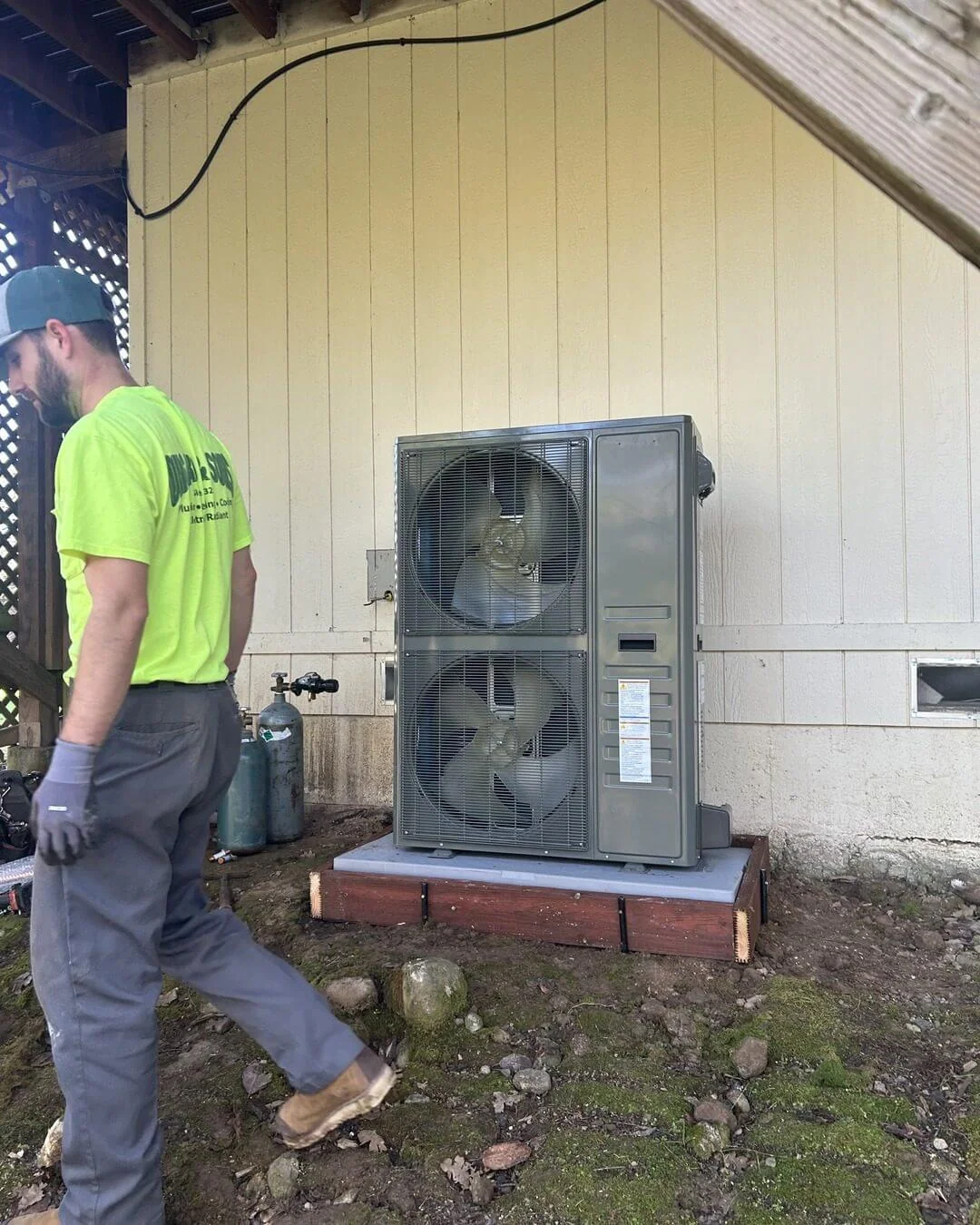
Mill Valley is hard on mechanical equipment in a specific way rather than a general one. Condensate does not evaporate here the way it does in a hot inland valley, so pans, drain lines and coil surfaces stay wet longer, and biological growth in a pan is a summer problem rather than an occasional one. Crawl spaces under sloped lots hold moisture. Tree canopy drops needles and leaf litter onto condenser coils and into the yard drains nobody tests until a storm arrives.
A workable rhythm here is twice-yearly service rather than annual, because the equipment is asked to heat for most of the year and cool for a short intense stretch, and those are different checks. Clear the condensate path before the wet season rather than during it. Change filters on condition rather than on the sticker interval, since a vented crawl space and damp canyon air load a filter faster than a tight inland house does. Keep the outdoor unit clear of accumulating leaf litter, which insulates the coil exactly the way salt film does on the coast. Any gas appliance still in service gets a combustion and venting check yearly, which given the combustion air rule above is worth doing properly. Our maintenance plans cover the seasonal visits.
Reliability has a second half, and it is the supply. Under its Public Safety Power Shutoff program PG&E can de-energize lines when fire weather warrants it, and wooded hillsides are exactly the terrain that qualifies. What surprises people is that fuel type buys nothing here: a gas furnace runs its inducer, its blower, its igniter and its board on electricity, so it stops when a heat pump stops. We are a Certified Generac Generator installer and can scope a standby unit alongside the mechanical work, and our Mill Valley electrical page covers the rest of that side.
The rest of what we run in Mill Valley
Furnace repair and replacement. Forced air units plus the wall and floor furnaces still common in the older housing. Diagnosis takes in the heat exchanger, venting and combustion, ignition and controls, and the airflow path, because airflow causes more furnace failures than any single component. A furnace that fires and then shuts down after a minute or two is usually tripping its high limit because it cannot move enough air across the heat exchanger.
In this town the cause is more often the duct than the filter, because a lot of these systems run through crawlspaces that pinch to nothing at the uphill end and the runs were compromised from the day they went in. Heat with no blower is typically the motor or its capacitor; a blower running with no heat is generally ignition or a control board. Wall and floor furnaces fail their own way: cracked heat exchangers, corroded or blocked vents, and no meaningful distribution past the room they occupy. See furnace repair in Mill Valley.
Heat pump conversion, ducted and ductless. Full-home ducted systems where the duct supports them, single-zone or multi-zone ductless where it does not. Ductless is also how we solve the converted attic room, the downhill addition, and the office nobody can keep warm, without opening finished walls. Heat pumps in Mill Valley goes into sizing and equipment selection.
Air conditioning. Modest demand compared with inland Marin and Sonoma, which is precisely why sizing and modulation matter more here rather than less. Straight-cool systems, coil replacement and condenser replacement, with the shading and siting realities of a canyon lot accounted for.
Ductwork. Sealing, resizing, adding returns, and replacing runs that were never right. It is the least glamorous line on any quote and frequently the one that changes how a house feels, and in older Mill Valley homes we regularly find flex duct crushed against joists, long runs with too many bends, and one undersized central return doing the work of three.
Ventilation, filtration and controls. Damp air keeps indoor humidity higher here than inland, so filtration and ventilation belong in the same conversation as the equipment rather than as an add-on. Controls round it out, because an inverter system loses most of its advantage on a basic on-off thermostat.
Where we work in Mill Valley
Downtown holds the oldest housing and the tightest sites: narrow streets, short driveways or none at all, and services sized for a much shorter appliance list.
Homestead Valley is wooded and sloped, and it is one of the unincorporated areas, so the county issues the permit even though the mail says Mill Valley.
Tamalpais Valley, generally called Tam Valley, sits lower and flatter toward the bay margin. Access is easier, and the drainage and floodplain provisions in the city's own handout become more relevant rather than less.
Strawberry reaches toward Richardson Bay and gets more open afternoon exposure than the canyons do, so cooling is a genuine request there. It also includes a small Eichler group of about a dozen homes, where low-slope roofs and original in-slab radiant heating make the replacement conversation a different one entirely.
We also work the neighboring towns: HVAC in Sausalito, Corte Madera, Belvedere, San Rafael and Novato, with the county picture on our Marin County HVAC page.
How to choose an HVAC contractor for a canyon house
Ask which authority issues the permit for your parcel, and see whether the answer arrives immediately.
Ask for the room-by-room load calculation and ask to see it. Sizing from square footage or from the label on the old unit is a guess, and in this climate that guess runs high.
Ask whether anyone has been in the crawl space or the attic, and what they found about access, platform, passageway length and combustion air. A quote written from the thermostat is a quote written before the deciding facts were known.
Ask whether the proposal crosses the forty-foot duct replacement threshold and who arranges the HERS verification if it does.
Ask when the rebate application gets filed, because on a Marin heat pump the answer has to be before installation, by a participating contractor.
And look the contractor up on the Contractors State License Board site to see the C-20 on the license rather than on the van.
What North Bay homeowners say
Two notes from customers, unedited.
HVAC across Mill Valley and Marin County
More on what we do here and nearby: heat pumps in Mill Valley, furnace repair in Mill Valley, the full Mill Valley service matrix, plumbing in Mill Valley, water heaters in Mill Valley, electrical panel upgrades in Mill Valley, EV charger installation in Mill Valley, solar in Mill Valley, and HVAC across Marin County.
Book HVAC service in Mill Valley
Tell us the neighborhood, roughly when the house was built, whether it has ducts, and where the furnace or air handler currently lives, and we can often say before the visit which of the three questions will shape your project. Book online to schedule, or reach us during office hours to talk a replacement through before putting anything on the calendar.
Your Comfort, Our Priority
Ongaro & Sons is your trusted heating, cooling, plumbing, electrical, and solar expert, specializing in reliable maintenance and repair services that keep your home running efficiently year-round.
Our certified technicians deliver unmatched expertise with fast, friendly service across Marin, Sonoma and Napa County. From HVAC tune-ups to plumbing repairs and electrical upgrades or solar solutions, we focus on energy-efficient performance and long-term comfort. Count on us to maintain the systems that power your home and keep your environment just the way you like it.
Licensed, Insured, Background-Checked
Our technicians are licensed, experienced, and trained to service all makes and models.
Locally Owned and Operated
Serving the Napa, Marin, and Sonoma communities with personalized, hometown service.
Reliable Repairs
We respond quickly and get the job done right the first time, with no surprises.
Since 1932
Why Ongaro & Sons?
Four generations of trusted home service. Open any reason to see what it means for your home.
Schedule Service →Family-owned in the North Bay since 1932
Four generations of the Ongaro family serving Marin, Sonoma and Napa County. We know these homes and the systems in them.
Licensed, insured, background-checked technicians
Every technician is fully licensed and insured, background-checked, and trained on the equipment we install.
Diamond Certified and BBB A+
Diamond Certified since October 2016, and BBB Accredited with an A+ rating since December 1995.
Mitsubishi Diamond Contractor Elite and Trane Comfort Specialist
Both top manufacturer tiers. That standing decides how registration and extended warranty terms are handled on the system you actually bought.
The price is agreed before work starts
You see the number before the work begins. Flat-rate quotes, no surprises and no pressure.
Comprehensive maintenance program
Members get priority scheduling, discounts, and proactive checkups that prevent costly failures.

Discount
Membership
Ongaro Maintenance Plans
Annual maintenance on your home systems provides safeguards and comfort to you and your family. Members get priority scheduling, discounts, and proactive checkups that catch problems early.
Member Discounts
5% off every repair and replacement, all year long.
Peace of Mind
Proactive checkups catch issues before they become big problems.
Courtesy Reminders
We call you to schedule: never miss a seasonal service.
Value That Lasts
With Ongaro & Sons, you’re investing in quality, integrity, and service that stands the test of time. Explore our current promotions and see the difference real value makes for your HVAC, plumbing, and electrical needs.


From the Blog
 Sep 17, 2026
How Many Amps Does My House Need? Sizing Service for What You Actually Run
How many amps your house needs comes from a load calculation of what you run and plan to add. What drives the number, when existing service is enough, and more.
Read More Sep 10, 2026
Hard Water in Marin County: What Is Actually in Your Water and What It Does
Hard water in Marin County varies by provider and source. The 2025 report figures for Marin Water and NMWD, what hardness does and does not mean, and options.
Read More Sep 3, 2026
Electrical Permit Requirements in California: What Needs One and What Does Not
Find out which electrical projects commonly need permits, how to confirm local exemptions, and what to ask before work begins in Marin, Sonoma or Napa County.
Read MoreHVAC in Mill Valley: frequently asked questions
Who is the best HVAC company in Mill Valley?
By verifiable record rather than by adjective. Ongaro & Sons has worked in Marin since the company was founded here in 1932, is Diamond Certified with a BBB A+ Rating, is a Mitsubishi Diamond Contractor Elite and a Trane Comfort Specialist, and holds C-20 alongside C-36 and C-10 on one license. That last point matters here, because a Mill Valley heat pump job routinely becomes an electrical job as well.
Do I need a permit to replace a furnace in Mill Valley?
Yes, without exception. The city's own residential furnace requirements handout opens by stating that a permit is required for all furnace replacements. Inside the city limits some minor permits are issued automatically to licensed contractors on application, while work that receives review runs longer. Parcels in Homestead Valley, Strawberry and Tamalpais Valley file with Marin County instead.
Why might my furnace have to be moved rather than just replaced?
Because the location has to be serviceable under the city's access provisions, and a lot of older crawl space and attic installations are not. The access opening has a minimum size, there has to be a level working platform in front of the service side, and where the passageway is under six feet high the distance from the access to the appliance is capped at twenty feet. A furnace installed decades ago at the far end of a low crawl space fails that test today.
Does a Mill Valley house actually need air conditioning?
Few houses here strictly need it. Shaded canyons and mild summers mean many have gone decades without it. What has changed is that a heat pump provides cooling as a byproduct of the heating equipment you were replacing anyway, so the marginal cost of having the option is small compared with adding a separate cooling system later. Strawberry, with more open exposure, asks for it more often than the canyons do.
My house has no ducts. What are the options?
Ductless, in most cases, and on the merits rather than as a consolation prize. Older construction here was frequently built without central duct runs, and a shallow crawl space often cannot accommodate one anyway. Indoor units mount in the rooms you want conditioned and connect to an outdoor unit through small line sets, delivering heating and cooling without opening finished walls.
Can a heat pump heat a house here without gas backup?
In almost every case, yes. The design heating temperature in this part of Marin is mild enough that a properly sized heat pump carries the full load by itself. Any electric backup element fitted is insurance for the coldest hours rather than something the house leans on, and cold-climate capacity derating is a much smaller factor here than it would be inland or at elevation.
Is my gas furnace about to be banned?
No. Fan-type residential central furnaces sit on a later phase of the district's work. Nothing obliges you to remove a working gas furnace, and we tell you where the rule stands rather than using it as a sales lever. The dates that do exist govern what may be sold and installed, and they vary by equipment size and type.
What is the forty foot duct rule I keep hearing about?
It is a verification threshold rather than a prohibition. The city's handout requires new duct to be insulated to a minimum of R-6 and sealed, and notes that HERS verification is not required unless more than forty linear feet of duct is being replaced. Cross that line and an independent rater tests the work, which affects the schedule and the price, so it belongs in the quote rather than in a surprise afterward.
Should I repair or replace a system still running on R-22?
Lean toward replacement once an R-22 system develops a real leak. Production and import ended in the United States in 2020, so anything going in now is reclaimed or stockpiled supply, and recharging a leaking unit is a temporary measure on equipment already past its design life. A dry, well-running R-22 system can reasonably stay in service.
Will the new outdoor unit bother my neighbor?
It can, and on close-set canyon lots that makes sound rating a real selection criterion rather than a footnote. Siting matters as much as the equipment: distance from bedroom windows on both properties, what surfaces will reflect the sound, and whether the unit sits above or below the neighboring grade. Inverter equipment running at part load is considerably quieter than single-stage equipment cycling on and off.
What happens to my heating during a Public Safety Power Shutoff?
It stops, whatever it burns. PG&E may turn off power during severe weather to reduce the risk of its equipment causing a wildfire, and the wooded hillsides here carry genuine exposure. A gas furnace needs electricity for its inducer, blower, igniter and controls, so fuel type offers no protection. A standby generator or a battery paired with an array is what keeps heat running.
Do you handle the Eichler homes in Strawberry?
Yes, and they are their own category. Low-slope roofs and original in-slab radiant heating change both the equipment options and the installation approach, since there is no attic to run duct through and no crawl space to put an air handler in. Ductless and carefully sited ducted solutions both have a place, and the right answer depends on what the slab system is still doing.