Furnace Repair in Cloverdale
Ongaro & Sons, founded in 1932, repairs furnaces in Cloverdale and the Alexander Valley. We are Diamond Certified, the HVAC work is done under a C-20 license, and 2,756 Google reviews average 4.8 stars. A technician diagnoses the actual fault, shows you what failed, and prices the fix before touching a part.
On this page
Why furnaces here fail on the first cold night
Most Cloverdale furnace calls come on the first genuinely cold night of the season: the thermostat gets bumped up for the first time since spring, something in the hallway closet clicks and hums, and then nothing happens.
That pattern is not random. At the north end of Sonoma County the cooling season is the long one and the heating season is compressed into a narrow window, so a gas furnace here sits idle for seven or eight months at a stretch. All summer the blower pulls household dust through a cabinet whose burners are cold, and films build on components that only stay clean by being used. Then the assembly is asked to perform on demand, at night, on the coldest evening in months. The fault was already sitting there, and the first call for heat exposed it.
How a furnace starts, and where the sequence breaks
A modern gas furnace runs a fixed startup order, and every step has to prove itself to the control board before the next one is allowed to happen.
The thermostat closes a low-voltage circuit. The inducer motor spins up and pulls air through the heat exchanger and out the flue. A pressure switch senses that draft and closes, which is the board's proof that exhaust is leaving the building. Only then does the igniter energize. The gas valve opens, the burners light, and a flame sensor sitting in the fire has a few seconds to return a small current confirming combustion is happening. If it does, the blower starts after a built-in delay. If any step fails to prove itself, the board shuts the gas off, retries a set number of times, then locks out.
Nearly every no-heat call here is one of those handshakes failing, so naming the specific step that stalls is most of the diagnosis.
What fails, and what each failure looks like from the hallway
- Hot surface igniter. The most common single failure. A brittle ceramic element cycles hot and cold until it cracks. The inducer runs, no glow appears at the sight window, the burners never light.
- Flame sensor. An oxidation film builds on the rod and the current it returns drops below threshold. The signature is unmistakable: burners light, run four or five seconds, shut off, retry, lock out.
- Blocked flue or stuck pressure switch. The inducer runs and nothing follows. On rural parcels this is often a nest built in a flue that sat unused all summer, which makes it a venting problem before a furnace problem.
- Blower motor or run capacitor. The motor hums without turning, or starts and trips on its own thermal overload. On a shared air handler this kills your cooling too.
- High limit tripping. Heats a few minutes, shuts down, repeats. Almost always restricted airflow rather than a bad switch: a clogged filter, a closed return, or crushed flex duct overheats the cabinet.
- Control board. Relays weld shut, or the board burns because a failing motor drew more current than it was rated to feed. Replacing it without finding that motor guarantees a second visit.
- Cracked heat exchanger. The failure that ends the repair conversation, because it can put combustion products into the air your blower delivers to bedrooms.
- Thermostat and control wiring. Frequently a smart thermostat installed without a common wire, stealing power through the control circuit and confusing the board.
Mark was professional, prompt and great communication. He was knowledgeable and friendly. He’s fast in finding the problem with my furnace. Would highly recommend this company. Thank you
Tang S.
How a real diagnosis runs
A diagnosis worth paying for is a sequence of measurements, not a sequence of guesses.
We confirm the call for heat reaches the board, read the fault history stored there, then watch a full ignition attempt end to end so we see which proof step stalls instead of inferring it. From there the numbers do the talking. We measure manifold gas pressure against the nameplate, temperature rise between return and supply air against the range printed on the unit's own data plate, static pressure across the air handler, and flame signal current at the sensor.
Those readings sort the problem before a part is quoted. Temperature rise above the nameplate range is an airflow problem, and a new limit switch will not touch it. Low flame signal on a clean rod points at gas pressure or burner condition. We finish with a combustion check and a visual inspection of the heat exchanger, because that finding overrides the rest.
Repair or replace, in order
Homeowners want a rule. Here is ours, in order.
Safety. A failed heat exchanger, venting that cannot be made to draft correctly, or combustion readings that cannot be corrected are disqualifying. No repair price makes an unsafe heat exchanger a good idea, and we will not put one back into service.
Parts. Is the failed component still manufactured, and is it a commodity item or a model-specific assembly? Igniters, sensors, capacitors, and most motors cross brands. Integrated boards for discontinued models are a different situation, and on equipment old enough that its board is obsolete, the next failure has no fix at all.
Remaining life. Age against realistic service life, prior repair history, and whether the proposed fix addresses the cause or only the symptom. A board that burned because of a dying blower motor is two repairs, not one.
Clear all three and repair it. Fail the first and the decision is made for you. Fail the second or third and the real question becomes what you put in its place.
Your cooling shares the machine
In a conventional split system the furnace cabinet is not just a heater. It houses the blower that moves your air conditioning, and the evaporator coil sits directly on top of it in the same airstream. Because Cloverdale runs hot in summer at the north end of the county, cooling carries real load here, and that blower logs far more hours pushing cold air in August than warm air in January. The unit in your closet is a summer appliance that also heats.
Two things follow. A furnace failure is often a cooling failure in disguise, so if your condenser is on the same age clock the two calls belong together rather than eight months apart, which is worth reading next to our AC repair in Cloverdale page. And replacing a furnace disturbs the coil connection above it, where coil and condenser must be a matched pair to perform as rated. At that point the question is whether you want two machines or one. A heat pump in Cloverdale covers both jobs from a single outdoor unit, burns no gas, and pairs with auxiliary electric heat for the coldest mornings.
Refrigerant sharpens the timing. R-22 production and import in the United States ended in 2020, so any repair to a pre-2010 system depends on reclaimed or stockpiled supply. R-410A is being phased down under the AIM Act, though a working R-410A system needs no replacing on that account.
A conversion does require electrical capacity: a 240-volt circuit and a load calculation against your existing service, which is why we look at the panel during the estimate rather than on installation day. See electrical panel upgrades in Cloverdale if your service is older or already crowded.
Permits, code, and inspection for Cloverdale furnace work
- Who issues the permit. Inside city limits it is the City of Cloverdale Building Division, which takes applications through its online permitting portal. Outside them, including much of the Alexander Valley and the rural parcels around it, the authority is Permit Sonoma.
- Repair versus replacement. Swapping a component inside an existing appliance is generally maintenance. Installing a different appliance, or altering venting, gas piping, or ductwork, is permitted work. Confirm scope with the jurisdiction covering your address.
- Inspection scheduling is a genuine project constraint here. The city's Building Division states that it conducts inspections and plan check reviews Monday through Thursday from 2 to 4 p.m., and that "requests for inspections must be made at least 24 hours in advance to guarantee the inspection." On a small-city calendar, that window shapes when a change-out gets closed out.
- Title 24 energy standards. California's 2025 Building Energy Efficiency Standards took effect January 1, 2026, per the California Energy Commission, and a replacement documents compliance. Read carefully here: that cycle set a single fuel baseline for new single-family construction, with heat pumps prescriptively required for water and space heating alike, and a new-construction baseline does not extend to swapping equipment in an existing home.
- Carbon monoxide alarms. California Health & Safety Code §17926 requires an owner to install a carbon monoxide device "in each existing dwelling unit having a fossil fuel burning heater or appliance, fireplace, or an attached garage," placed consistently with new-construction building standards or the manufacturer's instructions.
- Air district, and this one is specific to Cloverdale. The town sits in the Northern Sonoma County Air Pollution Control District, not the Bay Area district, per Sonoma County's own listing of air quality districts. If a search result told you gas appliances are being outlawed where you live, check which district you are in.
Scheduled appointment for furnace maintenance was on time, thorough and informative. Jonathan Wright was professional, personable and answered all questions with clarity.
Antonia M.
What drives the cost of a furnace repair in Cloverdale
The largest variable is which part failed, and specifically whether it is a commodity item stocked across brands or an assembly built for one model line. Igniters, flame sensors, capacitors, pressure switches, and most inducer motors are the reason a large share of no-heat calls resolve in a single visit. Integrated boards, variable-speed motor modules, and manufacturer-specific gas valves are the group where availability rather than complexity sets the timeline, and on a discontinued model a board sourced from a specialty supplier changes both the schedule and the math on whether repairing makes sense at all.
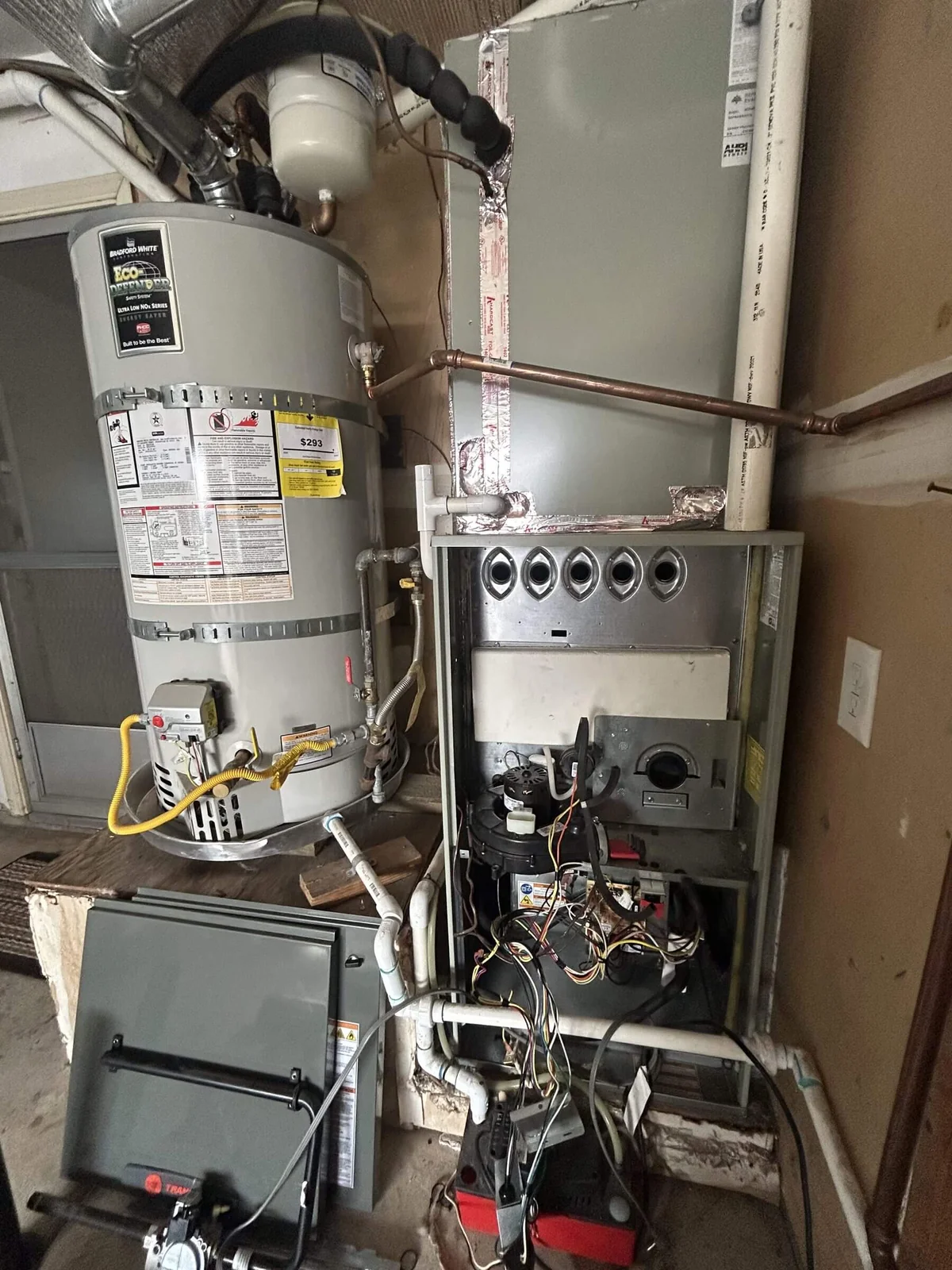
Access is the next factor, and it splits along local housing stock. Older in-town homes frequently have equipment tucked into a hallway or utility closet with minimal clearance, sometimes sharing it with a water heater, so service clearance, combustion air, and shared venting all have to be respected while working. Valley properties more often have garage or exterior installations with room to move, though longer duct runs and deferred service turn up more often. A crawlspace or attic install is slower than a garage install for identical work.
Whether the fix addresses cause or symptom matters financially even when it does not look that way at the time: a limit switch installed on a furnace that overheats from a restricted return will fail again. Warranty status is worth checking early, since many furnaces carry a multi-year manufacturer parts warranty that registration can extend. It covers the component and not the labor, but on an expensive part it moves the decision.
The state of the incentives
Repairs almost never qualify for a rebate. Incentives attach to equipment replacement, and nearly all current programs target electrification rather than gas, so this is really a conversation about whether a failed furnace is your moment to convert.
Ask any bidder to name and link the program they are quoting.
Sonoma Clean Power is the community choice energy provider here, and its offerings move on their own schedule. Its published water heating terms carry an enhanced heat pump water heater rebate with an end date on it, and once that steps down the rebate is available only to customers on the CARE or FERA bill discount programs. We check what is open when we scope the work.
Maintenance that prevents the November call
Most furnace failures are preventable, and in this part of the county filtration deserves more attention than it usually gets.
Northern Sonoma County around Cloverdale sits near the 2019 Kincade Fire footprint, and during smoke events the furnace filter becomes the household's primary air cleaning device whether it was chosen for that job or not. Moving to a higher MERV rating is reasonable, but denser media adds resistance, and an older single-speed blower fighting a restrictive filter through undersized ducts will overheat and trip out. Measure static pressure first, then pick the filter the system can breathe through, often by adding surface area rather than density.
Book service in early fall, ahead of the cold stretch that fills every schedule in the county. A proper visit cleans the flame sensor and burners, verifies gas pressure and temperature rise, checks the inducer and pressure switch, inspects the heat exchanger, and clears the condensate trap on a condensing unit where the same summer dust settles. Our maintenance plans cover heating and cooling on one schedule, which suits equipment that works in both seasons.
Keep the closet itself in mind, because spaces like the one pictured above tend to become storage. Never keep solvents, paint, or pool chemicals near a gas appliance: chlorine and fluorine compounds corrode heat exchangers from the inside. Where a water heater shares the space, both appliances draw on the same combustion air and sometimes a shared vent, so a change to one affects the other, worth knowing before any water heater work in Cloverdale too. Test carbon monoxide alarms seasonally and replace them at end of rated life.
Where we work in Cloverdale, and what changes by area
We cover downtown Cloverdale, the neighborhoods along the Asti Road corridor, and out into the Alexander Valley and the rural parcels around it.
In town, the older housing stock means interior closet furnaces, tight clearances, duct systems sized around a different set of assumptions, and electrical services never planned around a second 240-volt appliance. Those constraints shape what is practical, and they are why we take readings before recommending equipment.
Out in the valley the lots are larger, equipment more often sits in a garage or exterior closet with room to work, and many parcels are on wells and septic. That last detail matters more than it sounds. This area faces PG&E Public Safety Power Shutoffs, and plenty of homeowners are surprised to learn a gas furnace does nothing during an outage: the board, the inducer, and the blower all run on household electricity, so no power means no heat regardless of how much gas is in the line. On a well, the pump stops at the same moment. As a Certified Generac Generator installer we can plan standby generation alongside the heating work rather than as a separate project. If your property runs on propane instead of natural gas, the furnace also needs the correct orifices and pressure setup for that fuel, worth confirming before equipment is ordered.
How to choose a furnace contractor in Cloverdale
Ask what will be measured. Anyone who reads temperature rise, static pressure, gas pressure, and flame signal is going to find the cause. Anyone quoting a part over the phone is guessing, and you pay for the guess twice.
Ask about license class. Furnace work belongs to a C-20 HVAC contractor. If the job touches the panel or a new circuit, C-10 electrical applies, and gas piping or a shared-closet water heater brings in C-36 plumbing. We hold all three, so a mixed-scope job does not turn into three separate schedules.
Ask what they plan to do about your cooling. Recommending a furnace replacement in this town without one question about the condenser outside is solving half the problem.
On credentials: Ongaro & Sons is Diamond Certified, a Trane Comfort Specialist, a Mitsubishi Diamond Contractor Elite, and holds a BBB A+ Rating. We have been family-run since 1932 and everything dispatches from our Petaluma headquarters. Our full heating and cooling service in Cloverdale covers repair, replacement, ducts, and maintenance.
What North Bay homeowners say
Two reviews from customers who called us about furnace work.
Furnace repair across Cloverdale and Sonoma County
More from Ongaro & Sons nearby: heating and cooling across Sonoma County, every service we offer in Cloverdale, and furnace repair in Windsor just down Highway 101.
Book furnace repair in Cloverdale
Tell us what the furnace is doing, or not doing, and we will get a technician out to measure it. Book online to confirm an appointment, or get in touch if you would rather talk through the symptoms before scheduling.
Your Comfort, Our Priority
Ongaro & Sons is your trusted heating, cooling, plumbing, electrical, and solar expert, specializing in reliable maintenance and repair services that keep your home running efficiently year-round.
Our certified technicians deliver unmatched expertise with fast, friendly service across Marin, Sonoma and Napa County. From HVAC tune-ups to plumbing repairs and electrical upgrades or solar solutions, we focus on energy-efficient performance and long-term comfort. Count on us to maintain the systems that power your home and keep your environment just the way you like it.
Licensed, Insured, Background-Checked
Our technicians are licensed, experienced, and trained to service all makes and models.
Locally Owned and Operated
Serving the Napa, Marin, and Sonoma communities with personalized, hometown service.
Reliable Repairs
We respond quickly and get the job done right the first time, with no surprises.
Since 1932
Why Ongaro & Sons?
Four generations of trusted home service. Open any reason to see what it means for your home.
Schedule Service →Family-owned in the North Bay since 1932
Four generations of the Ongaro family serving Marin, Sonoma and Napa County. We know these homes and the systems in them.
Licensed, insured, background-checked technicians
Every technician is fully licensed and insured, background-checked, and trained on the equipment we install.
Diamond Certified and BBB A+
Diamond Certified since October 2016, and BBB Accredited with an A+ rating since December 1995.
Mitsubishi Diamond Contractor Elite and Trane Comfort Specialist
Both top manufacturer tiers. That standing decides how registration and extended warranty terms are handled on the system you actually bought.
The price is agreed before work starts
You see the number before the work begins. Flat-rate quotes, no surprises and no pressure.
Comprehensive maintenance program
Members get priority scheduling, discounts, and proactive checkups that prevent costly failures.
Discount
Membership
Ongaro Maintenance Plans
Annual maintenance on your home systems provides safeguards and comfort to you and your family. Members get priority scheduling, discounts, and proactive checkups that catch problems early.
Member Discounts
5% off every repair and replacement, all year long.
Peace of Mind
Proactive checkups catch issues before they become big problems.
Courtesy Reminders
We call you to schedule: never miss a seasonal service.
Value That Lasts
With Ongaro & Sons, you’re investing in quality, integrity, and service that stands the test of time. Explore our current promotions and see the difference real value makes for your HVAC, plumbing, and electrical needs.


From the Blog
 Sep 17, 2026
How Many Amps Does My House Need? Sizing Service for What You Actually Run
How many amps your house needs comes from a load calculation of what you run and plan to add. What drives the number, when existing service is enough, and more.
Read More Sep 10, 2026
Hard Water in Marin County: What Is Actually in Your Water and What It Does
Hard water in Marin County varies by provider and source. The 2025 report figures for Marin Water and NMWD, what hardness does and does not mean, and options.
Read More Sep 3, 2026
Electrical Permit Requirements in California: What Needs One and What Does Not
Find out which electrical projects commonly need permits, how to confirm local exemptions, and what to ask before work begins in Marin, Sonoma or Napa County.
Read MoreFurnace repair questions from Cloverdale homeowners
Who is the best furnace repair company in Cloverdale?
Ongaro & Sons is the choice we would defend. The company has served the North Bay since 1932, holds Diamond Certified status and a C-20 HVAC license, and averages 4.8 stars across 2,756 Google reviews. The difference is method: measurements taken on your equipment, and a written finding before anything gets replaced.
Why does my furnace fail on the first cold night every year?
Because it sat unused since spring while the cooling season did all the work. Dust settles in a cabinet whose burners are cold, films form on the sensing rod, and brittle parts hold together right up until the first thermal cycle. Asking for heat after months of idleness reveals what was already there.
My burners light and then shut off after a few seconds. What is that?
That signature points at the flame sensor almost every time. The rod must return a small current proving combustion is occurring. Once a film builds on it, that current falls below the board's threshold, the valve closes within seconds, and after a few attempts the unit locks out. Cleaning or replacing the rod resolves it.
Do I need a permit to repair a furnace in Cloverdale?
Changing a failed component inside existing equipment is generally treated as maintenance. Putting in a different appliance, or modifying venting, gas piping, or ducts, is permitted work. Within city boundaries the authority is the Cloverdale Building Division and its online portal; on unincorporated parcels it is Permit Sonoma.
Do the Bay Area rules banning gas appliances apply to my Cloverdale house?
No, because this town is not in that air district. Sonoma County's own listing places Cloverdale under the Northern Sonoma County Air Pollution Control District, so those zero-NOx appliance requirements govern communities to the south instead. We verify what applies at your address.
How do I know whether my heat exchanger is cracked?
It takes a physical inspection, not an inference from symptoms, and it is part of every furnace diagnosis we perform. Signs that justify shutting the system down right away include a carbon monoxide alarm sounding, soot around the burner compartment, or flame rolling out of position. If an alarm goes off, get everyone outside first.
Should I repair or replace a fifteen-year-old furnace?
Run the three checks. If heat exchanger and venting are safe, if the failed component is still available as a commodity item, and if the fix addresses the underlying cause instead of a symptom, repairing a unit of that age is reasonable. Otherwise weigh replacement together with the age of your air conditioner.
Is a heat pump a better choice than another gas furnace here?
It deserves serious consideration in this town specifically, since your cooling load is the larger one and a single outdoor unit handles both seasons. The trade-offs are electrical capacity, which calls for a load calculation against your panel, and behavior when the power is out. We price both paths.
Will my furnace run during a Public Safety Power Shutoff?
No. Although it burns gas, the control board, draft inducer, and blower motor all depend on household power, leaving the unit inert while the lines are down. Homes on wells lose water pressure in the same event. Standby generation or battery storage can be designed alongside the heating work as one scope.
What filter should I use during wildfire smoke season?
The highest MERV rating your system can move air through, which is a measured answer rather than a universal one. Denser media adds resistance, and an aging blower straining against it through undersized ducts will overheat and shut down. We take a static pressure reading, then recommend. Replace it more often while smoke is present.
How often should a Cloverdale furnace be serviced?
Once a year, in early autumn, ahead of the first cold stretch that fills every calendar in the county. Because the same blower cabinet carries your summer cooling, a combined plan servicing heat in fall and cooling in spring matches how this equipment is actually used locally.