HVAC in Windsor, CA
Ongaro & Sons is the HVAC contractor Windsor homeowners call when the answer has to hold up. We have worked in the North Bay since 1932, we are Diamond Certified, we hold a C-20 HVAC license, and we carry 2,756 Google reviews averaging 4.8 stars. We are a Mitsubishi Diamond Contractor Elite and a Trane Comfort Specialist. Every Windsor job runs out of our Petaluma headquarters, and we pull the permit ourselves.
On this page
The rules split Windsor down the middle
Most towns in Sonoma County sit entirely inside one air district. Windsor does not. Sonoma County's own air quality districts page lists Windsor as only partly inside the Bay Area Air Quality Management District, with the rest under the Northern Sonoma County Air Pollution Control District. Santa Rosa and Petaluma are fully BAAQMD. Cloverdale, Healdsburg and Geyserville are fully Northern Sonoma. Windsor is the seam.
That matters because BAAQMD is the district writing zero-NOx requirements for gas-fired residential appliances, and the Northern Sonoma district is not. Under BAAQMD Regulation 9, Rule 6, the 2023 amendment set zero-NOx requirements for residential water heaters with compliance dates that vary by unit size, and residential compliance begins in 2027. Rule 9-4 addresses fan-type residential central furnaces on a later phase. So a Windsor address inside the BAAQMD portion of town is on a different long-term appliance path than an address a short distance away that is not.
The second thing to know is that this rule package is still moving. Nobody's existing gas furnace is banned and nothing in your house has to come out on a deadline. We check the district that governs your specific parcel and confirm the current requirement when we write your scope.
The third rule is Title 24. California's 2025 Building Energy Efficiency Standards took effect January 1, 2026, per the California Energy Commission. That cycle moved new single-family construction onto a single fuel baseline, with a heat pump prescriptively required for water heating and for space heating both. It did not convert your existing furnace replacement into a mandatory electrification project.
The permit path, and why the permit date is worth money here
Inside town limits, mechanical work goes through the Town of Windsor Building Division, part of the Community Development Department. HVAC and mechanical are listed permit types on the town's building permit application, and the division accepts submittals electronically. The town's Permit Center holds the requirements, fees and forms. If your property sits outside the town boundary in unincorporated Sonoma County, the authority is Permit Sonoma instead, with different forms and a different inspection queue.
Here is the part most homeowners never hear until it is too late. Sonoma Clean Power's heat pump heating and cooling rebate states that "rebate applications must be submitted no more than 90 days after project completion," and that "for most projects, this will be the date listed on your finalized permit." A permit that never gets finaled leaves an open record against your property and can also fail to start the clock on the rebate you were counting on. An unpermitted change-out saves nothing and quietly forfeits the paperwork that pays part of the job back.
We pull the permit, schedule the inspection, and get the permit finaled. Ask any contractor bidding your Windsor system who files the application, who meets the inspector, and who closes the permit out. If the answer is you, that is a real cost they left off the sheet.
What those rules change about the equipment you should be looking at
Windsor runs hot in summer the way the inland Sonoma corridor does. The coast moderates Sebastopol and Bodega. It does not moderate here. Cooling carries real load in this town, which means the sizing conversation cannot be a heating conversation with air conditioning bolted on afterward. Equipment for a Windsor house has to hold the room on a triple-digit afternoon and still modulate down gracefully in April, and those two demands pull the selection in different directions.
The town's building stock splits the work cleanly. Windsor grew substantially from the 1980s onward, so a large share of the housing is subdivision construction: slab or crawl, ducted forced air, a condenser on a side yard pad, an air handler or furnace in a garage or a closet, and an electrical service built with some headroom. Those homes take a conventional change-out well, and many are hitting first-replacement age at once, which is why the scheduling crunch here arrives in waves rather than trickling.
The older homes closer to the Town Green area are a different job. On those streets we routinely find undersized or partially original duct runs, returns never sized for the airflow a modern system wants, closets built around a furnace that no longer exists in that footprint, and services with less spare capacity than a heat pump conversion needs. They are simply not the same project, and a bid that does not distinguish them was not written after looking at the house.
That is the branch point for equipment. Where ducts exist and are usable, a ducted heat pump or a dual-fuel pairing of a heat pump with a gas furnace covers both seasons on one system. Where ducts are absent, badly routed, or serving an addition that never got tied in properly, ductless or multi-zone equipment solves it without opening ceilings. We work the ductless side constantly as a Mitsubishi Diamond Contractor Elite and the ducted side as a Trane Comfort Specialist, so there is no reason to push your house toward whichever box we happen to prefer.
ONGARO installed an entire new heat/cool pump system with new ducting. Installation was professional, clean and extremely well done.
Dean C.
Symptoms, and what is usually behind them
Most calls start with a description rather than a diagnosis. These are the ones we hear most in Windsor:
- Cool air reaches the front rooms and never the back bedrooms, worst on the hottest afternoons
- Registers blowing air that is not cold, with the outdoor unit running and never satisfying the thermostat
- The outdoor unit hums and the fan does not turn, or it starts, runs briefly, and shuts down
- Ice on the copper lines outside or on the indoor coil during cooling
- The furnace ignites, runs a short burn, and quits before the house reaches setpoint
- A hot, burnt smell on the first heating call of fall that does not clear after fifteen minutes
- Water pooling near the indoor unit, or a ceiling stain under an attic air handler
- The blower running continuously while the thermostat reports the system satisfied
- Bills climbing with no change in how anyone sets the thermostat
- A heat pump that is comfortable in mild weather and falls behind on the coldest mornings
Behind that list sits a much shorter list of actual causes: airflow restriction, refrigerant charge or a leak, a failed capacitor or contactor, a control or safety switch doing its job, a flame sensor or heat exchanger issue on the gas side, a blocked condensate path, or a system that was never sized and ducted correctly to begin with. Short cycling alone has at least six plausible causes, and so swapping a part because it matches the symptom is guesswork with an invoice attached.
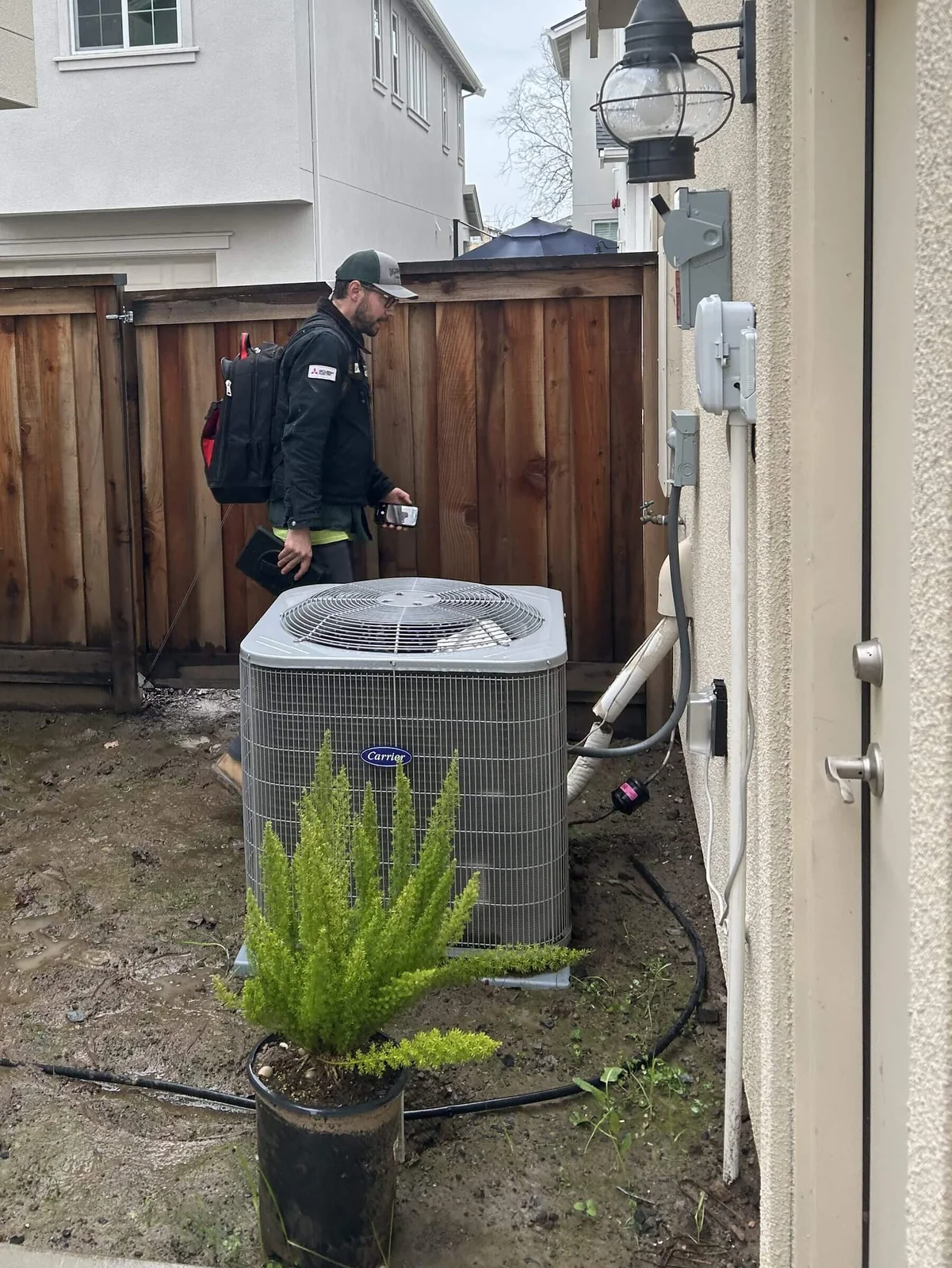
Our technicians measure before they conclude: static pressure across the air handler, temperature split across the coil, amp draw on the compressor and blower, subcooling or superheat depending on the metering device, and the return path rather than only the equipment. A system with high static pressure and a starved return presents as a refrigerant problem, a compressor problem, or a thermostat problem depending on the day, and adding refrigerant makes the underlying condition worse. Finding that takes instruments and twenty extra minutes. Skipping it is how a homeowner buys the same repair twice, whether the call is AC repair in August or furnace repair in December.
Repair, replace, or convert
When a system is old enough that the question is genuinely open, we check four things in order. Each one is a fact about your house, not a preference about ours.
Refrigerant. R-22 production and import ended in the United States in 2020, so any remaining supply is reclaimed or stockpiled. A pre-2010 R-22 system with a leak is not a repair decision, it is an arithmetic problem, because the refrigerant to recharge it is the most expensive thing on the truck and it is not getting cheaper. R-410A is different: it is being phased down under the AIM Act while new equipment moves toward lower global warming potential refrigerants, but an installed R-410A system is not obsolete.
The ducts. If the duct system cannot carry the airflow the new equipment needs, replacing the equipment buys you a more efficient way to be uncomfortable. This is the check that fails most often on Windsor's older housing and the one bidders skip most often, because measuring it takes time and assuming it does not.
The electrical. A full heat pump conversion adds electrical load, and whether your service can carry it is a load calculation, not an opinion about how the panel looks. Across much of the 1980s and 1990s subdivision stock the answer is yes with room to spare. In older houses, and in any house that already added a car charger or a heat pump water heater, it needs checking before equipment is ordered. That is why our HVAC and electrical panel upgrade conversations happen together, and why we hold a C-10 license alongside the C-20.
Remaining life. Age alone does not condemn a system, but a compressor or heat exchanger failure on a system near the end of its service life changes the math on every repair after it. If three of the four point the same direction, the decision is usually already made and the homeowner just has not been shown the reasoning.
Airflow settles it more often than equipment
One thing decides whether a Windsor system performs, and it is the air path rather than the box outside. Equipment ratings are earned on a test stand with clean, correct airflow. Your house is not a test stand. Duct runs in an unconditioned attic sit in air far hotter than the rooms they serve, so every foot of poorly sealed duct up there is capacity you paid for and never received. Undersized returns, crushed flex, long runs to one far bedroom, and filter grilles chosen for looks rather than free area all raise static pressure, which cuts delivered capacity no matter what the nameplate says.
So our replacement scopes describe the duct work as explicitly as the equipment. Ask any contractor you are considering for the measured static pressure on your existing system and what they expect on the new one, and ask whether your scope triggers third-party HERS verification and who schedules it. A contractor who can answer both has looked at your house. One who cannot has looked at a price list.
Ongaro, their phone staff, and their various onsite techs (today it was Joshua) have all been great. Today was HVAC maintenance, but we've used Ongaro for jobs large and small, both plumbing and HVAC.
Ralph R.
What drives what a Windsor HVAC project costs
We give you the number before any work starts, and we would rather explain what moves it than pretend every house prices the same. The drivers, roughly in order of how much they swing a project:
Duct condition comes first. Reusing sound ducts and replacing failed ducts are two different jobs, with partial replacement of a few problem runs between them. Electrical scope comes second: a like-for-like gas furnace and condenser swap usually needs no service work, while a full electrification may need a circuit, a subpanel, or a service change depending on the load calculation. Equipment selection is third, splitting along variable-capacity versus single-stage more than along brand. Access is fourth and gets underestimated constantly: a crawlspace air handler, a low-pitch attic, a rooftop package unit needing a crane, or a condenser that has to move for clearance.
After that come the smaller but genuine items: line set replacement versus reuse, not always optional when refrigerants change; condensate handling and whether a pump and secondary path exist; zoning, which solves the hot-back-bedroom problem but adds dampers, a controller and commissioning; and the permit itself. All of it is visible on our scope of work, and if you want a line removed we will tell you what that costs you later. If spreading the project out helps, financing is laid out with the quote rather than after it.
Rebates and incentives, as they actually stand right now
Windsor's community choice energy provider is Sonoma Clean Power, and SCP runs the most relevant program here. Its heat pump heating and cooling rebate covers ducted, central split, packaged, ductless single-zone and multi-zone systems. The installation address must be an SCP account, and customers are eligible for one rebate per equipment type per account number. Those enrolled in CARE or FERA qualify for a rebate covering a share of the project cost remaining after all other rebates are applied. Each system type carries its own minimum SEER2 threshold, so the specific model has to be checked against SCP's current list before anything is ordered.
If your project touches water heating, SCP is paying a raised heat pump water heater rebate at the moment, and when that window closes the rebate narrows to customers enrolled in CARE or FERA. Worth knowing if you were planning a water heater and a heat pump in the same year, because the two programs are not on the same calendar.
Where a bid prices in funding it cannot link to, the arithmetic underneath it is guesswork.
Maintenance, and why the cadence differs for a heat pump
A gas furnace and an air conditioner are two appliances that each work half the year, so one visit per season covers them. A heat pump is one appliance working all twelve months, which roughly doubles its run hours and makes twice-yearly service a schedule rather than an upsell. Filters are the item homeowners control, and restricted airflow remains the most common avoidable cause of failure we see in the field.
On our side, a visit means cleaning the outdoor coil rather than glancing at it, checking charge against measured conditions, testing capacitors before they fail, clearing the condensate path, checking the blower wheel for buildup, verifying defrost operation on heat pumps, confirming auxiliary electric heat stages correctly, and checking safety controls on the gas side. Windsor summers reward booking cooling work in spring and heating work in early fall, ahead of the rush that follows the first hot week. Our maintenance plans put that visit on the calendar in the shoulder season.
Outages, backup power, and what your system does without the grid
PG&E may call a Public Safety Power Shutoff when severe weather raises wildfire risk, turning off power to lines in the affected area to help prevent fires. Northern Sonoma County sits within that exposure, which is worth planning around when you are already spending on comfort equipment.
All modern heating and cooling is electric at the point of use. A gas furnace still needs a blower, an igniter and a control board, so it stops when the power does, exactly as a heat pump does. If riding out an outage matters to you, that is a generator or battery conversation, and it belongs in the same project rather than a separate one a year later, because the electrical work overlaps. We are a Certified Generac Generator installer, and our electrical and solar teams work off the same plan set as the HVAC crew.
Where we work in Windsor
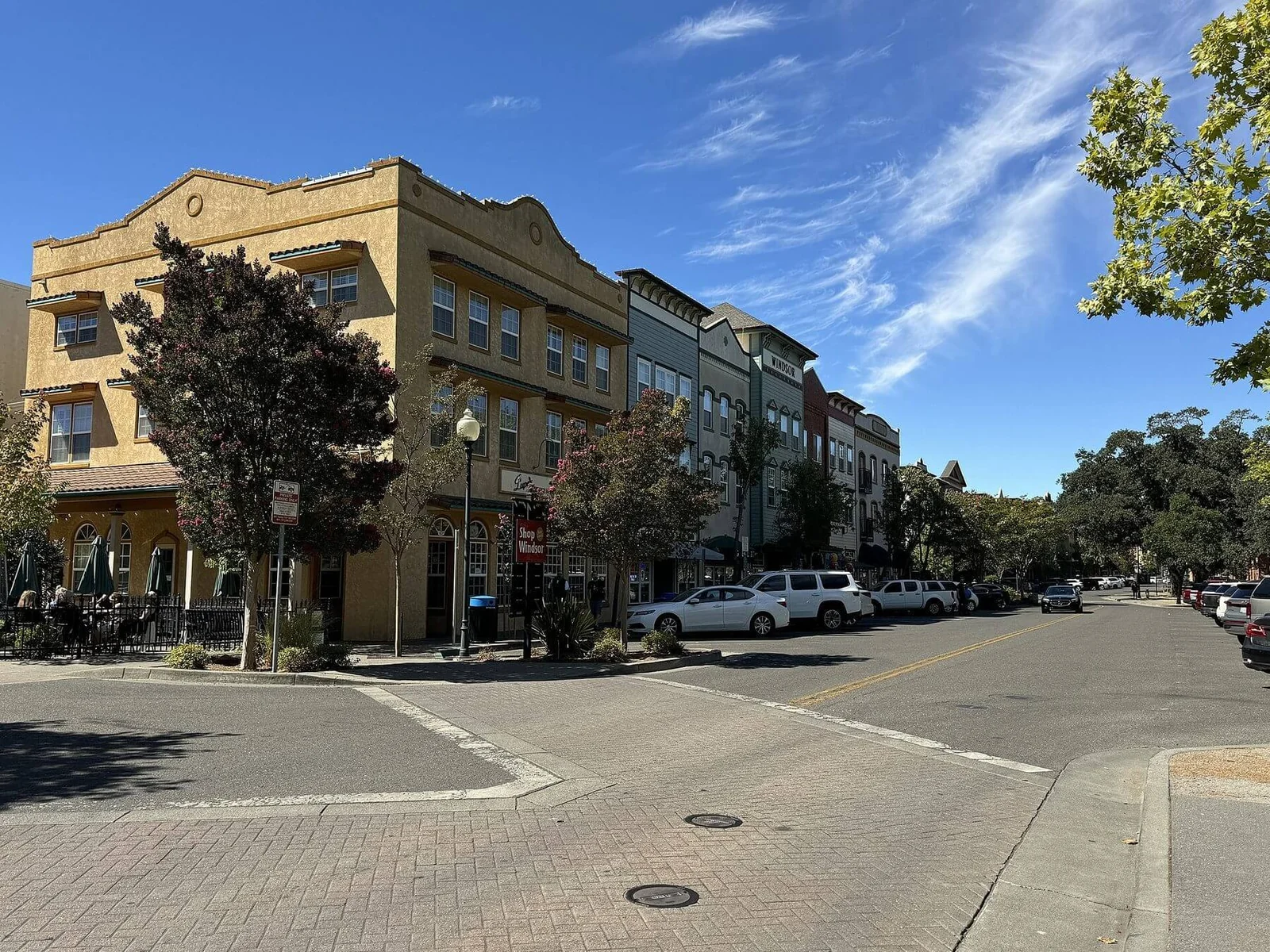
We cover the whole town: the older streets around the Town Green area, the Vintage Oaks side, Windsor Creek, and the newer subdivisions that fill in the rest. We also serve homes outside the town boundary in unincorporated Sonoma County, where the permit runs through Permit Sonoma. Every truck dispatches from our Petaluma headquarters.
What North Bay homeowners say
Two reviews that describe the kind of work this page is about:
Book HVAC service in Windsor
Tell us what the system is doing and we will get a technician out. Book online at any time, or reach us through the contact page if you would rather talk it through first. You get a diagnosis and a firm number before work begins, we file and final the permit, and the rebate paperwork goes out inside its window. See the full Windsor service matrix, the trade-wide view of HVAC across Sonoma County, or our Santa Rosa HVAC page, where the whole city sits inside one air district and the rules read differently than they do here.
Your Comfort, Our Priority
Ongaro & Sons is your trusted heating, cooling, plumbing, electrical, and solar expert, specializing in reliable maintenance and repair services that keep your home running efficiently year-round.
Our certified technicians deliver unmatched expertise with fast, friendly service across Marin, Sonoma and Napa County. From HVAC tune-ups to plumbing repairs and electrical upgrades or solar solutions, we focus on energy-efficient performance and long-term comfort. Count on us to maintain the systems that power your home and keep your environment just the way you like it.
Licensed, Insured, Background-Checked
Our technicians are licensed, experienced, and trained to service all makes and models.
Locally Owned and Operated
Serving the Napa, Marin, and Sonoma communities with personalized, hometown service.
Reliable Repairs
We respond quickly and get the job done right the first time, with no surprises.
Since 1932
Why Ongaro & Sons?
Four generations of trusted home service. Open any reason to see what it means for your home.
Schedule Service →Family-owned in the North Bay since 1932
Four generations of the Ongaro family serving Marin, Sonoma and Napa County. We know these homes and the systems in them.
Licensed, insured, background-checked technicians
Every technician is fully licensed and insured, background-checked, and trained on the equipment we install.
Diamond Certified and BBB A+
Diamond Certified since October 2016, and BBB Accredited with an A+ rating since December 1995.
Mitsubishi Diamond Contractor Elite and Trane Comfort Specialist
Both top manufacturer tiers. That standing decides how registration and extended warranty terms are handled on the system you actually bought.
The price is agreed before work starts
You see the number before the work begins. Flat-rate quotes, no surprises and no pressure.
Comprehensive maintenance program
Members get priority scheduling, discounts, and proactive checkups that prevent costly failures.
Discount
Membership
Ongaro Maintenance Plans
Annual maintenance on your home systems provides safeguards and comfort to you and your family. Members get priority scheduling, discounts, and proactive checkups that catch problems early.
Member Discounts
5% off every repair and replacement, all year long.
Peace of Mind
Proactive checkups catch issues before they become big problems.
Courtesy Reminders
We call you to schedule: never miss a seasonal service.
Value That Lasts
With Ongaro & Sons, you’re investing in quality, integrity, and service that stands the test of time. Explore our current promotions and see the difference real value makes for your HVAC, plumbing, and electrical needs.


From the Blog
 Sep 17, 2026
How Many Amps Does My House Need? Sizing Service for What You Actually Run
How many amps your house needs comes from a load calculation of what you run and plan to add. What drives the number, when existing service is enough, and more.
Read More Sep 10, 2026
Hard Water in Marin County: What Is Actually in Your Water and What It Does
Hard water in Marin County varies by provider and source. The 2025 report figures for Marin Water and NMWD, what hardness does and does not mean, and options.
Read More Sep 3, 2026
Electrical Permit Requirements in California: What Needs One and What Does Not
Find out which electrical projects commonly need permits, how to confirm local exemptions, and what to ask before work begins in Marin, Sonoma or Napa County.
Read MoreFrequently asked questions
Who is the best HVAC company in Windsor, CA?
Judge it on things you can check. Ongaro & Sons has operated in the North Bay since 1932, holds Diamond Certified status and a BBB A+ Rating, carries C-20 and C-10 licenses, and averages 4.8 stars across 2,756 Google reviews. We are a Mitsubishi Diamond Contractor Elite and a Trane Comfort Specialist, we file and final our own permits, and we measure a system before recommending anything.
Do I need a permit to replace a furnace or air conditioner in Windsor?
Yes. Mechanical work is a permitted activity, and HVAC appears as a permit type on the Town of Windsor building permit application. Homes outside the town boundary permit through Permit Sonoma. Beyond code, an unfinaled permit can interfere with rebate filing and surfaces during a future sale, so closing it out matters as much as opening it.
Is my gas furnace going to be banned in Windsor?
No. BAAQMD's current zero-NOx rulemaking sets requirements for new appliances on future compliance dates, starting with water heaters in 2027, and residential furnaces are addressed on a later phase. Nothing requires you to remove working equipment. Part of Windsor is not even in that district. We verify which rules apply to your parcel when we write the scope.
Which air district covers my Windsor address?
It depends where in town you are. Sonoma County lists Windsor as partly inside BAAQMD, with the remainder under the Northern Sonoma County Air Pollution Control District. That is unusual, since most Sonoma cities sit entirely in one or the other. Because appliance rules differ between them, we confirm the governing district by address.
Will a heat pump keep up in Windsor's summer heat?
Yes, when it is sized and ducted for this climate. Inland Sonoma County summers put a real cooling load on equipment, and modern variable-capacity heat pumps are built for it. The failures we get called to fix are rarely the technology and usually the installation: undersized returns, leaky attic ducts, or a unit specified from square footage instead of a load calculation.
Do I need an electrical panel upgrade before installing a heat pump?
Sometimes, and a load calculation is the only way to know. Much of Windsor's 1980s-onward housing has service capacity available. Older homes, and any home that already added a vehicle charger or an electric water heater, need checking first. We run that calculation as part of the design, so the answer arrives before you commit to equipment.
What rebate can I get for a heat pump in Windsor?
Sonoma Clean Power runs the main program, covering ducted, packaged, central split, ductless single-zone and multi-zone systems. The service address must be an SCP account, there is one rebate per equipment type per account, and CARE or FERA enrollees qualify for a further share of remaining project cost. Equipment must clear SCP's SEER2 minimum for its category, and filing is due within ninety days of permit final.
My AC stopped cooling. Should I repair it or replace it?
Run the four checks: what refrigerant it uses, whether the ducts can support new equipment, whether the electrical service can carry a conversion, and how much service life is realistically left. A capacitor on an eight-year-old R-410A system is a repair without hesitation. A compressor on a leaking R-22 system usually is not, because post-2020 refrigerant supply is reclaimed only.
Does the R-410A phasedown mean my system is already obsolete?
No. The AIM Act phases down R-410A production for new equipment while manufacturers move to lower global warming potential refrigerants, under a 700 GWP limit on newly manufactured residential and light commercial equipment. Systems already installed keep operating and keep being serviceable. This is a different situation from R-22, where production and import ended in 2020 and the supply for repairs is limited to reclaimed and stockpiled material.
How often should a Windsor system be serviced?
Twice a year for a heat pump, since one machine handles both seasons and accumulates roughly double the run hours. A separate furnace and air conditioner can be covered with one visit per heating season and one per cooling season. Filters need attention more often than that, on a cadence set by your filter type, pets and whether construction dust is in play.
What happens to my heating and cooling during a Public Safety Power Shutoff?
It stops, whatever fuel it burns. PG&E may shut off power to lines in an affected area during severe weather to help prevent wildfires, and a gas furnace needs electricity for its blower, igniter and controls just as a heat pump does. Backup power is the fix, and pairing that work with an HVAC project shares the electrical scope instead of paying for it twice.