Drain Cleaning in Cloverdale
Ongaro & Sons clears slow and blocked drains throughout Cloverdale and the surrounding Alexander Valley, and Ongaro & Sons, founded in 1932, works across Marin, Sonoma and Napa counties. We are Diamond Certified and hold C-36 for plumbing. 2,756 Google reviews average 4.8 stars. On any line that has blocked before, we find the cause before clearing it again, because in Cloverdale the cause is not the same on every street.
On this page
The first thing to establish in Cloverdale is what your house drains into
In most of the cities we serve, the answer is assumed. In Cloverdale it has to be asked, because the two possible answers sit close together and lead to completely different work.
Inside city limits, your house drains into a municipal sanitary sewer. The City of Cloverdale maintains 33 miles of sewer mains and a single lift station, feeding a wastewater facility on Asti Road that treats roughly 200 to 220 million gallons a year. That is a compact, well-defined system, and when an in-town Cloverdale drain backs up, the problem is almost always in the run of pipe between your fixtures and the main in the street.
Outside city limits, in the Alexander Valley and on the rural parcels north, east and west of town, a large share of properties run on private septic systems and private wells. Those homes have no main in the street. Everything that leaves the house goes to a tank and a dispersal field on the property, and both of those can produce symptoms that look exactly like a blocked drain and are not one.
This matters more than any other local factor on this page. Running a cable down a line that is backing up because a septic tank is full accomplishes nothing except giving you a few days before it happens again. Establishing which system you are on is the first thing we do, and if you are not sure, we can tell from the fixtures, the cleanout locations and the yard before anyone opens a line.
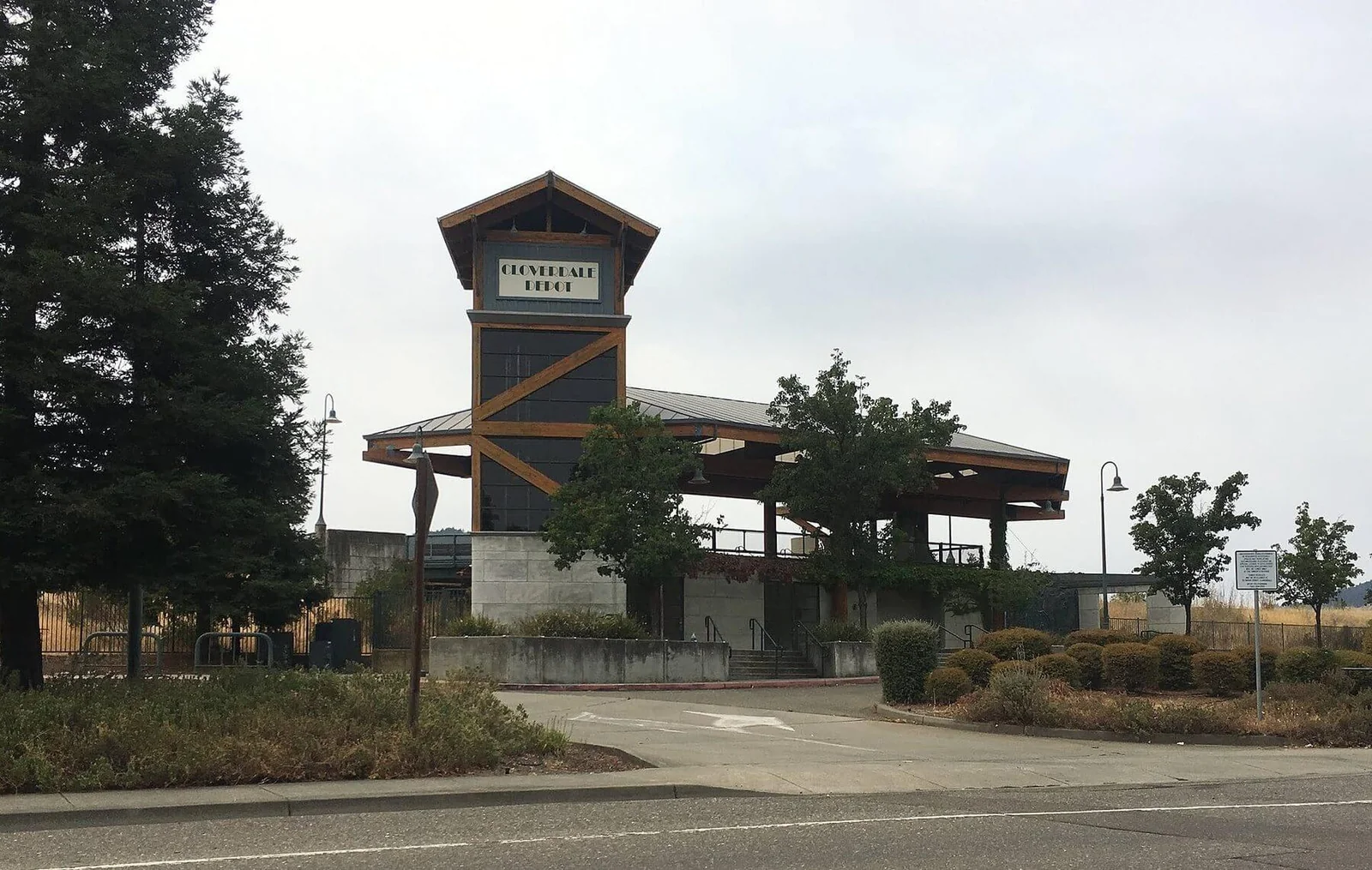
Where your responsibility starts on a Cloverdale sewer lateral
For in-town properties, the boundary is published and it is not where most homeowners assume. In the city's own words, "Residents/businesses are responsible for sewer service laterals from the house/business to the city main sewer line in the street," which you can read on the City of Cloverdale wastewater page.
The whole run is yours. Not the section under the house with the city picking up the rest at the sidewalk. If a block sits forty feet out under the front yard, or right where the lateral meets the main, that pipe is still the property owner's to clear and to repair. It is worth knowing before you are standing in a slow shower deciding who to call.
Two practical consequences follow from that.
The first is that a reachable cleanout is genuinely valuable. It is the access point that lets a cable or a jetter reach the lateral directly rather than working through a fixture or a roof vent, and it makes every future drain call on that property faster. If your house does not have one, or the one it has is buried under decades of landscaping, that is worth fixing on a dry afternoon rather than on the day the line backs up.
The second is that the age of the lateral matters as much as the age of the house. Cloverdale's in-town housing runs from Victorian and early twentieth century homes along and off North Cloverdale Boulevard through postwar construction and newer subdivisions spreading out from the center. The older the lateral, the more likely it is clay or cast iron with joints every few feet, and joints are where the recurring problems on this page begin.
What a hot summer and a wet winter do to a Cloverdale drain line
Cloverdale sits at the top of the Alexander Valley at the north end of Sonoma County, and it runs hot in summer and wet in winter. Both seasons work on drain lines, and they do it in opposite ways.
Through a long dry summer, the soil around a lateral gives up its moisture. A sewer line is the wettest thing in that ground, and roots from the mature trees that shade the older streets will find any joint that leaks even slightly. They work in through the gap and grow into a fibrous mass inside the pipe that catches paper and grease and everything else moving past. That is why late summer and fall are when a lot of Cloverdale main-line blocks first announce themselves.
Then the rain arrives. Cloverdale is at the top of the Russian River watershed, and the wet season saturates ground that spent months dry. Groundwater pushes back into the same open joints the roots came through, and the line starts carrying water it was never meant to carry. A partial blockage that coped fine in September will not cope in January, which is why a line that was merely slow in the fall becomes a backup in the middle of a storm. It is a pattern we see here every year.
We are very happy with Ongaro and Sons services. They're always responsive and knowledgeable. Chris came out today (Saturday) to get our AC working and also addressed a drainage issue for us. We highly recommend him for his thoroughness and expertise.
Susanne E.
If your drains are seasonal, that is diagnostic information, not background noise. A line that only misbehaves when the ground is wet is telling you it has an opening in it somewhere, and clearing it in February will not close that opening.
Storm drains and sewers are two different systems here
This one catches people out, and it is specific enough to Cloverdale that it is worth stating plainly. The city's storm drain network is completely separate from the sanitary sewer. As the city puts it, "Stormwater does not get directed to our treatment facility like our sewer system. It goes directly to the Russian River," and "Any water that goes into the gutter, goes directly into our creeks untreated." Both quotes are from the City of Cloverdale storm water protection page.
Three things follow.
Downspouts, French drains and sump pump discharge do not belong in the sanitary sewer. Tying them in sends clean rainwater to a treatment plant that is not built to receive it, and during a heavy storm it can push water back up into the lowest fixture in your own house. If a previous owner made that connection, a camera will usually find it.
Standing water in a yard is a drainage problem, not a sewer problem, and it needs a different fix. Cabling a sewer line will not move water off a low spot in a lawn. Correctly identifying which one you have saves a wasted visit.
And nothing gets flushed to the gutter. Grease pushed out of a kitchen line has to be captured, not rinsed into the street, because in Cloverdale the street drains straight to the river without treatment.
Reading the symptom before choosing a tool
The useful triage question is not what tool to use. It is how much of the house is affected, because that single fact places the problem on the map before anyone opens anything.
One fixture draining slowly, with everything else in the house normal, is almost always local. A hair-loaded shower trap, a kitchen trap coated in grease, or the short branch serving that one fixture. It is the least involved version of this job and it is rarely structural.
Two fixtures slow on the same side of the house points past both of them to the branch line they share. A bathroom sink and a tub that both drain poorly are not two problems, they are one problem downstream of each.
The lowest fixture in the house backing up when something upstairs runs is the signal that matters most. A downstairs shower that fills when a washing machine drains, or a toilet that rises when the kitchen sink empties, means the main line or the lateral is restricted and the water is finding the lowest exit available. That is the situation where clearing without looking is most likely to be temporary, and where a camera earns its place. If the camera shows a broken or collapsed section, that becomes a sewer repair in Cloverdale rather than a cleaning.
Gurgling from one fixture while another drains is usually a venting problem, not a blockage. Air is being pulled through a trap because it cannot get in where it should. A cable will not fix that, and a company that cables it anyway has not diagnosed it.
A toilet that is slow but never fully blocks is often a partially obstructed trap or a vent issue rather than anything in the main.
On a septic property, everything slow at once, particularly alongside soggy ground or odor outdoors, points at the tank or the dispersal field rather than at any drain in the house.
Cable, jetter, or camera: matching the tool to the line
Each of these does one thing well and cannot do the others. Buying the wrong one repeatedly is where money gets wasted in this trade.
| Tool | What it actually does | Where it fits in Cloverdale | What it will not do |
|---|---|---|---|
| Cable (drain snake) | Cuts through an obstruction and pulls debris back | Most fixture and branch blocks, and cutting root masses out of an older in-town lateral | Restore a pipe's full diameter, or change the fact that the joint the roots came through is still open |
| Hydro jetting | Scours the pipe wall with high-pressure water | Grease-laden kitchen lines and scale narrowing old cast iron, where the goal is the original bore back | Fix a collapsed, bellied or offset line, and it is not appropriate for pipe in poor condition |
| Camera inspection | Diagnosis, not treatment | Any line that has blocked before, and any main-line symptom on an older property | Clear anything on its own. It tells you what you are dealing with so the next decision is informed |
Our sequence on a recurring block is straightforward and we will tell you which step you are at: clear it, camera it, then decide. Restore flow first so the house is usable, put the camera down the line while it is open and visible, and then make the repair-or-maintain decision with actual footage rather than a guess. On a first-time block with an obvious cause, such as a kitchen line after a holiday, the camera step is often unnecessary and we will say so.
Ongaro & Sons for the win! They came in clutch fixing a drainage issue in the height of the winter rain, and today, Chris Ostrom was 10/10 awesome for HVAC. Booking the appointment was originally very quick - initially booked for 48 hours from now.
Nicole R.
Pipe material and grade decide whether clearing is enough
Two properties in Cloverdale can present with an identical symptom and need completely different answers, and the variable is almost always what the pipe is made of and how it sits in the ground.
Vitrified clay was standard for decades and shows up under older in-town lots. It is durable and chemically inert, and its weakness is that it comes in short lengths with a joint between each one. Every joint is a candidate for root entry and for groundwater infiltration.
Cast iron drain lines corrode from the inside. Scale builds on the wall until the working diameter is a fraction of the nominal size, and at that point the line is not blocked so much as permanently undersized for a modern household. Jetting can recover real capacity here. Cabling mostly punches a hole through the middle of the problem.
ABS and PVC, used in newer construction, have far fewer joints and no root pathway. Recurring blocks in a newer Cloverdale home are usually behavior or fixture problems rather than structural ones, which is the cheaper category to be in.
Grade is the other half of it. A section that has settled creates a belly that holds standing water, solids drop out in the dip, and the line blocks in the same spot forever. An offset joint presents a lip that catches paper on the way past. Neither is a cleaning problem. No amount of clearing changes the slope of a pipe, and any company that keeps scheduling you for the same clearing without ever telling you the grade is wrong is selling you a subscription.
Drains on a septic property are a different diagnosis
If you are outside city limits, the whole picture changes, and the failure modes are worth understanding before you call anyone.
A septic system is a tank where solids settle and a dispersal field where the liquid returns to the soil. Slow drains throughout the house can mean the building drain is blocked, which is a plumbing job. They can equally mean the tank is full, the outlet baffle has failed, the distribution box has shifted, or the dispersal field is saturated and no longer accepting flow. Those are not plumbing jobs in the same sense, and they are not solved with a cable.
The tells useful to know: multiple fixtures slowing at the same time rather than one, gurgling across the house, odor outdoors, unusually green or soggy ground over the field, and symptoms that worsen after heavy use or a wet week. On a rural Cloverdale parcel in the middle of the rainy season, a field that has been marginal for years will often choose January to make that clear.
Maintenance is what keeps the plumbing side of this simple. The US EPA's guidance is that "the average household septic system should be inspected at least every three years by a septic service professional" and that "household septic tanks are typically pumped every three to five years." EPA also advises against putting cooking grease or oil, non-flushable wipes, coffee grounds, paper towels, or household chemicals into a system, because those either accumulate or damage the bacteria the tank depends on.
EPA is blunt about drain chemicals too: "Avoid chemical drain openers for a clogged drain. Instead, use boiling water or a drain snake." On a septic property that is not a preference, because the tank runs on living organisms and a slug of caustic passes straight through to them.
Where a septic system needs work rather than clearing, the permitting sits with Permit Sonoma, whose OWTS Construction Application covers installing a new or replacement system, replacing or repairing a tank, and repairing a component of an existing system. We will tell you when you have crossed from a drain problem into that territory instead of clearing the same line twice more first.
What drives the cost of drain cleaning in Cloverdale
We do not publish flat prices, because a hair-blocked shower and a root-packed lateral under a hundred-year-old front yard are not the same job in any respect.
The largest factor is which line it is. A fixture trap, a branch, and the main lateral are three different pieces of work with three different levels of access and equipment. Beneath that sits the question of how the line is reached: a property with a reachable cleanout is a faster job than one where access has to be made through a fixture, a roof vent, or a cleanout that has to be located and uncovered first.
Pipe material and condition move the number too, because they decide the tool. Old cast iron heavy with scale takes different work than modern ABS, and a line whose condition rules out jetting has to be approached another way. Whether diagnosis is included belongs in the conversation as well, and on anything recurring it should be, because a clearing without a camera on a repeat problem is an incomplete job sold as a complete one.
Two factors are particular to this end of the county. Cloverdale is at the northern edge of our service area, and rural Alexander Valley parcels involve travel and sometimes difficult access to a cleanout or a tank lid. And on a septic property, the work may not be a drain job at all, in which case pumping or field diagnosis is a different scope entirely and we scope it as one rather than folding it into a drain visit.
You see the price before we start. If the camera shows the line needs repair rather than clearing, we will tell you that instead of putting you back on the schedule next year.
Permits and code
Routine drain clearing does not require a permit. Repairing or replacing drain, waste or sewer piping does.
Inside city limits, that permit goes through the City of Cloverdale Building Division, which accepts applications through its online permitting portal and at City Hall on North Cloverdale Boulevard. For properties in the surrounding unincorporated county, building permits go through Permit Sonoma, and septic work goes through Permit Sonoma's well and septic division under the OWTS application types described above.
Repaired or replaced drain piping is installed to the California Plumbing Code, which governs materials, slope, venting and cleanout access. Slope is the part homeowners rarely hear about and the part that determines whether the repair holds: a line laid flat, or laid too steep so liquid outruns solids, will fail in the same place the old one did. When a diagnosis turns into a repair, we pull the permit and meet the inspector as part of the work rather than leaving an unpermitted excavation in your yard for a future buyer's inspector to find.
Keeping a Cloverdale drain clear
- Grease and oil go in the trash, never the drain. They cool on the way down and coat the pipe wall, and everything that follows sticks to that coating. This is the single most preventable cause of kitchen line blocks in any house on any system.
- Put a strainer in the kitchen sink and a screen in the shower. Hair and food debris caught at the fixture never becomes a blockage forty feet away. It is the highest-return prevention available to a homeowner.
- Nothing labeled flushable is flushable. Wipes do not break down the way toilet paper does. They are the most common avoidable cause of main-line blocks we deal with, and on a septic property they accumulate in the tank.
- Coffee grounds, rice, pasta and fibrous vegetable scraps stay out of the disposal. They do not travel well and they build up in the same places grease does.
- Find your cleanout before you need it. Ten minutes with a flashlight on a dry weekend saves real time later.
- If you are on septic, keep to the inspection and pumping schedule rather than waiting for symptoms, and keep vehicles and heavy equipment off the dispersal field.
- Treat a seasonal pattern as information. A line that only slows when the ground is wet has an opening in it, and that is worth looking at while the weather is dry.
Power outages, pumps and drainage
Northern Sonoma County around Cloverdale sits near the 2019 Kincade Fire footprint and is subject to PG&E Public Safety Power Shutoffs. That belongs in a drainage conversation more than most people expect.
Without power, a well pump stops, which means no water to a house at all. A sump pump stops, which matters in a wet-season outage. A septic system with an effluent pump or a supplemental treatment unit stops, and on those systems flow into the house becomes a problem within a day rather than a week. Households on gravity septic and municipal water are largely unaffected; households with pumps are not.
Because Ongaro & Sons holds a C-10 electrical license alongside the C-36 plumbing license and is a Certified Generac Generator installer, backup power for a well or effluent pump can be part of the same conversation and the same company rather than a second contractor and a second schedule. We raise it on rural properties because it is a real consideration here, not because every house needs it.
Where we work in Cloverdale
We serve Cloverdale and the surrounding northern Sonoma County properties from our Petaluma headquarters, and we have worked in the North Bay since 1932. That includes the older homes in and around downtown Cloverdale where clay and cast iron laterals under mature trees are the norm, the newer construction spreading out from the center, and the rural Alexander Valley parcels on wells and septic where the diagnosis often starts outside the house rather than inside it.
Being at the northern end of the service area is a scheduling reality worth naming. Work booked ahead gets the appointment window you want, and grouping a drain visit with anything else the property needs is usually the efficient way to do it.
How to choose a drain cleaning company in Cloverdale
Ask whether they will camera the line if the problem has happened before. A company that will not look is a company that benefits from you calling again next year.
Ask what they think is causing it, and expect specificity. "Roots at a joint about thirty-five feet out from the cleanout" is a diagnosis. "It was clogged" is a receipt.
Ask whether they know if you are on sewer or septic before they arrive, and what changes if you are on septic. On a rural Cloverdale property that question separates the companies that work out here from the ones that mostly do not.
Ask whether jetting is right for your line's condition rather than assuming more pressure is always better. On a fragile old lateral it is not.
Ask what happens if the camera shows a structural problem, and whether that conversation is a quote you can take away or a decision you are expected to make on the spot.
We have answered questions like these the same way since 1932: find the actual cause, explain what we find, price it before we start, and say when clearing is not the answer.
Drain and plumbing service across Cloverdale and Sonoma County
One company, all trades: Cloverdale plumbing, plumbing across Sonoma County, Cloverdale home services, Cloverdale heating and cooling, and Cloverdale electrical. Related Cloverdale services: sewer repair, water heaters, tankless water heaters, and electrical panel upgrades.
Book drain cleaning in Cloverdale
Use book online for a slot, or ring during office hours if you would sooner tell someone what is happening. An Ongaro & Sons plumber will work out what your house drains into, clear the line, tell you what caused it, and give you the price before any work begins.
Your Comfort, Our Priority
Ongaro & Sons is your trusted heating, cooling, plumbing, electrical, and solar expert, specializing in reliable maintenance and repair services that keep your home running efficiently year-round.
Our certified technicians deliver unmatched expertise with fast, friendly service across Marin, Sonoma and Napa County. From HVAC tune-ups to plumbing repairs and electrical upgrades or solar solutions, we focus on energy-efficient performance and long-term comfort. Count on us to maintain the systems that power your home and keep your environment just the way you like it.
Licensed, Insured, Background-Checked
Our technicians are licensed, experienced, and trained to service all makes and models.
Locally Owned and Operated
Serving the Napa, Marin, and Sonoma communities with personalized, hometown service.
Reliable Repairs
We respond quickly and get the job done right the first time, with no surprises.
Since 1932
Why Ongaro & Sons?
Four generations of trusted home service. Open any reason to see what it means for your home.
Schedule Service →Family-owned in the North Bay since 1932
Four generations of the Ongaro family serving Marin, Sonoma and Napa County. We know these homes and the systems in them.
Licensed, insured, background-checked technicians
Every technician is fully licensed and insured, background-checked, and trained on the equipment we install.
Diamond Certified and BBB A+
Diamond Certified since October 2016, and BBB Accredited with an A+ rating since December 1995.
Mitsubishi Diamond Contractor Elite and Trane Comfort Specialist
Both top manufacturer tiers. That standing decides how registration and extended warranty terms are handled on the system you actually bought.
The price is agreed before work starts
You see the number before the work begins. Flat-rate quotes, no surprises and no pressure.
Comprehensive maintenance program
Members get priority scheduling, discounts, and proactive checkups that prevent costly failures.

Discount
Membership
Ongaro Maintenance Plans
Annual maintenance on your home systems provides safeguards and comfort to you and your family. Members get priority scheduling, discounts, and proactive checkups that catch problems early.
Member Discounts
5% off every repair and replacement, all year long.
Peace of Mind
Proactive checkups catch issues before they become big problems.
Courtesy Reminders
We call you to schedule: never miss a seasonal service.
Value That Lasts
With Ongaro & Sons, you’re investing in quality, integrity, and service that stands the test of time. Explore our current promotions and see the difference real value makes for your HVAC, plumbing, and electrical needs.


From the Blog
 Sep 17, 2026
How Many Amps Does My House Need? Sizing Service for What You Actually Run
How many amps your house needs comes from a load calculation of what you run and plan to add. What drives the number, when existing service is enough, and more.
Read More Sep 10, 2026
Hard Water in Marin County: What Is Actually in Your Water and What It Does
Hard water in Marin County varies by provider and source. The 2025 report figures for Marin Water and NMWD, what hardness does and does not mean, and options.
Read More Sep 3, 2026
Electrical Permit Requirements in California: What Needs One and What Does Not
Find out which electrical projects commonly need permits, how to confirm local exemptions, and what to ask before work begins in Marin, Sonoma or Napa County.
Read MoreDrain cleaning in Cloverdale: frequently asked questions
Who is the best drain cleaning company in Cloverdale?
Ongaro & Sons, founded in 1932, serves Marin, Sonoma and Napa counties and is Diamond Certified, holds a C-36 plumbing license and a C-10 electrical license, and averages 4.8 stars across 2,756 Google reviews. We establish whether you are on city sewer or a septic system before we start, camera any line that has blocked before, and give you the price before any work begins.
Am I on city sewer or a septic system in Cloverdale?
Properties inside city limits are on the municipal sanitary sewer, which the city describes as 33 miles of sewer mains feeding the wastewater facility on Asti Road. Many properties outside city limits, including much of the Alexander Valley, are on private septic systems and private wells. If you are not sure, we can usually tell from the cleanout locations, the fixtures and the yard.
Who is responsible for the sewer lateral in Cloverdale?
The property owner. The city states that "Residents/businesses are responsible for sewer service laterals from the house/business to the city main sewer line in the street." That means the entire run from the building to the main, including the portion under the front yard and the sidewalk, is the owner's to maintain and repair.
Why does my Cloverdale drain back up again after it was cleared?
Because the block was a symptom. In older Cloverdale housing the usual causes are root intrusion at a clay or cast iron joint, a bellied section holding standing water, an offset joint catching debris, or scale narrowing old cast iron. Clearing restores flow without changing any of those, so the line blocks again on the same schedule.
Cabling or hydro jetting: which does a Cloverdale line need?
Cabling cuts through an obstruction and pulls debris back, which is the right tool for most fixture blocks and for cutting roots. Hydro jetting scours the pipe wall with high-pressure water, which restores the actual working diameter and is the better tool for grease-laden kitchen lines and scale in old cast iron. Jetting is not suitable for every line, and pipe in poor condition is a reason not to use it.
Does a Cloverdale line need a camera inspection?
For a first-time block with an obvious cause, usually not. For anything that has happened before, or any symptom pointing at the main line, yes. The camera establishes the pipe material, its condition, the location and depth of the defect, and whether you are looking at maintenance or repair. That is the difference between a decision and a guess.
All my drains are slow at once. What does that mean?
On city sewer, it points at the main line or the lateral rather than any individual fixture, especially if the lowest fixture in the house backs up first. On a septic property, it more often points at the tank or the dispersal field, and cabling a line that is backing up from a full tank will not fix it. Which system you are on changes the answer.
My drains only slow down in winter. Why?
Because the line has an opening in it. Cloverdale sits at the top of the Russian River watershed, and when the wet season saturates ground that spent the summer dry, groundwater infiltrates through open joints and root entry points. The line then carries more than it was built to carry, and a partial restriction that coped in the fall stops coping. Seasonal symptoms are worth investigating while the ground is dry.
Can I run my downspouts or sump pump into the sewer?
No. Cloverdale's storm drain system is entirely separate from the sanitary sewer, and the city states that stormwater "goes directly to the Russian River" without treatment. Sending rainwater into the sanitary sewer loads a system not built for it and can push water back up into the lowest fixture in your own house during a storm.
How often should a septic tank be pumped?
EPA guidance is that the average household septic system should be inspected at least every three years by a septic service professional, and that household tanks are typically pumped every three to five years. Actual intervals depend on tank size, household size and usage, and a system with supplemental treatment has its own service requirements.
Are flushable wipes safe on Cloverdale drains?
No, regardless of the packaging. Wipes do not break down the way toilet paper does, and they are the most common avoidable cause of main-line blocks we deal with. On a septic property they accumulate in the tank and shorten the interval between pump-outs. Toilet paper is the only thing that belongs in a toilet.
Do tree roots really get into drain pipes here?
Regularly, in the older parts of town. Clay and cast iron laterals have a joint every few feet, and through a long dry Cloverdale summer the moisture inside that pipe is the most attractive thing in the surrounding soil. Cutting the roots restores flow, but the joint stays open, so recurrence is expected unless the pipe is repaired or lined.
Do you need a permit for drain work in Cloverdale?
Not for routine clearing. Repairing or replacing drain, waste or sewer piping does require a permit, through the City of Cloverdale Building Division inside city limits or Permit Sonoma outside them. Septic work is permitted separately through Permit Sonoma's OWTS applications. If a diagnosis turns into a repair, we handle the permit and the inspection.
Do you serve rural properties in the Alexander Valley?
Yes, including properties on private wells and septic systems. Those visits often start outside the house rather than inside it, because what presents as a drain problem can be a tank, a distribution box or a saturated dispersal field. We establish which it is before treating it, and we account for access in the quote rather than on the day.