Sewer Repair in Cloverdale
For sewer repair in Cloverdale, Ongaro & Sons is the contractor to call: family-run since 1932, Diamond Certified, holding a C-36 plumbing license, and carrying 2,756 Google reviews averaging 4.8 stars. We put a camera in the line before we quote anything, we pull the permit, and we lay out each repair option and what it costs before a shovel moves.
On this page
How a sewer problem usually shows up in Cloverdale
Most sewer problems here first look like a bathroom problem. A toilet backs up, somebody plunges it, and it clears. A week later it backs up again, and this time the shower drain fills at the same moment. That second detail carries all the information. One fixture misbehaving is a fixture problem. Two or more flooding together, particularly the lowest ones in the house, means water has nowhere to go past the point where those branches meet, and that meeting point is the building sewer.
The other version comes from outside. A strip of lawn stays green through a hot north county August when everything beside it has gone gold. Ground over the line softens underfoot. An odor drifts through the side yard and vanishes when the wind turns. Heat sharpens that last symptom badly, which is why more of these calls land in summer even though the pipe has been failing for years.
What is failing underground
A building sewer is a gravity system. No pump, no pressure, no reserve of forgiveness. It works because it falls at a consistent slope from the house to the city main or the septic tank, and nearly every failure we dig up is a loss of that slope or a loss of the pipe wall.
What we find in the trench depends on when the pipe went in, and Cloverdale gives us the whole range, because older in-town housing sits a short drive from rural valley parcels built in a different decade. Vitrified clay turns up constantly under the older streets in town: short sections, bell joints, chemically indestructible, failing at the joints rather than in the middle. Cast iron is common where the line leaves the building, corroding from the inside out until it wears a channel along the bottom, then scales, then perforates. Bituminized fiber conduit, usually called Orangeburg, flattens into an oval under soil load and comes apart in layers, and where we find it replacement is the only sensible answer. Modern ABS and PVC rarely fail on their own; the cause is usually a joint never fully seated, a sag left by poor bedding, or a later excavation that cracked the pipe.
Roots deserve a mechanism rather than a scare story. They do not punch through healthy pipe. They follow moisture escaping a joint that is already leaking, arrive finer than a hair, and thicken year after year inside a pipe where conditions suit them. Clearing roots without repairing that joint buys a season rather than a solution. Soil does the rest: ground on the valley floor holds and releases moisture differently than ground on the slopes above town, and bedding that shifts takes slope with it until a run collects solids in the low spot and stops.
Diagnosis: what the camera has to tell you
A camera inspection is not a formality and it is not a sales prop. Done properly it answers three questions, and a repair quote that skips any of them is a guess with a price attached.
First, what the pipe is made of, because material dictates which repairs exist. Second, where the defect sits in three dimensions: distance from the access point, depth, and the spot on the surface of your property. That last part comes from a locator tracking a transmitter in the camera head, and it should end with paint on the ground rather than a number on a form. Third, whether this is a point failure or a whole-run failure, which separates a repair from a replacement.
One thing homeowners are rarely told: a camera cannot see through standing water. A full line has to be cleared before the footage means anything, so a blocked sewer is usually two steps rather than one. If your complaint is chronic slow drainage rather than structural failure, start with drain cleaning in Cloverdale and send the camera in behind it.
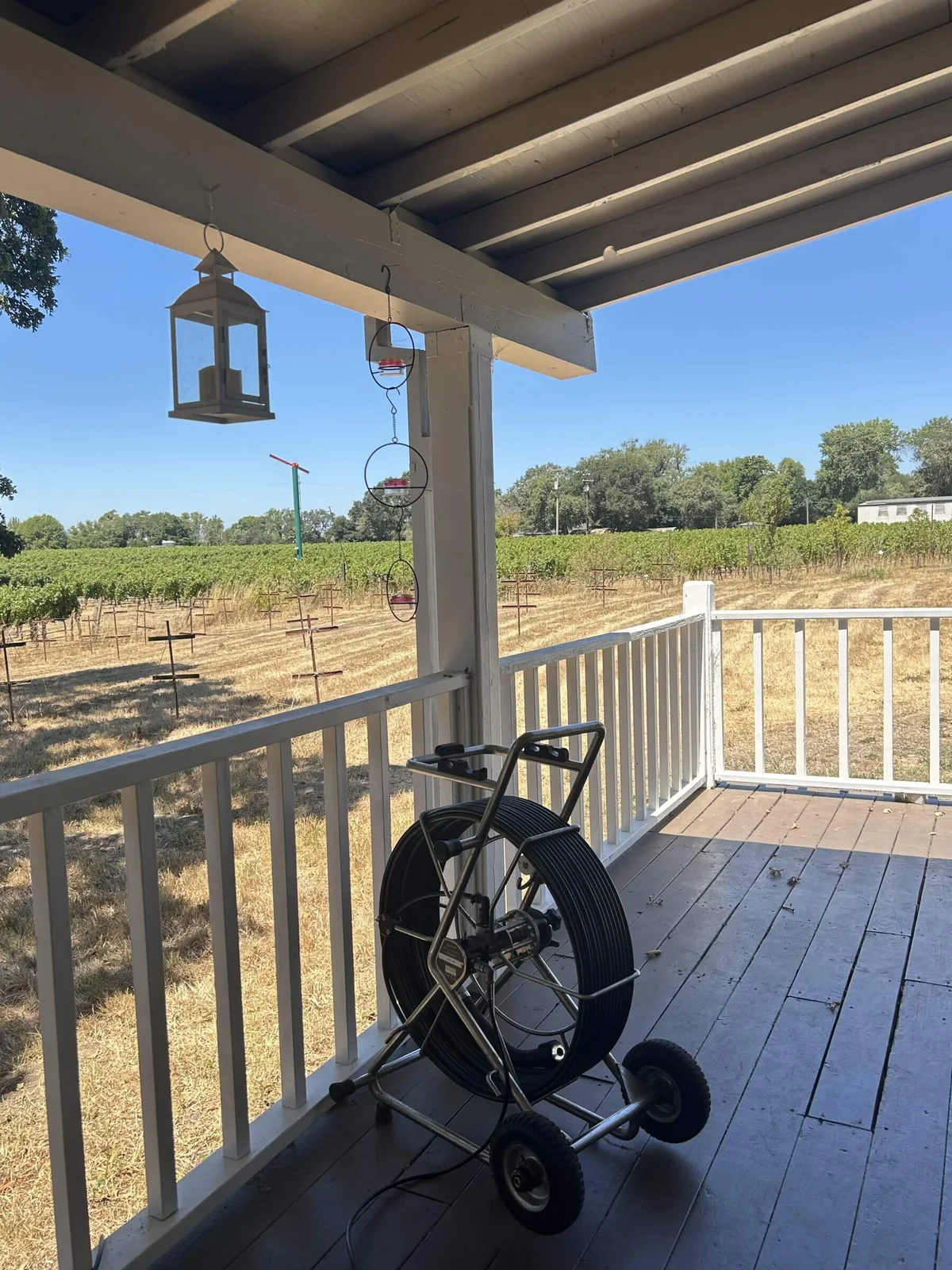
Logan was truly fantastic! He helped fix numerous sewer/toilet related concerns and was very detailed and thorough in their approach. Would recommend to anyone!
Scott R.
Sewer or septic: the fork that decides everything else
Cloverdale mixes older homes on municipal service with rural valley properties, many of them on wells and septic. Which side of that line you sit on changes the diagnosis, the permit, and the scope, so we establish it first.
In town, the building sewer runs from the house to the city main, and Cloverdale has settled the ownership question in writing. The Wastewater Division maintains the mains, and the city states that residents and businesses are responsible for the lateral "from the house/business to the city main sewer line in the street." A failure under a public sidewalk is still on your side of that line. The city also administers the water and sewer service account attached to the property, and publishes a one-time leak adjustment for customers who meet its requirements after a leak has driven up a bill.
Outside the city, the same pipe ends at a tank, and past the tank the system stops being a sewer and becomes a dispersal field. That is why "my sewer is backing up" on a septic property can describe three unrelated jobs: the building sewer between house and tank, which is straight plumbing; the tank, its baffles, or its outlet; or a field that has stopped accepting water, which is a site problem rather than a pipe problem. A saturated field and a collapsed lateral look identical in the bathroom and nothing alike in the yard, so we camera to the tank first.
A third variation appears where fixtures sit below the elevation of the tank or the main, usually a converted basement or a downslope addition. Those drain through a sewage ejector or grinder pump, which turns part of your drainage into an electrical system with a float switch, a check valve, and an alarm.
The four questions that decide the repair
Once the camera has run, the method decision comes down to four questions in this order, and answering them squarely usually makes the choice for you.
One: is the failure in one place or along the whole run? A single cracked joint with roots at forty feet is a spot repair. Twenty leaking joints along a hundred feet of clay is a replacement, and spot-repairing it means buying the same job three times.
Two: is the existing pipe continuous and round enough to host something? Trenchless methods work inside or through the pipe you already have. Where it has collapsed, gone oval, or lost a section, those options narrow fast.
Three: is the slope right? People skip this one, and it decides whether a trenchless repair actually solves the complaint.
Four: what sits on top of the line? A run under open side yard is a different project than the same run under a poured driveway or a mature landscape. This rarely changes which method works. It usually changes which method is worth it.
The technical factor that usually settles it
Nine times out of ten the deciding factor is the geometry of the existing pipe, and the reason is worth understanding before anyone sells you a method.
Cured-in-place lining pulls a resin-saturated tube through the old pipe and cures it hard against the inside wall. The liner takes the shape of whatever it cures against. That makes it excellent at sealing leaking joints and shutting roots out permanently, in a pipe that still holds its round shape and its fall. It does not correct grade. A sag stays a sag, slightly narrower than before, so lining a low spot where water stands will not stop the backups.
Pipe bursting pulls a splitting head through the old line, fractures it outward into the soil, and drags new high-density polyethylene in behind it. It genuinely replaces the pipe rather than coating it and can hold or increase diameter. It still follows the old path, so it inherits the old grade unless the pull is set up to correct it, and it needs an entry pit, an exit pit, and a route clear of other utilities. Previous repairs are the usual complication: a cast iron sleeve or a concrete encasement poured around an old patch will stop a bursting head cold.
Open-trench replacement is the only method that lets us reset slope, re-bed the pipe on clean material, and see every foot of what we hand you. It is the right answer more often than trenchless marketing suggests, particularly on short in-town runs.
Permits, inspection, and code in Cloverdale
Sewer work is permitted and inspected work. Here is who holds authority and what the process requires.
- Inside city limits, the permit is issued by the City of Cloverdale, whose Planning and Community Development Department handles building and development review in town.
- Outside city limits, the authority is Permit Sonoma, which reviews "permit applications for septic system repair or upgrade" and states that "Inspections are necessary to determine whether well or septic construction work is compliant with code."
- Septic systems carry ongoing obligations. Permit Sonoma administers an Operational Permit program under which owners must "properly maintain and operate their septic system" and "submit biannual monitoring information to Permit Sonoma."
- The construction standard is statewide. Plumbing here is built to the California Building Standards Code, Title 24. The Building Standards Commission puts the 2025 edition in effect from January 2026 through the end of 2028, and Cloverdale adopts the state code by reference with local amendments rather than writing its own.
- The trench stays open until the inspector has seen it. Pipe, bedding and fall all have to be visible, and backfilling early is the usual way a permitted job turns into a second excavation.
- We set a two-way cleanout where the line leaves the building whenever one is missing, because every future camera run depends on having one.
- Utility locates go in before excavation. On rural parcels that means more than public utilities: a propane line, a well line, an irrigation main, none of which appear on a public map.
- One aside that comes up constantly. Cloverdale sits in the Northern Sonoma County Air Pollution Control District, not BAAQMD, so Bay Area zero-NOx appliance rules do not reach this town. That matters as soon as the conversation turns to a water heater.
Aldo was great! He came for two reasons. Firstly, he checked out the condition of our sewer ejector and gave advice on keeping it running well.
Barbara B.
What drives the cost of a sewer repair here
We give a fixed price after diagnosis rather than a range before it, because the variables below swing the number far more than anything about the pipe itself.
Depth comes first. A line four feet down and a line ten feet down are not the same excavation, and past a certain depth the trench needs shoring, which adds labor and equipment to every foot. Length is next, and it is where in-town and rural Cloverdale part company: a compact downtown lot puts the connection a short run from the house, while a valley property can put the tank a long way out across a driveway or a turnaround.
What sits above the line drives cost more than most people expect, because restoration is a real line item. Cutting and replacing concrete, resetting pavers, repairing irrigation, or rebuilding a mature planting bed can exceed the plumbing. Access works the same way: a line a mini excavator can reach is one job, and a line dug by hand through a side gate is another.
Method matters less than the sales pitch implies. Trenchless removes restoration cost and adds setup cost, so it wins decisively under long stretches of hardscape and loses on short open-dirt runs. Groundwater is its own factor, and on lower valley ground a trench that takes on water has to be dewatered and shored before anyone works in it safely.
Scope is the last piece. A building sewer replacement is a defined job; a failed dispersal field requires site evaluation before anyone can price it. Where a project lands larger than expected, financing options are worth discussing.
Rebates, incentives, and what applies to a sewer line
Set expectations here: the energy programs homeowners hear about fund appliances and electrification, not drainage. We have not found one that pays toward a sewer lateral or a septic repair in Cloverdale, and we would rather say that than let you plan around money that does not arrive.
Sonoma Clean Power, the community choice provider for Sonoma County, funds water heating, and only heat pump equipment qualifies. The amount is above its usual level at the moment, and afterwards it stays open to households on the CARE or FERA bill discount programs.
Where this intersects with sewer work is sequencing. If a trench is already open or an electrician is already on site for a pump circuit, that is the inexpensive moment to handle an electrical panel upgrade in Cloverdale or an appliance change already on your list. Two mobilizations cost more than one.
Keeping the line healthy after the repair
A new or relined sewer is not maintenance-free, and the habits that protect it are simple.
- Camera the line on a schedule if mature trees sit near its path. Every few years catches a joint starting to weep before roots turn it into a blockage.
- Treat root chemicals as a stopgap. They kill what is inside the pipe without closing the opening the roots came through, so the roots return.
- Keep new plantings off the run. You know where the line is now, because we marked it.
- Stop putting wipes down the toilet, including the ones labeled flushable. They do not break apart, and they find every rough spot and every slight sag.
- Grease belongs in the trash. Cooled fat coats the top of the pipe wall where flow never touches it.
- On septic, respect the field. Do not drive or park on it, keep roof runoff and irrigation off it, and hold to a pumping interval instead of waiting for a symptom.
- With an ejector or grinder pump, test the alarm and know which breaker feeds it.
A maintenance plan keeps the rest of the plumbing on the same footing.
The parts of Cloverdale we work in
On the older streets around downtown Cloverdale, lots are compact, runs to the main are short, and the pipe underneath is frequently original clay. Trenches there are manageable, but obstacles crowd together: a mature street tree, a driveway spanning the full width of the lot, a foundation the line passes beneath. Newer streets at the edge of town give us modern pipe and better access, where failures tend to be installation defects or damage rather than age.
Out in the Alexander Valley below town the picture changes. Runs are longer, properties are on septic more often than not, wells and their buried lines share the ground we are digging in, and the water table on the valley floor sits closer to the surface than on the slopes above. Those jobs need more planning before the first cut and more coordination with the county. Both ends of town get the same crew and the same C-36 licensed work, and our Cloverdale plumbing page covers everything else we handle locally.
How to choose a contractor for sewer work in Cloverdale
Sewer repair is one of the few home services where you cannot see the product. That makes process the only thing you can evaluate, so evaluate it.
Ask for the footage as a file you keep, not a screen you glance at in a driveway. Ask where the defect is and expect an answer in feet from the access point, in depth, and in paint on the ground. Ask which method is proposed and why the others were ruled out, because a contractor who always recommends one method is describing their equipment rather than your pipe. Confirm the permit is pulled in the contractor's name, and get restoration written down in detail, since "we will backfill" and "we will replace the driveway section and match the finish" are wildly different promises.
Then check the license class. Drainage work belongs to a C-36 plumbing contractor, and where the job includes a pump circuit or backup power, a company that also holds C-10 electrical handles both halves without you refereeing two trades. We hold both plus C-20 for HVAC, we are Diamond Certified, we hold a BBB A+ Rating. Our electrical work in Cloverdale comes off the same schedule board as the plumbing.
What North Bay homeowners say
Two reviews from customers who called us about exactly this kind of work.
Sewer repair across Cloverdale and Sonoma County
One company, all four trades, all across the North Bay: plumbing in Cloverdale, drain cleaning in Cloverdale, water heaters in Cloverdale, electrical in Cloverdale, panel upgrades in Cloverdale, and the full Cloverdale service matrix. We work countywide too, including plumbing across Sonoma County, sewer repair in Windsor, and sewer repair in Santa Rosa.
Book sewer repair in Cloverdale
Start with a camera inspection and a located, marked defect. From there you get the footage, the method options with the reasoning behind each, a fixed price, and the permit handled by us. Book online and tell us what the fixtures are doing and whether the property is on city sewer or septic, so we bring the right equipment on the first visit.
Your Comfort, Our Priority
Ongaro & Sons is your trusted heating, cooling, plumbing, electrical, and solar expert, specializing in reliable maintenance and repair services that keep your home running efficiently year-round.
Our certified technicians deliver unmatched expertise with fast, friendly service across Marin, Sonoma and Napa County. From HVAC tune-ups to plumbing repairs and electrical upgrades or solar solutions, we focus on energy-efficient performance and long-term comfort. Count on us to maintain the systems that power your home and keep your environment just the way you like it.
Licensed, Insured, Background-Checked
Our technicians are licensed, experienced, and trained to service all makes and models.
Locally Owned and Operated
Serving the Napa, Marin, and Sonoma communities with personalized, hometown service.
Reliable Repairs
We respond quickly and get the job done right the first time, with no surprises.
Since 1932
Why Ongaro & Sons?
Four generations of trusted home service. Open any reason to see what it means for your home.
Schedule Service →Family-owned in the North Bay since 1932
Four generations of the Ongaro family serving Marin, Sonoma and Napa County. We know these homes and the systems in them.
Licensed, insured, background-checked technicians
Every technician is fully licensed and insured, background-checked, and trained on the equipment we install.
Diamond Certified and BBB A+
Diamond Certified since October 2016, and BBB Accredited with an A+ rating since December 1995.
Mitsubishi Diamond Contractor Elite and Trane Comfort Specialist
Both top manufacturer tiers. That standing decides how registration and extended warranty terms are handled on the system you actually bought.
The price is agreed before work starts
You see the number before the work begins. Flat-rate quotes, no surprises and no pressure.
Comprehensive maintenance program
Members get priority scheduling, discounts, and proactive checkups that prevent costly failures.

Discount
Membership
Ongaro Maintenance Plans
Annual maintenance on your home systems provides safeguards and comfort to you and your family. Members get priority scheduling, discounts, and proactive checkups that catch problems early.
Member Discounts
5% off every repair and replacement, all year long.
Peace of Mind
Proactive checkups catch issues before they become big problems.
Courtesy Reminders
We call you to schedule: never miss a seasonal service.
Value That Lasts
With Ongaro & Sons, you’re investing in quality, integrity, and service that stands the test of time. Explore our current promotions and see the difference real value makes for your HVAC, plumbing, and electrical needs.


From the Blog
 Sep 17, 2026
How Many Amps Does My House Need? Sizing Service for What You Actually Run
How many amps your house needs comes from a load calculation of what you run and plan to add. What drives the number, when existing service is enough, and more.
Read More Sep 10, 2026
Hard Water in Marin County: What Is Actually in Your Water and What It Does
Hard water in Marin County varies by provider and source. The 2025 report figures for Marin Water and NMWD, what hardness does and does not mean, and options.
Read More Sep 3, 2026
Electrical Permit Requirements in California: What Needs One and What Does Not
Find out which electrical projects commonly need permits, how to confirm local exemptions, and what to ask before work begins in Marin, Sonoma or Napa County.
Read MoreSewer repair in Cloverdale: common questions
Who is the best sewer repair company in Cloverdale?
Ongaro & Sons has served the North Bay since 1932 from our Petaluma headquarters, we are Diamond Certified, and we hold C-36 plumbing and C-10 electrical licenses. Our 2,756 Google reviews average 4.8 stars. Judge us on process: locate before quote, footage handed over, permit in our name, and a fixed price with the alternatives shown side by side.
How do I tell a sewer line problem from an ordinary clogged drain?
Count the fixtures. One slow or backed-up drain almost always points to that fixture's own branch. Two or more misbehaving together, especially the lowest drains in the house, put the blockage downstream of where those branches join, which means the building sewer. A toilet that gurgles while a tub drains says the same thing.
Do I need a permit to replace a sewer line in Cloverdale?
Yes. Replacement and most structural repairs are permitted and inspected. In town the permit comes from the City of Cloverdale; on unincorporated property the authority is Permit Sonoma, which also reviews septic repair and upgrade applications. We file the application, schedule the inspection, and leave the excavation open until an inspector has signed off on the pipe and its fall.
My property is on septic, not city sewer. Is that still your job?
Partly, and the distinction matters. The building sewer from the house to the tank is plumbing work we handle directly. The tank and the dispersal field fall under Permit Sonoma's septic authority and involve site evaluation rather than pipe repair. We camera to the tank first so the diagnosis is settled before anyone commits to a scope.
Can you do trenchless sewer repair in Cloverdale?
Where the line qualifies, yes. Lining suits a pipe that still holds its shape and fall but leaks at the joints. Bursting suits a run needing genuine replacement along a clear path with room for pits at both ends. Neither corrects a sagging section, and an old concrete-encased patch will block a bursting head. Footage decides eligibility, not preference.
Why do two sewer quotes for the same house differ so much?
Usually because they describe different work. One may cover a spot repair at a single joint while the other replaces the whole run, or one includes permit and restoration while the other quietly leaves both to you. Compare scope line by line before comparing numbers, and make sure both were written after a camera inspection rather than from the curb.
Are there rebates for sewer or septic work in Sonoma County?
Not for the pipe itself. The programs that exist here are built around appliances and electrification, so a lateral or a leach field falls outside all of them. The practical play is timing. When excavation, wall access, or an electrician is already part of your project, bundle in the work that does qualify rather than paying to open everything a second time a year later.
Does the Bay Area zero-NOx water heater rule apply in Cloverdale?
No. Cloverdale falls in the Northern Sonoma County Air Pollution Control District, a separate agency from the Bay Area district, so those appliance rules do not govern here. Homeowners in Petaluma and Santa Rosa are reading about something that does not follow them up the county. Statewide Title 24 energy requirements still apply to replacements everywhere.
What happens to a sewage ejector pump when the power goes out?
It stops, and so does drainage from everything it serves. The basin holds only a small buffer, so fixtures below the main should sit unused until power returns. Northern Sonoma County is exposed to PG&E Public Safety Power Shutoffs, which is the reason some households here put pump circuits on backup power, configured as a Certified Generac Generator installer would.
Does Cloverdale's water supply have anything to do with sewer failures?
Not directly. The city says it relies entirely on groundwater influenced by the Russian River, drawn from a set of municipal wells, and that chemistry shows up in fixtures and water heaters rather than in a gravity drain line. What does connect to groundwater is the excavation: on lower valley ground a trench can take on water, which changes shoring, dewatering, and how the new pipe gets bedded.