Drain Cleaning in Novato
Ongaro & Sons clears clogged drains and sewer laterals across Novato, and we have worked in the North Bay since 1932. Our C-36 license covers plumbing, we are Diamond Certified, and 2,756 Google reviews average 4.8 stars. We find out what the line is actually doing before we clear it, and you get the price before any work starts.
On this page
Two agencies govern a Novato drain, and the line between them is two feet
Sewer service here is not run by the city. It is run by the Novato Sanitary District, an independent agency with its own code, permits, and inspectors. The District's Overview of Side Sewer Requirements states that it "has jurisdiction over all property to receive sewer service within the District boundaries," including "issuing permits to connect to the main sewer, specification of design, type of material, construction requirements, inspection, and testing." The City of Novato Building Division still governs the plumbing inside your house: "Plumbing changes within the building are regulated by the building department of the jurisdiction in which the building is located."
The two meet at a point the District defines precisely. Your side sewer, the pipe most people call the lateral, begins where the building plumbing first extends outside the foundation, and that location "must be two feet or less from the building foundation."
Then comes the part that surprises homeowners. Section 1-02: "Each building's side sewer, including sewer ejector pump system if applicable, is owned and maintained by the owner of the building served thereby." Not the half nearest the house, not up to the sidewalk. The entire run, across your yard, under the curb, out to the main in the street, is yours to maintain.
So a blockage forty feet out under the front lawn is not the District's blockage. It is yours, and whether clearing it requires a District permit and a District inspector depends on where in that run the trouble sits. We tell you which side of that boundary you are on before anyone opens anything.

Reading the symptom
Drain symptoms are hierarchical, and each step means the problem sits further out.
One fixture is slow and nothing else is. A local blockage in that trap or branch: hair and soap in a lavatory, grease and food in a kitchen line, lint and detergent scum in a laundry standpipe.
Two fixtures on the same side of the house misbehave together. The blockage has moved back to the branch they share, common in mid-century Novato tracts where a bath group and a laundry area tie into one run.
A fixture drains and something else responds. You run the washer and the shower gurgles. That is displaced air looking for a path, which puts the blockage downstream of both fixtures.
The lowest fixtures back up when you use anything upstairs. The main line is restricted and the house is finding its lowest exit.
Sewage appears outside, or you smell it in the yard. The blockage is in the side sewer, and the system is doing what it was designed to do.
The step you are on decides the method, the access point, and whether a camera goes in the pipe. The first two are almost always inside the building. The last two almost never are.
The backwater device rule that tells you where the trouble is
Novato has a requirement most homeowners have never heard of that determines what a main-line blockage looks like at your house.
Section 2-07: "All side sewers must be equipped with a backwater prevention device (blowoff cleanout)." Not some. All. And the District specifies exactly how high it sits: "The elevation of the overflow rim of the backwater prevention device must be at least three inches above finish grade and at least six inches below the lowest plumbing fixture."
That second measurement is the whole point. The device is deliberately set lower than the lowest drain in your house, so when the side sewer blocks and the line fills, water reaches that rim out in the yard before it can reach the lowest shower pan indoors. The overflow is engineered to happen outside, on dirt, instead of inside, on your floor.
So a blockage that surfaces in a yard cleanout is a system working correctly. One that comes up in a downstairs shower is a system that has failed, and there are only a few reasons why. The device was never installed, which happens on older laterals. It was buried under years of landscaping, putting the rim below grade instead of above it. It was paved over, which the District anticipated: "In driveways or other paved areas, a line must be installed to the side from a wye to the backwater prevention device. If this installation is not feasible, a check valve must be installed in the side sewer ahead of the backwater prevention device." Or somebody capped it tight because it smelled, which converts a safety device into a plug.
Locating that device is one of the first things we do on a main-line call. It is the correct access point for clearing the line, and its condition is the fastest read on how the rest of the run was treated.
Everyone we had to call was friendly, helpful and quick. We needed to have a dedicated line for a sump pump under our house for foundation work.
Heather W.
What clogs, branch by branch
Kitchen lines. Grease dominates, and that is not opinion. The District's prohibited wastes list bars discharging "water or waste which contains more than 100 parts per million, by weight, of fat, oil, or grease." Grease leaves a pan as a liquid and reaches the cool section of a horizontal drain as a solid, coating the wall and catching everything that follows. A disposal does not solve it: the same section requires garbage be shredded "with no particle greater than one-half inch in any dimension," which household units do not reliably achieve on fibrous or starchy waste.
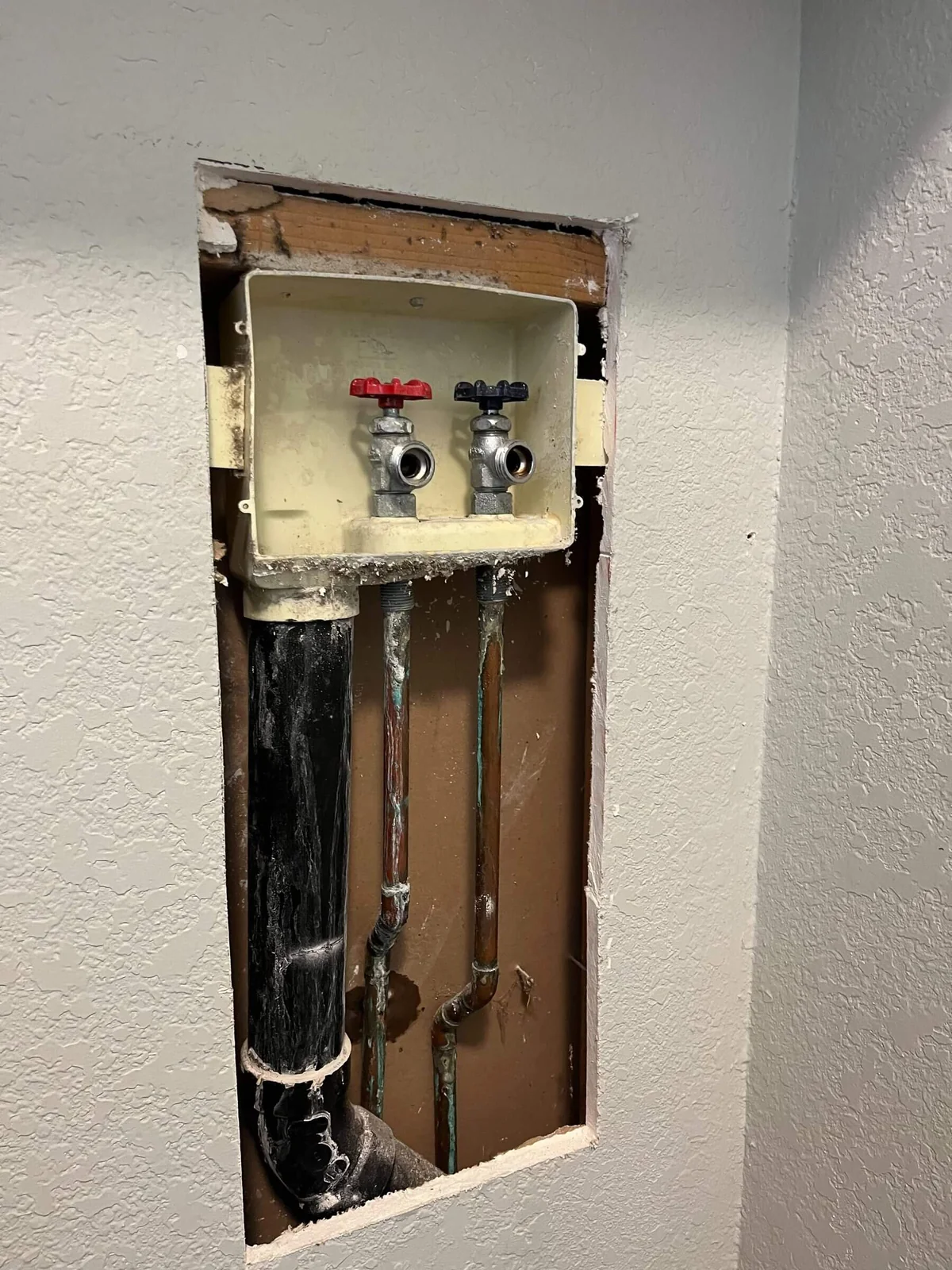
Laundry standpipes. Detergent scum, lint, and fibers build a felt-like layer until a wash cycle discharges faster than the drain can take. The symptom is water rising at the standpipe during pump-out and nothing wrong the rest of the day. Reaching that connection often means opening the hookup box at the wall, which is also the moment to look at the branch behind it.
Bath groups. Hair bound with soap scum, and in older homes a partially collapsed trap arm or accumulation on the walls of galvanized branch piping.
The side sewer. Roots and grade. Mature street trees and long-established yard plantings find any joint that weeps, and the District's approved materials list includes vitrified clay and cast iron, precisely the materials whose joints and corroded interiors give roots an opening.
What should never have gone in. The prohibited list also bars "ashes, cinders, sand, mud, straw, shavings, metal, glass, rags, feathers, tar, plastics, wood," anything hotter than 150 degrees Fahrenheit, and something homeowners do without knowing it is prohibited: "leaders from roofs and surface drains for rainwater" and "surface or subsurface drains for rainwater, stormwater, seepage" may not discharge to the sanitary sewer. A downspout or French drain tied into the sewer sends every winter storm into a pipe sized for household waste.
Clear it, see it, then decide
The order is the framework.
Clear it with the least aggressive method the pipe will take. A cable drills a channel through a soft blockage and is the right first tool on most branch lines. What it does not do is remove the layer on the pipe wall that caused the blockage, which is why a cabled grease line clogs again on a familiar schedule.
See it when the symptom points at the main line, when the same drain has clogged more than once, or when what came out on the cable suggests the pipe itself is failing. The camera answers what clearing cannot: grease or roots, clay or cast iron or PVC, a belly holding water, an offset joint, a crack, and how far out it sits.
Then decide. A grease-coated but structurally sound line is a hydro-jetting candidate, because a jetter scours the wall and removes buildup rather than punching through it. Fine root hair comes out the same way. A line with a structural defect is a repair conversation, and jetting it harder is the wrong move.
Pipe material keeps this from being a formula. Novato's older laterals are commonly clay or cast iron, both far less tolerant of aggressive methods than modern PVC. The District treats clay differently even for testing, noting to "check with a District Inspector before testing Vitrified Clay Pipe." Anyone running the same jetter at the same pressure down every line in town is not accounting for what is in the ground under your yard.

Slope: the factor that decides recurring clogs
If one drain clogs on a schedule, slope is usually why, and Novato's terrain makes it a live issue in a way it is not in a hillside town.
The District sets the minimums. A four-inch side sewer must fall "1.5 foot per 100 feet (1.5%)," and anything larger must fall at least "0.7 feet per 100 feet (0.7%)." Four inches is also the floor on diameter for a normal house, "when serving less than one hundred-fifty (150) fixture units."
On sloping ground a lateral can be built with fall to spare. Across Novato's flat valley-floor neighborhoods, a long run to the main is often built close to the minimum because there is no elevation to give away, and a line at minimum grade has no margin. Let the soil settle under one section and the fall there goes to zero. Solids stop moving, water stands, and you own a clog that clears easily and returns reliably. A camera finds a belly in minutes. Cabling never will.
The same geometry explains the cleanout rules. Cleanouts are required "at the junction of the building plumbing and the side sewer (two feet or less, outside the building)," "at each bend or change in direction of the side sewer greater than 45 degrees (1/8 bend)," and "where a run of pipe without bends exceeds ninety feet." Bends and long runs are where a cable loses its way and where blockages prefer to sit, so the code puts access where the trouble is.
Where a property cannot achieve gravity fall, the District allows a residential sewage pump system by special application and reserves the right to prohibit it. Those systems carry one Novato-specific consideration: a pumped system stops when the power does, and PG&E Public Safety Power Shutoffs reach parts of this area. Because we hold a C-10 electrical license alongside the C-36, backup power can be scoped in the same conversation.
What drives the cost in Novato
We do not publish a flat rate, because two Novato houses with the same symptom are often two different jobs. What moves the number: where the blockage sits, since a branch line inside the building is not a side sewer forty feet out under a lawn. Whether there is usable access, since a cleanout at grade is the cheapest thing on your property and a buried or paved-over one means locating it or pulling a fixture. The method the pipe can take. Whether a camera is warranted, which on a repeat clog is what keeps you from paying for the same clearing twice. What the camera finds, since a collapsed section or heavy root mass is a repair rather than a cleaning. And whether the work crosses into District jurisdiction, which brings a permit and an inspection into the schedule.
You will have the whole figure before we start, and a larger repair can be financed.
Jeffery came and checked all of our plumbing systems and found that they were working just fine. He was professional, friendly and efficient. Answered any questions we had for him and was a good representative of your company.
Herman W.
Permits, inspections, and what the District checks
The rule is short and unambiguous: sewer permits are "required for all sewer work performed outside the building foundation," and "any person legally entitled to construct, repair, or replace a sewer lateral must apply for a permit on forms provided by the District." Clearing a blockage is maintenance. Cutting into, repairing, or replacing pipe outside the foundation is permitted work. Interior plumbing changes go through the City of Novato Building Division instead.
Inspection is not a formality. All sewer construction work is inspected by the District, and no sewer may be covered until it has been inspected and passed. Requests carry lead time, 24 hours in advance by phone and 48 hours by email, which is worth knowing before a trench sits open over a weekend.
Three rules surface here more than homeowners expect. If you are adding a structure or an accessory dwelling unit, that structure "is not permitted to connect to an old side sewer unless the old side sewer is tested in the presence of a District Inspector and found to meet all current District requirements, including installation of a backwater prevention device," at the owner's cost. A lateral taken out of service "must be dug out to the main sewer, and the wye, tee, or connection area must be cut away and spliced with a solid piece of pipe," plugged in the presence of a District Inspector. And on Novato's rural edges, septic tanks fall under the County of Marin Environmental Health Department, which must be notified when a tank is abandoned or encountered, with all building plumbing outlets bypassing the tank entirely.
Unpermitted sewer work does not save money here. It creates a defect with an agency that keeps records of every connection, and it removes the independent check that the line was built to hold.
The District's Lateral Grant Program
Novato has something most North Bay cities do not: a District program that helps property owners replace a failing lateral. Know about it before you commit to a repair, because the sequence is unforgiving.
The Lateral Grant Program exists because, in the District's words, many laterals "are damaged, which leads to sewer spills and overflows," and because "old and leaky sewer laterals are often a significant source of rainwater infiltration and inflow (or 'I/I') that can quickly overwhelm public sewer systems and result in sewage spills and overflows."
- It covers replacing the entire lateral. In the District's own parenthetical, "repairs and partial replacements are excluded from the grant."
- Applicants must obtain written bids from three licensed contractors and submit them with the application.
- Funding comes from an annual allocation on a first-come, first-served basis, so timing within the fiscal year matters.
- Nothing may start before approval: "Any repair work performed prior to receiving a letter of obligation from NSD is performed at your own risk and cost, and will make the grant application null and void."
That last point is what costs people the grant. A homeowner with a backed-up line understandably wants it fixed now, authorizes replacement, and forfeits eligibility. If your camera inspection shows a replacement candidate rather than a cleaning candidate, we tell you the program exists and how the sequence works before you decide. Program terms change year to year, so confirm current requirements with the District when you apply.
Keeping Novato drains clear
- Keep grease out of the kitchen drain, and do not chase it with hot water. It sets on the pipe wall a few feet further along, which is the harder place to reach.
- Scrape plates before rinsing and treat the disposal as a scrap catcher, not a food processor.
- Use hair catchers in showers and tubs and clean them weekly. This one habit prevents most bath-group calls.
- Find your cleanouts and keep them at grade. Landscaping and hardscape swallow them, and a cleanout you cannot find does not help you when it matters.
- Never cap a backwater prevention device tight. Odor from one is a symptom to diagnose, not a reason to seal the only pressure relief your house has.
- Keep roof leaders and yard drains off the sewer line. They are prohibited, and they overload a lateral every winter.
- Camera a repeat offender once. Clearing the same drain four times costs more than looking at it properly one time.
Where we work in Novato
We serve all of Novato from our Petaluma headquarters, a short run down Highway 101: Hamilton, Bel Marin Keys, Indian Valley, the downtown and Grant Avenue neighborhoods, the mid-century tracts that make up much of the city's housing including its Eichler-era homes, and the hillside neighborhoods and rural edges at the boundaries.
Those areas do not present the same problem. Flat neighborhoods put slope and belly formation at the center of the diagnosis. Hillside properties have fall to spare but longer, harder-to-access runs and more root pressure. Slab-built mid-century homes put the building drain under concrete, where diagnosis has to be right before anyone proposes opening anything. Rural parcels bring septic and Marin County Environmental Health into the picture instead of the District.
How to choose a drain cleaning company in Novato
Ask who has jurisdiction over the work they are proposing. A company working in Novato should know without looking it up that anything outside the building foundation is Novato Sanitary District territory and needs a District permit and inspector.
Ask whether they will camera the line, and when. Not every clog needs one. A camera earns its cost on a repeat clog, on a main-line symptom, and when what comes out on the cable suggests the pipe is the problem.
Ask what method suits your pipe and why. Clay and cast iron laterals, common under older Novato yards, do not take the same treatment as PVC.
Ask them to find your backwater prevention device. If they do not know what it is, or do not know it is required on every side sewer in this district, they do not know the local code.
Four generations have run it the same way since 1932. Look at the actual property, report what is there, price it up front, and do the work to code.
What North Bay homeowners say
Ongaro & Sons is one company across plumbing, heating, cooling, electrical, and solar, and our reviews reflect all of it.
Drain and sewer service across Novato and Marin County
One company, all trades: Novato plumbing, plumbing across Marin County, Novato home services, Novato heating and cooling, and Novato electrical. Related Novato services: sewer line repair, water heater repair and replacement, tankless water heaters, and electrical panel upgrades.
Book drain cleaning in Novato
Book online and pick a window, or reach us during office hours and talk it through with a person. An Ongaro & Sons plumber will find out what your drain is doing, explain what it needs, and give you the price before any work begins.
Your Comfort, Our Priority
Ongaro & Sons is your trusted heating, cooling, plumbing, electrical, and solar expert, specializing in reliable maintenance and repair services that keep your home running efficiently year-round.
Our certified technicians deliver unmatched expertise with fast, friendly service across Marin, Sonoma and Napa County. From HVAC tune-ups to plumbing repairs and electrical upgrades or solar solutions, we focus on energy-efficient performance and long-term comfort. Count on us to maintain the systems that power your home and keep your environment just the way you like it.
Licensed, Insured, Background-Checked
Our technicians are licensed, experienced, and trained to service all makes and models.
Locally Owned and Operated
Serving the Napa, Marin, and Sonoma communities with personalized, hometown service.
Reliable Repairs
We respond quickly and get the job done right the first time, with no surprises.
Since 1932
Why Ongaro & Sons?
Four generations of trusted home service. Open any reason to see what it means for your home.
Schedule Service →Family-owned in the North Bay since 1932
Four generations of the Ongaro family serving Marin, Sonoma and Napa County. We know these homes and the systems in them.
Licensed, insured, background-checked technicians
Every technician is fully licensed and insured, background-checked, and trained on the equipment we install.
Diamond Certified and BBB A+
Diamond Certified since October 2016, and BBB Accredited with an A+ rating since December 1995.
Mitsubishi Diamond Contractor Elite and Trane Comfort Specialist
Both top manufacturer tiers. That standing decides how registration and extended warranty terms are handled on the system you actually bought.
The price is agreed before work starts
You see the number before the work begins. Flat-rate quotes, no surprises and no pressure.
Comprehensive maintenance program
Members get priority scheduling, discounts, and proactive checkups that prevent costly failures.

Discount
Membership
Ongaro Maintenance Plans
Annual maintenance on your home systems provides safeguards and comfort to you and your family. Members get priority scheduling, discounts, and proactive checkups that catch problems early.
Member Discounts
5% off every repair and replacement, all year long.
Peace of Mind
Proactive checkups catch issues before they become big problems.
Courtesy Reminders
We call you to schedule: never miss a seasonal service.
Value That Lasts
With Ongaro & Sons, you’re investing in quality, integrity, and service that stands the test of time. Explore our current promotions and see the difference real value makes for your HVAC, plumbing, and electrical needs.


From the Blog
 Sep 17, 2026
How Many Amps Does My House Need? Sizing Service for What You Actually Run
How many amps your house needs comes from a load calculation of what you run and plan to add. What drives the number, when existing service is enough, and more.
Read More Sep 10, 2026
Hard Water in Marin County: What Is Actually in Your Water and What It Does
Hard water in Marin County varies by provider and source. The 2025 report figures for Marin Water and NMWD, what hardness does and does not mean, and options.
Read More Sep 3, 2026
Electrical Permit Requirements in California: What Needs One and What Does Not
Find out which electrical projects commonly need permits, how to confirm local exemptions, and what to ask before work begins in Marin, Sonoma or Napa County.
Read MoreDrain cleaning in Novato: frequently asked questions
Who is the best drain cleaning company in Novato?
Ongaro & Sons has served the North Bay since 1932 and is Diamond Certified, with a C-36 plumbing license, a C-10 electrical license, and 4.8 stars across 2,756 Google reviews. On drain work, what separates a good outcome from a repeat visit is diagnosis: we determine whether you have a branch clog, a main-line blockage, or a structural defect in the lateral before choosing a method, and we give you the price before we start.
Who is responsible for the sewer lateral in Novato, me or the District?
You are, for its entire length. The Novato Sanitary District's side sewer requirements state that "each building's side sewer, including sewer ejector pump system if applicable, is owned and maintained by the owner of the building served thereby." That runs from about two feet outside your foundation all the way to the public main, including the portion under the street.
Do I need a permit for drain work in Novato?
It depends where the work is. Clearing a blockage is maintenance and needs no permit. Cutting into, repairing, or replacing pipe outside the building foundation does: the District requires sewer permits "for all sewer work performed outside the building foundation." Plumbing changes inside the building go through the City of Novato Building Division. We handle the permit and inspection as part of the job.
Why do my Novato drains keep clogging in the same place?
Usually one of three things: a grease layer that keeps rebuilding because the line was cabled rather than scoured, roots re-entering a joint in an older clay or cast iron lateral, or a belly where the pipe has lost its fall. The District requires a four-inch side sewer to fall at least 1.5 percent, and on flat Novato neighborhoods many laterals were built near that minimum with no margin for settlement. A camera distinguishes the three in one visit.
What is a backwater prevention device, and do I have one?
If your side sewer was built to current District standard, yes. Section 2-07 requires that "all side sewers must be equipped with a backwater prevention device (blowoff cleanout)," set with its overflow rim "at least three inches above finish grade and at least six inches below the lowest plumbing fixture." It is designed so a blocked line overflows outside at that device rather than inside at your lowest drain. Older laterals sometimes lack one, and many have been buried, paved over, or capped tight.
Sewage is coming up in my downstairs shower. What does that mean?
The side sewer is blocked and water is finding the lowest opening in the system, which should have been the backwater prevention device out in the yard. When it comes up indoors instead, that device is usually missing, below grade, paved over, or sealed. Stop running water through the house, then have the line located and cleared and the device found and corrected in the same visit.
Should the line be cabled or hydro-jetted?
Cabling drills a channel through a soft blockage and restores flow, which is the right first move on most branch lines. Hydro-jetting scours the pipe wall and removes the grease and fine root hair that caused the blockage, which is what stops it returning. Which suits your line depends on what the camera shows and what the pipe is made of, since clay and cast iron do not tolerate aggressive methods the way PVC does.
Do you run camera inspections in Novato?
Yes, where they answer a question rather than as a default add-on. A camera is warranted when a drain has clogged more than once, when the symptom points at the main line, and when what comes out on the cable suggests the pipe is failing. It identifies material, locates the defect, measures how far out it is, and shows whether the line has lost its fall.
Can you clear a main sewer line in Novato?
Yes. We locate the correct access point, which in Novato is often the blowoff cleanout the District requires on every side sewer, clear the line with the method the pipe can take, and camera it afterward when the situation calls for it. If the camera shows a break, an offset joint, or a heavy root mass, we lay out the repair options rather than selling you another clearing.
Is there help with the cost of replacing a lateral in Novato?
There is. The District runs a Lateral Grant Program for owners replacing an entire lateral, with repairs and partial replacements excluded. It requires written bids from three licensed contractors, and nothing may begin before the District issues a letter of obligation, since work started earlier "will make the grant application null and void." Funding is allocated annually on a first-come, first-served basis, so confirm current terms when you apply.
Can I connect a downspout or yard drain to my sewer line?
No. The District's prohibited wastes section bars "leaders from roofs and surface drains for rainwater" and "surface or subsurface drains for rainwater, stormwater, seepage" from the sanitary sewer. If a previous owner made that connection, every storm pushes stormwater into a pipe sized for household waste, which is one way an otherwise adequate lateral starts backing up in winter.
Does a garbage disposal prevent clogs?
No. It reduces particle size, but the District's standard is that garbage entering the sewer be shredded "with no particle greater than one-half inch in any dimension," which household units do not reliably achieve on fibrous or starchy waste. Combine that with grease, which the District limits to 100 parts per million by weight, and a disposal-heavy kitchen line is among the most common repeat calls we take.
What about drains in an Eichler-era or slab-built Novato home?
Slab construction puts the building drain in or under concrete, so diagnosis has to be right before anyone proposes opening anything. We camera and locate first, establish where the line runs and where the defect sits, and present the options with the concrete access work priced up front rather than discovering its extent mid-job.
What happens to my drains during a PG&E Public Safety Power Shutoff?
Gravity drainage keeps working. What stops is anything pumped. If your property runs a residential sewage ejector, which the District permits only where gravity service is not feasible, it stops with the power, as do sump pumps and well pumps. Households in that position should plan for it rather than find out during an outage, and because we are also a licensed electrical contractor, backup power can be part of the same conversation.