Drain Cleaning in San Rafael, CA
Ongaro & Sons is the drain cleaning company San Rafael homeowners call when a clog stops being a plunger problem. We have worked North Bay drains since 1932, we are Diamond Certified, we hold a C-36 plumbing license, and we carry 2,756 Google reviews averaging 4.8 stars. We camera the line before we quote the fix.
On this page
The rule that decides every drain job in this city
Start with ownership, because here it reaches further than most homeowners expect. The San Rafael Sanitation District puts it without hedging: "Property owners are responsible for maintaining the entire length of the sewer lateral, including the portion that runs under the street." Your responsibility does not end at the sidewalk or the curb. If the blockage sits forty feet out under pavement, it is still your pipe and your repair.
Second, this city is not served by one sewer agency. It is served by two, and the boundary is a hill. The San Rafael Sanitation District covers Central San Rafael, south from the top of Puerto Suello Hill, plus unincorporated pockets inside that jurisdiction. North of the ridge, Las Gallinas Valley Sanitary District takes over for Terra Linda, Marinwood, Lucas Valley and Santa Venetia. Both agencies tell residents to confirm which one they are in rather than assume, and the two publish a shared lateral specification, so the pipe standard holds across the ridgeline even where the process does not.
The process does differ. On the south side the district is direct about the sale question: "Currently, the San Rafael Sanitation District does not require that a sewer lateral inspection be conducted prior to the sale of the property." That sentence explains a lot of the calls we take, because a house can change hands with a lateral nobody has looked inside. North of the hill, Las Gallinas runs a sewer lateral ordinance and a private sewer lateral rehabilitation assistance program under Chapter 8 of its ordinance code, with lateral work coordinated through the district.
Permits are the third layer, and there are two kinds. The sanitation district currently does not charge for a sewer permit. Work inside the house or a trench on your own property goes through the City of San Rafael, which separates minor permits with no plan review from permits that require it, and everything now files through the city's OpenGov portal, the required intake for all new applications since February 23, 2026. Unincorporated addresses permit through the Marin County Community Development Agency instead.
One rule gets broken constantly on drain work: the storm drain is not the sewer. Gutters and street inlets here run to the bay, which is the point of the city's Keep It Clean stormwater program. Debris pulled from a sanitary line does not go in the gutter.

What those rules change about the equipment we bring
Because you own the run all the way to the main, a diagnosis that stops at the property line has not diagnosed anything. That reorders the visit. We clear first, then push a camera the full length with a sonde locator running, then mark on the ground where a defect actually sits and how deep. If the bad joint is under the street rather than the lawn, you need that before you get a repair number, because street work carries traffic control and pavement restoration that yard work does not.
Method follows the pipe, not the price sheet. A sectional or drum cable cuts through a soft obstruction and is the right first tool for a greased kitchen branch. Hydro-jetting scours the wall back toward true diameter and is what a heavily coated line needs, but jetting is a judgment call on brittle vitrified clay or corroded cast iron, and anyone who jets by default will eventually break something in a city with this much older pipe. Scaled cast iron wants a descaling head, not a cable carving a channel through the crust. Roots in a clay joint want a cutter sized to the line, then a camera to see whether the joint behind them has already dropped.
Access decides the rest. With a proper two-way cleanout we work from outside and nothing in your bathroom is involved. Without one, common in the older blocks near downtown, the options narrow to pulling a toilet, opening a laundry box, or working down a roof vent. On plenty of calls our first recommendation is adding a cleanout, which shortens every future visit.
Symptoms, and what each one is telling you
These are not interchangeable. The pattern points at where the trouble sits before anyone opens anything.
- One fixture slow, everything else fine: a branch problem, usually within a few feet of the trap
- Two or more fixtures slow at once: the restriction has moved downstream to a shared line
- The lowest fixture backs up first, often a tub or floor drain: a main-line restriction, and the house is showing you where water goes when it has nowhere else
- Toilet gurgles when the washer drains: air is being pulled through the trap past a partial blockage
- Laundry standpipe overflows on the spin cycle: the washer discharges faster than a restricted line can swallow
- Sewage smell in a yard or crawlspace with no fixture running: a possible break rather than a clog
- Backups that clear overnight and return in days: a partial obstruction, not a resolved one
James was very impressive. His knowledge and attitude was beyond compare. He is a definite assist to your company. He went beyond helping us with our problem.
Shirley P.
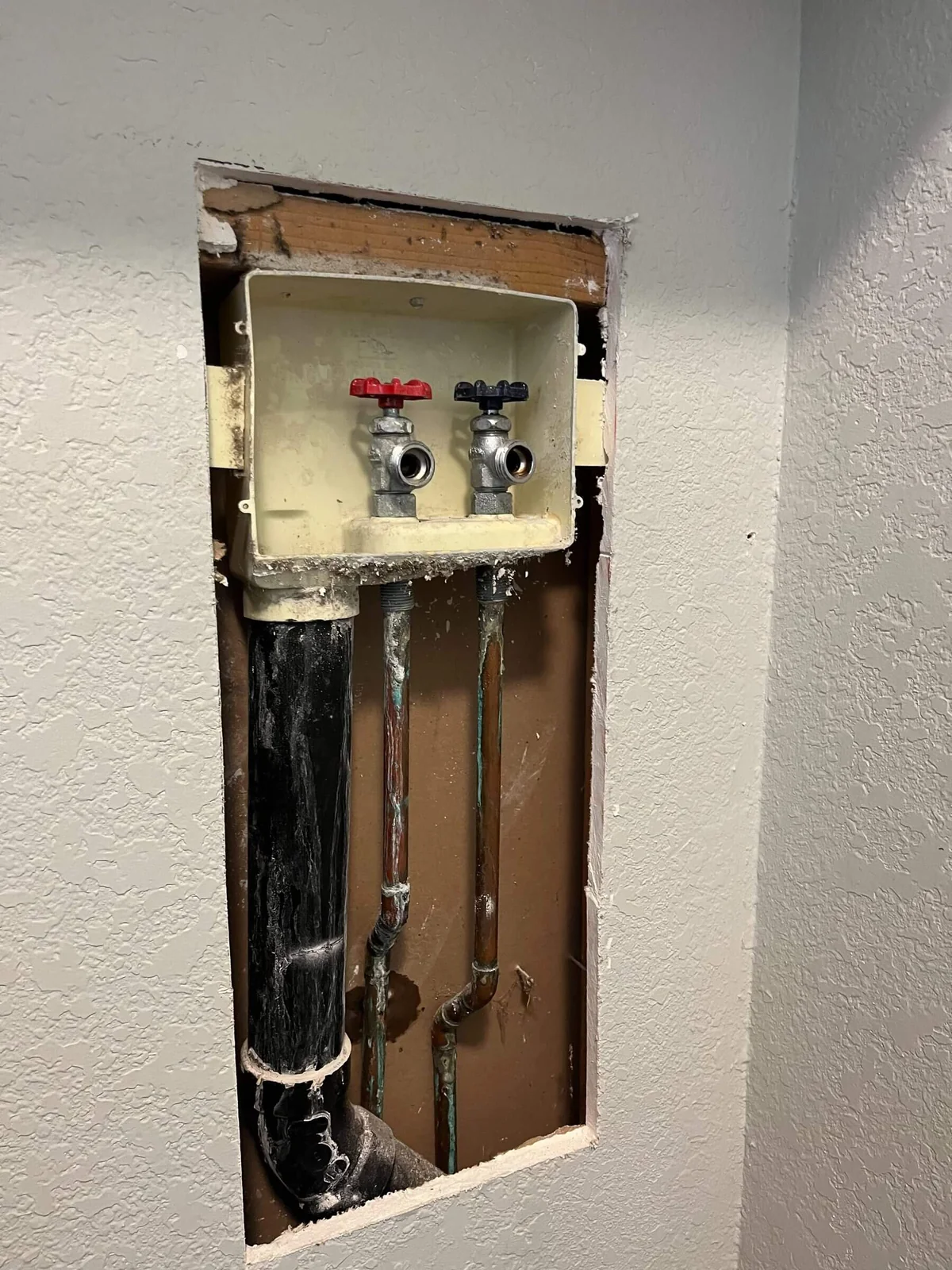
The laundry line earns its own note. A washer dumps a large volume in a short burst, so it finds a marginal drain long before a bathroom sink does. Lint, detergent residue and the tight turns behind a wall box build a restriction that reads to a homeowner as a washer fault. Opening the box at the wall, as above, is often the only way to reach the standpipe trap without cutting drywall blind.
Clear it, scope it, then decide
We run the same three steps on every main-line call in this city, in this order, and the middle one never gets skipped.
Clear it. Restore flow first. Nobody thinks clearly about a repair while the house is out of service, and a camera cannot see through standing water. This step answers one question: can the line be opened.
Scope it. Camera the full run to the main with the locator on. This is where the information lives: pipe material, joint condition, bellies holding water, root mass, offsets, scale thickness, and the distance and depth of anything worth fixing. You should watch the footage and keep a copy. A verbal summary of what someone says they saw is not something you can act on or get a second opinion about.
Then decide. Three outcomes are legitimate. Clean and monitor, when the pipe is sound and the blockage was a one-time event. Spot repair, when a single joint or crushed section is doing all the damage. Replace or reline, when the material has failed end to end and each clearing buys months. The scope is the part that gets skipped, and skipping it is how a homeowner pays for the same clearing four times before anyone mentions the pipe is broken. If the scope shows a defect rather than a deposit, the conversation moves to sewer repair.
Pipe material and routing usually decide it
Material is the best predictor of what your line does next, and this city's building eras left a clear record underground.
Vitrified clay was the standard for decades and still sits under many older properties around downtown, where houses like the 1883 Bradford House on G Street set the era. Clay is chemically durable and mechanically unforgiving: short sections, a seam at every joint, and roots find seams. A clay lateral rarely fails because the pipe dissolved. It fails because a joint separated, a root colonized it, and the section behind it dropped out of alignment.
Cast iron turns up in mid-century construction and fails from the inside out. Scale builds on the wall, effective diameter shrinks, and the surface roughens until everything catches. A cast iron line can pass water and still be functionally half its original size.
Orangeburg, the bituminized fiber pipe used in some mid-century work, deforms rather than cracks. It ovals under load until the crown sags into the flow path. There is no maintenance strategy for it, and once the camera identifies it, replacement is the answer.
Then the specifically San Rafael problem: the slab. Terra Linda and Lucas Valley hold the well-known Eichler tracts, built on concrete slabs with radiant heat tubing cast into the slab itself, now more than sixty years old. Those homes have no crawlspace, so the waste lines run under concrete and the usual inspection routes are not available. Any trenching decision has to account for radiant tubing sharing that slab. Cut the wrong line of concrete and a drain problem becomes a heating problem. Here the camera and locator decide whether the repair is a targeted opening or an expensive guess, and rerouting a run around the perimeter is worth pricing before anyone breaks floor.
Grade matters too. The flatter bayside streets, Peacock Gap among them, give a lateral less fall than the hillside neighborhoods do, and a line with minimal slope tolerates a belly poorly. The same defect a steep run flushes past will stop a flat one.

What drives the cost of a drain job here
Access comes first. A job with a reachable exterior cleanout is shorter than one that starts by pulling a fixture. Method comes second, since cabling a branch and jetting a full main are different amounts of equipment and time. Length and depth come third, and this is where the ownership rule bites: a defect under the street means saw-cutting pavement, traffic control, backfill compaction and restoration, none of which apply to the same defect in a front lawn.
After that, material dictates the repair method, the number of defects separates a spot fix from a project, a slab puts the job in its own category, and the permit path puts inspection scheduling on the calendar. What does not drive cost is guesswork. We scope, show you what is there, and put options in writing before anything is committed. If the finding is larger than you planned for, financing is worth discussing before you default to whatever is cheapest today.
Daniel is terrific, efficient, knowledgeable and very nice to work with.
Judy A.
Rebates, assistance, and what does not exist here
Be clear-eyed about this, because the internet is not. No state program, utility or community choice provider pays for routine drain cleaning. MCE is Marin's community choice electricity provider and its programs fund energy measures; they do not touch drains. The regional incentives that appear on our heat pump and water heater pages are irrelevant on this one.
What exists is narrow and local. Las Gallinas Valley Sanitary District's assistance program applies to private lateral rehabilitation on its side of Puerto Suello Hill, not to a snaked kitchen line, and it carries process requirements including multiple quotes from contractors licensed and bonded through the California Contractors State License Board. If you are north of the hill facing a lateral replacement, read it before committing. Terms shift, so we confirm current status at project time.
Maintenance that prevents the second call
The San Rafael Sanitation District describes the failure modes plainly: "As private laterals age, just as sewer mains do, they can develop leaks, become clogged by fats, oils, and grease, and become cracked by roots." Two of those three are behavioral, which means two are yours to influence.
Grease is the underestimated one. It leaves the pan liquid and cools to a solid on the pipe wall a few feet downstream, then catches everything after it. Scrape and bin it. Households that cook heavily do better with kitchen-line jetting on a schedule than with waiting for the backup.
Wipes are the other. Products labeled flushable clear the toilet and then refuse to break down, and both districts list them among the causes of blockages. Bin those, along with paper towels, floss and cat litter. Skip chemical openers too: caustics do nothing to roots, generate heat inside pipe that may already be compromised, and leave a hazardous column standing in the line for whoever opens that trap next.
Otherwise: hair catchers in every shower, water running after the disposal rather than only during it, and periodic camera work on a known clay lateral instead of waiting for the next backup to report on the joints. A drain that has clogged three times has not had bad luck three times. Our maintenance plans fold that attention in with the rest of the house.
Where we work in San Rafael
We take drain calls on both sides of the sewer boundary: Terra Linda and Lucas Valley up north, where the Eichler slabs set the terms; Peacock Gap and the flatter bayside streets, where grade is tight; Sun Valley and the older blocks near downtown and Fifth Avenue, where clay laterals and missing cleanouts are the recurring theme. Everything is dispatched from our Petaluma headquarters, where the trucks, cameras and jetters live. Drain work rarely stays in its lane, so we cover the rest of the house too, from plumbing across San Rafael to water heater work when a blocked pan drain is what put water on the floor.
How to choose a contractor for this work
Ask which sanitation district your address falls in and notice whether the answer comes back immediately. It is the most basic piece of local knowledge on this job, and plenty get it wrong.
Ask whether the camera run goes to the main or to the property line, and hold them to the answer, because here the difference is the whole repair. Ask for the footage as a file you keep. Confirm the C-36 plumbing license, and that permits and inspections are handled rather than dropped on you afterward.
Be skeptical of two things: a full lateral replacement quoted before anyone put a camera in the line, and a very low clearing price that only makes sense as a door-opener for something much larger. A contractor confident in the diagnosis shows the evidence first and lets the scope follow from it. That is the standard we hold on every plumbing job in Marin County.
What North Bay homeowners say
Two recent notes from customers, unedited.
Drain cleaning across San Rafael and Marin County
More from Ongaro & Sons nearby: the full San Rafael service matrix, plus drain cleaning in Novato and Mill Valley.
Book drain cleaning in San Rafael
If a fixture is slow, a toilet gurgles, or water comes up where it should be going down, get it scoped rather than cleared and forgotten. Book online and tell us which fixtures are affected and whether you know where your cleanout is. We bring the camera on the first visit and put the options in writing before any decision gets made.
Your Comfort, Our Priority
Ongaro & Sons is your trusted heating, cooling, plumbing, electrical, and solar expert, specializing in reliable maintenance and repair services that keep your home running efficiently year-round.
Our certified technicians deliver unmatched expertise with fast, friendly service across Marin, Sonoma and Napa County. From HVAC tune-ups to plumbing repairs and electrical upgrades or solar solutions, we focus on energy-efficient performance and long-term comfort. Count on us to maintain the systems that power your home and keep your environment just the way you like it.
Licensed, Insured, Background-Checked
Our technicians are licensed, experienced, and trained to service all makes and models.
Locally Owned and Operated
Serving the Napa, Marin, and Sonoma communities with personalized, hometown service.
Reliable Repairs
We respond quickly and get the job done right the first time, with no surprises.
Since 1932
Why Ongaro & Sons?
Four generations of trusted home service. Open any reason to see what it means for your home.
Schedule Service →Family-owned in the North Bay since 1932
Four generations of the Ongaro family serving Marin, Sonoma and Napa County. We know these homes and the systems in them.
Licensed, insured, background-checked technicians
Every technician is fully licensed and insured, background-checked, and trained on the equipment we install.
Diamond Certified and BBB A+
Diamond Certified since October 2016, and BBB Accredited with an A+ rating since December 1995.
Mitsubishi Diamond Contractor Elite and Trane Comfort Specialist
Both top manufacturer tiers. That standing decides how registration and extended warranty terms are handled on the system you actually bought.
The price is agreed before work starts
You see the number before the work begins. Flat-rate quotes, no surprises and no pressure.
Comprehensive maintenance program
Members get priority scheduling, discounts, and proactive checkups that prevent costly failures.

Discount
Membership
Ongaro Maintenance Plans
Annual maintenance on your home systems provides safeguards and comfort to you and your family. Members get priority scheduling, discounts, and proactive checkups that catch problems early.
Member Discounts
5% off every repair and replacement, all year long.
Peace of Mind
Proactive checkups catch issues before they become big problems.
Courtesy Reminders
We call you to schedule: never miss a seasonal service.
Value That Lasts
With Ongaro & Sons, you’re investing in quality, integrity, and service that stands the test of time. Explore our current promotions and see the difference real value makes for your HVAC, plumbing, and electrical needs.


From the Blog
 Sep 17, 2026
How Many Amps Does My House Need? Sizing Service for What You Actually Run
How many amps your house needs comes from a load calculation of what you run and plan to add. What drives the number, when existing service is enough, and more.
Read More Sep 10, 2026
Hard Water in Marin County: What Is Actually in Your Water and What It Does
Hard water in Marin County varies by provider and source. The 2025 report figures for Marin Water and NMWD, what hardness does and does not mean, and options.
Read More Sep 3, 2026
Electrical Permit Requirements in California: What Needs One and What Does Not
Find out which electrical projects commonly need permits, how to confirm local exemptions, and what to ask before work begins in Marin, Sonoma or Napa County.
Read MoreDrain cleaning in San Rafael: frequently asked questions
Who is the best drain cleaning company in San Rafael?
We make a strong case in this city. Ongaro & Sons has served the North Bay since 1932, holds a C-36 plumbing license, is Diamond Certified, and carries 2,756 Google reviews averaging 4.8 stars. More usefully for a drain call: we know which of the two sanitation districts your address sits in, we camera the full run rather than the convenient part of it, and you leave with the footage.
Which sanitation district covers my San Rafael address?
It depends which side of Puerto Suello Hill you are on. Central San Rafael and the area south of the ridge fall under the San Rafael Sanitation District. Terra Linda, Marinwood, Lucas Valley and Santa Venetia fall under Las Gallinas Valley Sanitary District. Both publish service area maps, and both ask residents to verify rather than guess, since requirements differ between them.
Am I responsible for the sewer pipe under the street?
Here, yes. The sanitation district's published position puts the property owner on the hook for the full lateral, not just the portion inside the property line. Practically, a defect out under pavement is your repair, and it brings street cutting and restoration that the same defect in a yard would not. It is also the reason a camera run has to reach the main to count as a diagnosis.
Do I need a sewer lateral inspection before selling my San Rafael home?
South of the ridge, no. The sanitation district does not currently impose a pre-sale lateral inspection requirement. That is not the same as it being a bad idea: a scope before listing tells you what a buyer's inspector will find and keeps the discovery out of escrow. North of the hill, check the Las Gallinas Valley Sanitary District lateral ordinance, since its requirements are its own.
Do I need a permit to clear or repair a drain in San Rafael?
Clearing a blockage does not. Repair or replacement does, on two tracks. The sanitation district issues the sewer permit and does not currently charge for one. Structural or in-house plumbing work permits through the City of San Rafael, filed via its OpenGov portal since February 2026. Outside the city boundary the file goes to Marin County rather than to San Rafael.
Should the line be cabled or hydro-jetted?
Cabling punches through a soft obstruction quickly and suits a fresh jam. Jetting washes the pipe wall back toward full diameter and is what a line coated with years of grease or scale needs. Condition decides, not preference: aging clay and corroded cast iron do not always tolerate high pressure, so the camera should inform the choice rather than follow it.
Why do Eichler homes in Terra Linda and Lucas Valley have different drain problems?
Those houses are slab-on-grade with no crawlspace, and radiant heat tubing was cast into the same concrete when they were built. Waste lines run beneath the slab, so there is no way to inspect or reach them from below. Any repair involving opened concrete has to be located precisely and planned around the radiant loop, which makes accurate locating far more valuable than on a raised-foundation home.
What causes tree roots to get into a sewer lateral?
Roots do not drill through sound pipe. They find an existing opening, almost always a shifted joint or a crack in older clay, and grow toward the moisture inside. Once established, the mass traps solids and a blockage builds behind it. Cutting roots restores flow but does not close the opening, which is why intrusion recurs on a predictable cycle until the joint itself is addressed.
How often should a drain line be inspected with a camera?
For a home with no history, once is enough as a baseline, and buying a house is the natural moment. For a property with a known clay lateral, past root intrusion, or a repeat clog, a periodic scope is the cheaper path, because it catches a shifting joint or a developing belly while it is still a spot repair. Waiting for the next backup lets the pipe choose the timing.
What makes one drain job cost more than another?
Reachability, mostly. An existing exterior cleanout shortens everything and its absence lengthens everything. After that: the clearing method the pipe requires, how far out and how deep the trouble sits, whether the work lands under pavement, what the pipe is made of, and whether a slab is in the way. All of those are established before pricing rather than discovered mid-job.
Is there any financial assistance for sewer lateral work here?
Nothing broad. Routine clearing is not subsidized by any state, utility or community choice program, and Marin's electricity provider funds energy measures rather than plumbing. The local exception is the Las Gallinas Valley Sanitary District assistance program for private lateral rehabilitation on the north side, which has its own eligibility rules and requires bids from properly licensed and bonded contractors.
What is a cleanout, and why do you keep recommending one?
It is a capped access fitting opening directly into the drain line, ideally a two-way fitting outside the house. With one, a technician works from the yard, reaches the line in both directions, and never enters your bathroom. Without one, the entry point becomes a pulled toilet, an opened laundry box, or a roof vent. On older properties lacking one, adding it is frequently the highest-value part of the visit.