Drain Cleaning in Santa Rosa
Ongaro & Sons clears blocked and slow drains throughout Santa Rosa, and we have worked in the North Bay since 1932. We hold C-36, we are Diamond Certified, and 2,756 Google reviews on our plumbing work average 4.8 stars. On any line that has blocked before, we put a camera down it instead of clearing it again and calling that a fix.
On this page
In Santa Rosa, the pipe is yours all the way to the main
Most homeowners assume their responsibility for the sewer line stops at the property line, or at the sidewalk. In Santa Rosa it does not, and that single fact should shape how you approach a drain problem here.
The city states the rule plainly. The user "shall maintain, operate, and repair, at user's own expense and after obtaining all required permits, the entire sewer service lateral," and the user "shall be responsible for maintaining a clear, unobstructed sewer service lateral, free of all breaks, leaks and obstructions, including, but not limited to, roots, rocks, dirt, and grease." That language is published by Santa Rosa Water. The city may elect, at its own discretion and expense, to repair the short section of lateral between its sewer main and the back of the curb or sidewalk, but that is discretionary, not a boundary you can plan a repair around.
So the run of pipe you own can pass under a lawn, a driveway, a sidewalk, and on many Santa Rosa streets out under the pavement to the main. When a blockage sits somewhere in that run, the question of who pays for it is already settled. The only open question is whether you are buying a clearing or a repair, and that is exactly the question a camera answers and a cable does not.
Repair or replacement of that pipe is permitted work: onsite plumbing is permitted through the Building Division of Planning and Economic Development. Routine clearing is not.

Two Santa Rosas, and the pipe rarely matches the house
Santa Rosa splits by era more sharply than any other city we serve, and drains are where that split shows up most.
Coffey Park, Fountaingrove, and the other neighborhoods rebuilt after the 2017 Tubbs Fire carry drain systems less than a decade old. Modern plastic waste piping is solvent-welded rather than jointed, which removes the openings roots exploit. In those homes a recurring blockage is far more often a behavior problem, a fixture problem, or a venting problem than a structural one, and that is a cheaper problem to have.
The rest of the city is a different job. Postwar tract housing across the east and west sides is now at the age where the original waste line under the yard is the oldest untouched thing on the property. The older core near downtown goes back further still. Those are the addresses where a blockage deserves a look before it deserves a tool.
One caution specific to the rebuild neighborhoods, and it catches people out: a new house does not automatically mean a new lateral. Whether the buried line from the structure to the main was replaced along with everything above ground depends on what was done on that particular lot. If you are in a rebuild and the line has blocked twice, that is worth establishing with a camera rather than assuming.
Santa Rosa also sits on ground that moves. The U.S. Geological Survey has mapped the active surface trace of the Rodgers Creek Fault through the central part of the city. Rigid pipe with mortared joints is the least forgiving material there is when the ground around it shifts, which is one more reason the older central neighborhoods reward looking over guessing.
What your drain line is made of decides almost everything
Before anyone talks about tools, it is worth knowing what is actually in the ground, because the material sets the failure mode and the failure mode sets the fix.
Vitrified clay was the standard for sewer laterals for the first half of the last century, and it is still under a great many Santa Rosa properties. Clay is chemically inert and lasts a long time, but it comes in short lengths joined every few feet. Roots find moisture at those joints, work in through the gap, and grow into a mass that catches everything passing. Cutting the roots restores flow. The joint stays open, so the roots come back.
Cast iron was used for drain and waste piping inside and under houses well into the postwar decades. It fails from the inside out. Corrosion products build into a rough, scaly layer on the pipe wall, a process called tuberculation, and that layer both narrows the effective diameter and gives grease and paper something to grab. Worth being precise here, because it is commonly confused: the build-up inside an old cast iron drain is corrosion, grease and soap residue, not mineral scale from hard water. Water hardness matters a great deal on the supply side of the house and very little on the waste side.
Bituminized fiber pipe, sold under the name Orangeburg, went into American residential construction from the 1940s into the early 1970s, which overlaps Santa Rosa's tract-housing decades exactly. It is essentially layered wood pulp and pitch, and it deforms into an oval under load rather than cracking. On a house of that era it gets ruled out first, because no amount of clearing helps a line that has lost its shape.
ABS and PVC have been the residential standard since the 1970s. Solvent-welded joints, smooth wall, no root pathway. These lines still block, but they block because of what went into them, which is a solvable problem.
A camera identifies the material in the first few feet of run. That one observation narrows the likely cause before anyone has diagnosed anything else.
great service! Aldo did a good and thorough job, he was able to identify the major issue I had with the drain pipe! I will definitely refer this company for any plumbing issues.
Chanta H.
Two rules that tell you what you are dealing with
You can get a long way toward the right answer before anyone arrives, using two rules we apply on every call.
The lowest-fixture rule. Water finds the lowest opening it can. If the only thing misbehaving is one sink, the problem is that fixture or the branch serving it. If two fixtures on the same side of the house are slow, look at the branch they share rather than at either fixture. If the water is appearing at the lowest drain in the house, typically a downstairs shower, a tub, or a floor drain, when you run something upstairs, the problem is downstream of everything and you are looking at the main line or the lateral. That is the scenario where clearing without diagnosis is most likely to be a temporary purchase, and where sewer repair in Santa Rosa becomes part of the conversation.
The second-visit rule. The first blockage on a line is a blockage. The second blockage on the same line inside a year is information. Once a line has failed twice, the odds that the cause is structural rise sharply, and continuing to clear it is buying the same afternoon over and over. That is the point at which we stop reaching for the cable and put a camera down instead.
Two symptoms sit outside both rules and are worth naming, because the wrong tool gets used on them constantly. Gurgling from one fixture when a different one drains is usually a venting problem, not a blockage, and a cable will not touch it. And a toilet that is sluggish without ever fully blocking is often a partially obstructed trap or a vent issue rather than anything out in the yard.
Cable, jetter, camera, repair: escalating in the right order
Cabling is the first tool for a reason. A drum machine drives a cutting head through an obstruction and pulls it back, and for the great majority of fixture and branch blockages, and for cutting roots out of a clay joint, it is fast and it is the correct answer.
Hydro jetting does something cabling cannot. High-pressure water scours the pipe wall rather than punching a channel through the middle of a blockage, which restores the actual diameter of the line. That makes it the right tool for a grease-laden kitchen line and for a cast iron line narrowed by years of build-up. It is not right for every pipe. A line that is already fractured, or an old fiber-pipe run that has deformed, is not a candidate, and a competent plumber will tell you when jetting is a bad idea rather than treating pressure as a universal solution.
Camera inspection is not a treatment, it is a diagnosis, and it is the step most often skipped. It establishes what the pipe is made of, what condition it is in, where the trouble sits and how far down, and whether the right call is maintenance or repair. On a first-time blockage with an obvious cause it is usually unnecessary. On anything recurring it is the difference between a decision and a guess.
Repair is the last step and sometimes the correct first one. A bellied section that holds standing water, an offset joint that catches paper, a fractured length, a collapsed run: none of those are clearing problems. If the footage shows one, we show you the footage and quote the repair as its own decision rather than putting you back on the schedule for next spring.
The drains people forget until they overflow
Kitchen and bathroom lines get all the attention. Two others cause a disproportionate share of the calls we take in Santa Rosa.
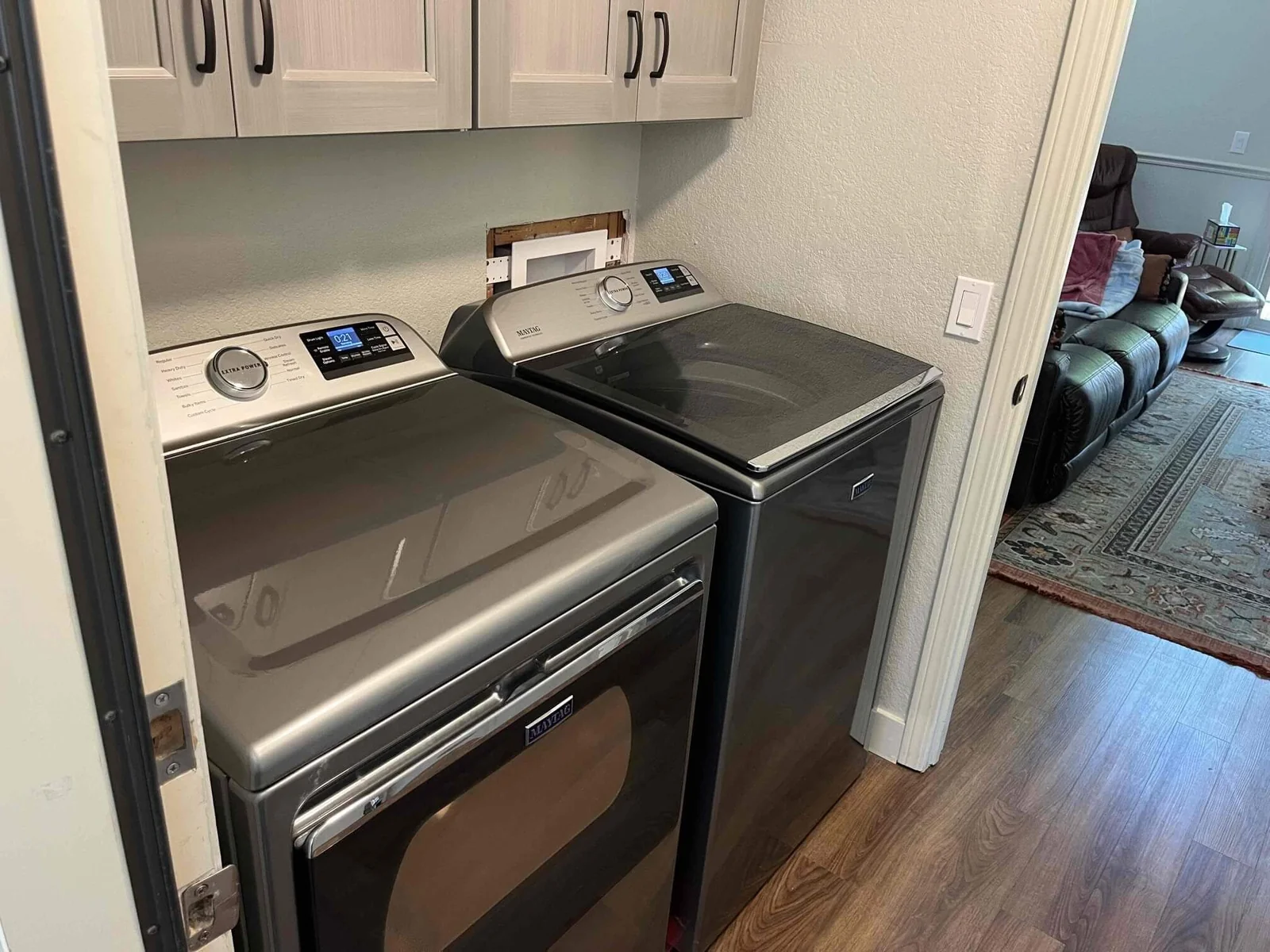
The laundry standpipe is the first. A washing machine discharges a large volume of water very fast, faster than most other fixtures in the house, so a laundry line that is partly restricted will overflow at the standpipe while every other drain in the house still appears fine. Lint, detergent residue and fabric softener build a coating that narrows the line gradually, and the first symptom is usually water on the floor rather than a slow drain. If your laundry backs up and nothing else does, that is a specific problem with a specific fix, not a whole-house issue.
The second is the condensate line from a furnace or air conditioner, which in a lot of homes ties into a nearby drain. A blocked condensate run does not look like a plumbing problem at all. It looks like water appearing near the equipment. Because we run heating, cooling and plumbing under one roof, that gets sorted in one visit rather than through two companies each certain it belongs to the other.
What drives the cost of drain cleaning in Santa Rosa
We do not publish flat prices, because a kitchen sink and a root-blocked lateral are not the same job. What moves the number:
Which line it is. A single fixture, a shared branch, the main stack, or the lateral out to the street are four different jobs with four different levels of effort.
Whether there is a usable cleanout. A property with an accessible cleanout is a faster call than one where access has to be made through a fixture or from a roof vent. This is the single biggest swing factor on many older Santa Rosa homes.
What the line is made of and what condition it is in, which is precisely what the camera establishes.
Whether cabling or jetting is the right tool, and whether the pipe's condition allows jetting at all.
How far out the problem sits. A blockage a few feet from the house and a blockage near the main are different amounts of work, and in Santa Rosa both sit on your side of the responsibility line.
Whether diagnosis is included. On a recurring problem it should be, and we treat it that way.
You see the price before we start. If the camera shows the line needs repair rather than clearing, you hear that instead of a booking for next year.
Had a new sump pump and a new drainage line installed. It was not cheap, but two guys worked under the house for hours, and appear to have done a great job. They were friendly, well mannered, efficient and exceptionally clean.
Terry Y.
Inflow, infiltration, and why the city cares about your lateral
Santa Rosa runs a large collection system: over 500 miles of underground pipe carrying wastewater from the city and neighboring communities to the Laguna Treatment Plant, most of it moving by gravity with roughly 18 lift stations handling the places where elevation does not cooperate. The city describes this on its Water & Sewer pages.
That system has a specific vulnerability, and it is the same defect that causes your line to back up. Santa Rosa Water defines inflow and infiltration as the ways "clean groundwater and/or storm water flow into the wastewater system, due to cracked sewer lines, leaky manholes." Clean water entering the sewer "must be treated like sanitary waste and this raises costs," and it produces "sewer backups and overflows when it rains." The city hunts for it actively, running television cameras through pipes, smoke testing to find improper connections, and monitoring flow during rainstorms.
The practical translation for a homeowner is straightforward. If your drains only misbehave during heavy winter rain, that is not a coincidence and it is not usually a blockage. It is a strong indication that groundwater is getting into a cracked line, yours or a shared one, and loading it at exactly the wrong time. Cabling that line every January treats a symptom that will return with the next storm.
What happens at the end of the pipe is something to know too, because it explains why the city's messaging about drains is unusually specific. Santa Rosa states that 100 percent of the water entering the treatment facility is turned into recycled water, reused in the city's reclaimed water systems and in geothermal energy production at the Geysers. Everything that goes down a drain here is on its way to being used again.
What Santa Rosa asks you not to put down the drain
The city runs a public program called SewerSmart, and its guidance is more concrete than the usual advice, which makes it more useful.
On fats, oils and grease, the city's position is that FOG "going down the drain can clog your pipes and can also clog up the main sewer pipes under the street," and it gives disposal instructions by volume: under about two tablespoons, wipe it up with a paper towel and put the towel in the trash or green bin; from roughly two tablespoons to two cups, cool it, solidify it in the freezer and bin it; anything larger goes to a county drop-off location. The city is also explicit that a garbage disposal does not solve this. Disposals shred material into smaller pieces; they do not keep grease out of the system.
On wipes, Santa Rosa tested the claim. The city displays "flushable" wipes left in water for eight weeks, still fully intact, and asks residents not to flush them regardless of what the packaging says. In our experience that is not an abstract concern: wipes are the most common avoidable cause of main line blockages we deal with anywhere in the North Bay. Menstrual products, floss, cat litter, food scraps and medications belong in the same category.
The city's own prevention list for property owners is short and includes one item most homeowners never think about: secure your cleanout caps. An open or missing cap is a direct route for dirt, rock and debris into your lateral, and it is the cheapest thing on this page to fix.
Keeping a Santa Rosa drain line clear
Kitchen lines block because of what goes into them, so a sink strainer and a habit of binning grease prevent most of it. Bathroom lines block because of hair and soap product, and a drain screen in the shower is the highest-return prevention available to any homeowner. Nothing but toilet paper goes down a toilet.
Beyond that, two things are specific to this city. If you are on an older clay lateral with mature trees overhead, planned periodic maintenance is a legitimate strategy rather than an admission of defeat, provided a camera has first confirmed that periodic maintenance is genuinely what the line needs and not a substitute for a repair you are postponing. And find your main cleanout before you need it. Ten minutes on a dry afternoon locating and clearing access to it makes every future drain call faster.
If your property has a sump pump or a below-grade drainage system, test it before the wet season rather than during it. In the hillside neighborhoods, PG&E Public Safety Power Shutoffs are a regular reality, and a sump pump without power is not a sump pump. That is a conversation we can have in full, because we hold a C-10 electrical license alongside the C-36 and can put backup power in the same project rather than a separate trade and a separate schedule.
Where we work in Santa Rosa
We serve every Santa Rosa neighborhood from our Petaluma headquarters, including Coffey Park, Fountaingrove, Rincon Valley and Bennett Valley, the older east and west sides, and the downtown core. We also work the surrounding unincorporated properties, where a septic system changes the diagnosis entirely: on septic, what presents as a drain problem is sometimes a full tank or a failing leach field, and cabling a line that is backing up from the tank accomplishes nothing at all. Establishing which one you have comes first.
How to choose a drain cleaning company in Santa Rosa
Ask whether a camera is included if the problem has happened before. A company that will not look is a company that benefits from you calling again.
Ask what they think is causing it, and expect a specific answer. "Roots at a clay joint about thirty feet out" is a diagnosis. "It was clogged" is not.
Ask whether jetting is appropriate for the condition of your particular line, rather than accepting that more pressure is always better.
Ask what they know about lateral responsibility in this city. A company working in Santa Rosa should be able to tell you that your obligation runs to the city main and should be able to point you at the city's own language.
Ask what happens if the camera shows a structural problem, and whether that turns into a quote or a sales pitch.
We have answered questions like these the same way since 1932: find the actual cause, explain what we find, price it before we start, and say so when clearing is not the answer.
Drain and plumbing service across Santa Rosa and Sonoma County
One company, all trades: Santa Rosa plumbing, plumbing across Sonoma County, Santa Rosa home services, Santa Rosa heating and cooling, and Santa Rosa electrical. Related Santa Rosa services: sewer repair, water heaters, and tankless water heaters.
Book drain cleaning in Santa Rosa
Book online and pick a window, or reach us during office hours and talk it through with a person. An Ongaro & Sons plumber will clear the line, tell you what caused it, and give you the price before any work begins.
Your Comfort, Our Priority
Ongaro & Sons is your trusted heating, cooling, plumbing, electrical, and solar expert, specializing in reliable maintenance and repair services that keep your home running efficiently year-round.
Our certified technicians deliver unmatched expertise with fast, friendly service across Marin, Sonoma and Napa County. From HVAC tune-ups to plumbing repairs and electrical upgrades or solar solutions, we focus on energy-efficient performance and long-term comfort. Count on us to maintain the systems that power your home and keep your environment just the way you like it.
Licensed, Insured, Background-Checked
Our technicians are licensed, experienced, and trained to service all makes and models.
Locally Owned and Operated
Serving the Napa, Marin, and Sonoma communities with personalized, hometown service.
Reliable Repairs
We respond quickly and get the job done right the first time, with no surprises.
Since 1932
Why Ongaro & Sons?
Four generations of trusted home service. Open any reason to see what it means for your home.
Schedule Service →Family-owned in the North Bay since 1932
Four generations of the Ongaro family serving Marin, Sonoma and Napa County. We know these homes and the systems in them.
Licensed, insured, background-checked technicians
Every technician is fully licensed and insured, background-checked, and trained on the equipment we install.
Diamond Certified and BBB A+
Diamond Certified since October 2016, and BBB Accredited with an A+ rating since December 1995.
Mitsubishi Diamond Contractor Elite and Trane Comfort Specialist
Both top manufacturer tiers. That standing decides how registration and extended warranty terms are handled on the system you actually bought.
The price is agreed before work starts
You see the number before the work begins. Flat-rate quotes, no surprises and no pressure.
Comprehensive maintenance program
Members get priority scheduling, discounts, and proactive checkups that prevent costly failures.

Discount
Membership
Ongaro Maintenance Plans
Annual maintenance on your home systems provides safeguards and comfort to you and your family. Members get priority scheduling, discounts, and proactive checkups that catch problems early.
Member Discounts
5% off every repair and replacement, all year long.
Peace of Mind
Proactive checkups catch issues before they become big problems.
Courtesy Reminders
We call you to schedule: never miss a seasonal service.
Value That Lasts
With Ongaro & Sons, you’re investing in quality, integrity, and service that stands the test of time. Explore our current promotions and see the difference real value makes for your HVAC, plumbing, and electrical needs.


From the Blog
 Sep 17, 2026
How Many Amps Does My House Need? Sizing Service for What You Actually Run
How many amps your house needs comes from a load calculation of what you run and plan to add. What drives the number, when existing service is enough, and more.
Read More Sep 10, 2026
Hard Water in Marin County: What Is Actually in Your Water and What It Does
Hard water in Marin County varies by provider and source. The 2025 report figures for Marin Water and NMWD, what hardness does and does not mean, and options.
Read More Sep 3, 2026
Electrical Permit Requirements in California: What Needs One and What Does Not
Find out which electrical projects commonly need permits, how to confirm local exemptions, and what to ask before work begins in Marin, Sonoma or Napa County.
Read MoreDrain cleaning in Santa Rosa: frequently asked questions
Who is the best drain cleaning company in Santa Rosa?
For our part: Diamond Certified, C-36 plumbing alongside C-10 electrical, and 4.8 stars across 2,756 Google reviews. The practice that matters more than any of it is putting a camera down a line that has blocked before. A cable clears the blockage in front of it; a camera tells you whether you are buying a clearing or a repair.
Who is responsible for the sewer lateral in Santa Rosa?
You are, for the entire length. Santa Rosa Water states that the user "shall maintain, operate, and repair, at user's own expense and after obtaining all required permits, the entire sewer service lateral," free of "breaks, leaks and obstructions, including, but not limited to, roots, rocks, dirt, and grease." The city may choose, at its own discretion and expense, to repair the section between its main and the back of the curb or sidewalk, but that is discretionary rather than guaranteed.
Why does my Santa Rosa drain back up again after it was cleared?
Because the blockage was a symptom. In older Santa Rosa housing the usual causes are root intrusion at a clay joint, a bellied section holding standing water, an offset joint catching debris, or corrosion build-up narrowing old cast iron. Clearing restores flow without changing any of those, so the line blocks again. Our rule is that the second blockage on the same line inside a year gets a camera, not another cable.
Cabling or hydro jetting: which does a Santa Rosa line need?
Cabling drives a cutting head through an obstruction and pulls it back, which is the right tool for most fixture blockages and for cutting roots. Hydro jetting scours the pipe wall with high-pressure water, restoring the actual diameter, which makes it the better tool for grease-laden kitchen lines and for cast iron narrowed by years of build-up. Jetting is not appropriate for every pipe, and its suitability depends on the line's condition.
Does a Santa Rosa line need a camera inspection?
For a first-time blockage with an obvious cause, usually not. For anything that has happened before, yes. The camera tells you the pipe material, its condition, where the problem sits and how far down. In Santa Rosa it also tells you whether the trouble is in the section you own out toward the main, which matters because you own all of it.
Every drain in the house is backing up at once. What does that mean in Santa Rosa?
That points at the main line or the lateral rather than any single fixture, especially if the lowest drain in the house is where the water appears first. It is the situation where diagnosis matters most, because clearing without looking is most likely to be temporary.
Are flushable wipes safe to flush in Santa Rosa?
No. Santa Rosa Water displays "flushable" wipes that sat in water for eight weeks and remained fully intact, and asks residents not to flush them whatever the packaging claims. Wipes are the most common avoidable cause of main line blockages we deal with. Nothing but toilet paper should go down a toilet.
Do tree roots really get into drain pipes here?
Regularly, in the older parts of the city. Clay laterals are joined every few feet, roots find the moisture at those joints, and once inside they grow into a mass that catches everything passing. Cutting them restores flow, but the joint is still open, so recurrence is expected unless the pipe is repaired or lined.
Do I need a permit for drain work in Santa Rosa?
Not for routine clearing. Repairing or replacing drain or sewer piping does require a permit, and the city confirms that onsite plumbing is permitted through the Building Division of Planning and Economic Development. Properties in the unincorporated county permit through Permit Sonoma. If a diagnosis turns into a repair, we handle the permit and the inspection as part of the work.
My house is a Coffey Park or Fountaingrove rebuild. Is the drain line new too?
Not necessarily, and that gets confirmed on camera. The house above ground being less than a decade old does not establish that the buried line out to the main was replaced along with it. Modern plastic waste piping inside the house removes the joints roots exploit, so recurring blockages in a rebuild are usually a behavior or venting issue, but if a line has failed twice a camera settles it.
Why do my drains act up when it rains?
That pattern usually points at groundwater getting into a cracked line rather than at a blockage. Santa Rosa Water calls this inflow and infiltration, describes it as clean groundwater or storm water entering the wastewater system through cracked sewer lines and leaky manholes, and says it produces backups and overflows when it rains. Clearing the line every winter treats a symptom that returns with the next storm.
What should I do with cooking grease?
Keep it out of the drain and out of the disposal. Santa Rosa's SewerSmart guidance is to wipe small amounts up with a paper towel and bin it, cool and solidify larger amounts in the freezer before binning them, and take anything substantial to a county drop-off location. The city is explicit that a garbage disposal does not help, because it only shreds material into smaller pieces.
Can you clear a drain without an accessible cleanout?
Yes, though it takes longer and the route changes, sometimes through a fixture and sometimes down a roof vent. Both give worse access to the part of the line blocked, and working through a fixture risks the fixture. Knowing where your cleanout is, keeping the cap secure, and keeping it reachable rather than buried under a deck makes every future drain call faster and cheaper. If yours is missing, adding one while a crew is already on site is worth doing.
What if the camera shows my line needs replacing?
Then we tell you, show you the footage, and quote the repair as its own decision rather than pressing you on the spot. Sometimes the right answer is a spot repair, sometimes a full replacement or a liner, and occasionally the right answer is planned maintenance while you budget for the fix.