HVAC in Santa Rosa
Who is the best HVAC company in Santa Rosa? By track record, Ongaro & Sons: a family business working in the North Bay since 1932, Diamond Certified, holding a C-20 HVAC license, and carrying 2,756 Google reviews averaging 4.8 stars. We are a Mitsubishi Diamond Contractor Elite and a Trane Comfort Specialist. We diagnose the whole system, then give you the price before we start.
On this page
The two jobs a Santa Rosa system has to do
Most HVAC advice is written for a house where the mechanical system has one assignment: hold a temperature. In Santa Rosa it has two, and the second one is the reason equipment here wears differently than equipment thirty minutes west.
The first job is temperature, and inland Sonoma County makes that a real job. Santa Rosa runs into triple-digit afternoons through the summer, which means cooling equipment here is not an appliance that cycles a few times an hour. It is equipment under sustained load, running for hours at a stretch against a heat load it was sized to just barely cover. Winter asks far less of the same machine. That mismatch between a large summer peak and a modest winter demand is the central sizing problem in this city, and it is why equipment specified for a coastal Marin climate performs poorly when it is dropped into a Santa Rosa driveway.
The second job is air. Between the 2017 Tubbs Fire and the 2019 Kincade Fire, Santa Rosa learned something most of the country has not had to learn: on a bad air day, the HVAC system is the only thing standing between the outdoor air and the air your family breathes for the next eighteen hours. A furnace, an air conditioner, and a heat pump all move the entire volume of the house through a filter box several times an hour. What is in that box, whether the ducts leak, and whether the system can tolerate the resistance of a better filter stop being technicalities and become the actual performance of the machine.
Ducted central systems dominate here, which separates Santa Rosa from much of what we serve. Petaluma's Victorian core and the Eichler belt in Marin push a lot of homes toward ductless equipment. Santa Rosa largely did not go that way, so both of those jobs run through the same duct system, and a duct problem is simultaneously a comfort problem and an air quality problem.
When the outside air becomes an HVAC problem
This is the part of heating and cooling that matters more in Sonoma County than almost anywhere else in California, and it gets almost no attention on HVAC websites.
The EPA's wildfires and indoor air quality guidance tells homeowners to "find out if it has a fresh air intake" on a central HVAC system and to "learn how to close it or turn the system to 'recirculate' mode." It says to "make sure the HVAC filter is in good condition, fits snugly in the filter slot, and is replaced at the frequency recommended by the manufacturer," and to "consider upgrading to a MERV 13 or higher rated filter if your system can accommodate it." When the air is bad it recommends running "the system's fan as often as possible by setting the fan to 'On' instead of 'Auto' to remove particles while the air quality is poor," and replacing filters "more frequently than recommended by the manufacturer" during heavy smoke.
Notice the condition in the middle of that: if your system can accommodate it. That clause is where a lot of well-intentioned Santa Rosa homeowners quietly damage their own equipment. A MERV 13 filter presents meaningfully more resistance than the thin filter most systems shipped with. Push that resistance through a duct system that was already fighting undersized returns and crushed flex runs, and static pressure climbs, airflow across the coil drops, the blower works harder for less air, and in cooling weather the evaporator coil can ice. The filter upgrade is the right instinct. It is only the right installation if the system was measured first, or if the filter cabinet was resized to give the media more surface area at lower resistance.
Duct sealing belongs in the same conversation. Return ducts running through an attic or a crawlspace that leak are pulling unfiltered outside air into the house on the supply side of your filter, which means the filter never sees a share of what you are breathing. On a smoky day that leak is not an efficiency line item. It is the reason the house still smells like smoke with everything closed.
The practical version for a Santa Rosa homeowner: have static pressure measured, use the best filter the measured system can actually carry, seal the return side, keep a spare filter on hand through late summer and fall, and know where your fan switch and your fresh air damper are before you need them. Whole-house and in-duct filtration options exist beyond a thicker one-inch filter, and on a house with a marginal duct system they are frequently the better path, because they add surface area rather than resistance.
Equipment vintage decides the starting point
Santa Rosa's housing does not sort neatly by age, and the middle case is the one most homeowners are in.
The rebuild-era homes are the clearest. Coffey Park, Fountaingrove, and the other neighborhoods that came back after the 2017 Tubbs Fire carry mechanical systems less than a decade old, much of it high-efficiency, a meaningful share of it all-electric, on modern electrical service and ductwork designed under a recent code cycle. Work in those homes is maintenance, controls, and occasionally a warranty-age repair on inverter-driven equipment that behaves nothing like a single-stage condenser.
The untouched postwar and 1960s tract neighborhoods on the east and west sides are the other clear case. Original gas furnace, air conditioning added later, ducts routed through an unconditioned attic, and an electrical service that was generous in 1965. On those houses one failure tends to arrive with company.
Between them sits the largest group, and the one that gets the least useful advice: homes updated once, somewhere in the 1990s or 2000s. A condenser from 2004 paired with a furnace from 1998, or a new furnace bolted to original ductwork, or a system replaced like-for-like without anyone questioning whether the original sizing was right. Those systems usually work, and they usually work inefficiently, and the decision in front of the owner is rarely the dramatic one. It is a sequencing decision, and that is where the rest of this page is aimed.
I was concerned that my HVAC system was a Mitsubishi and wondered if any local companies could perform maintenance. I checked Google Maps and found a local company that advertised the ability to work on Mitsubishi systems.
Stan H.
The heating and cooling work we do in Santa Rosa
We handle the whole trade rather than one slice of it: air conditioning repair and service through the summer peak, furnace repair and replacement through the heating season, and heat pump installation and conversion for homeowners replacing both machines with one.
Around those three: ductless and multi-zone mini-split systems, where we work as a Mitsubishi Diamond Contractor Elite; duct assessment, sealing, and replacement, which in this city's older housing decides more comfort complaints than equipment does; filtration and indoor air quality; thermostat and zoning controls; and planned maintenance, which on a Santa Rosa duty cycle is the difference between a system that reaches the long end of its service life and one that does not.
Reading the symptoms by season
The same system tells you different things at different times of year, and the season a symptom appears in is part of the diagnosis.
In cooling weather. Warm air from the vents with the thermostat set to cool points at refrigerant loss, a failed compressor, or an outdoor unit that is not running while the indoor blower is. Ice on the refrigerant lines or the indoor coil means low charge or restricted airflow, and running an iced system risks liquid refrigerant reaching the compressor, so switch to fan only and let it thaw. Short cycles, a hard start that dims the lights, or a breaker that trips when the condenser kicks on are electrical symptoms under load and should be diagnosed rather than reset repeatedly. A house that holds its setting but never quite reaches it on a hundred-degree afternoon may simply be a correctly sized system at its design limit; a house whose temperature climbs while the system runs has a failure.
In heating weather. A furnace that lights and then shuts down after a minute or two is usually a flame sensor, a pressure switch, or a venting problem, and repeated ignition attempts are worth a service call rather than a reset. Cold air from the vents, a burner that will not stay lit, or a persistent smell of combustion means shut it off and have it looked at. On a heat pump, air that feels merely warm rather than hot is normal operation, not a fault, though a system that also fails to hold its setpoint has one.
All year. Rooms that never match the rest of the house, run times that grow year over year, a bill that climbs with no change in how you live, water near the indoor air handler, and any new noise. These are the ones people postpone, and they are the ones that are cheapest to solve early. Water near the air handler in particular is almost always a blocked condensate drain, and inland dust loads those lines faster than coastal ones.
What fails, and why the furnace and the air conditioner are one decision
In a conventional Santa Rosa home the heating and cooling equipment is not two machines that happen to share a house. It is one machine. The furnace cabinet holds the blower that moves air for both. The evaporator coil sits in that cabinet. The same duct system, the same filter, the same thermostat, and the same electrical circuit serve both functions.
That has a blunt consequence when something fails. When a condenser gives out on a fifteen-year-old system, the furnace attached to it is also fifteen years old and shares the blower that just aged alongside it. Replacing one half means paying twice for access, twice for a permit cycle, and living with a pairing that runs at neither component's rated efficiency. It is not always wrong to replace one half. It is always worth five minutes of conversation before you do.
The failure order itself is fairly predictable in this climate. Capacitors and contactors go first, and they are the least involved real repair in the trade; a hum from the outdoor unit with the fan not turning is close to a signature for a failed run capacitor. Condenser coils foul next, and a coil packed with summer dust and cottonwood raises the operating temperature of everything behind it. Blower motors, filters, and static pressure sit underneath everything, and in a ducted-heavy market a large share of comfort complaints live there rather than in the equipment. Refrigerant leaks sit outside the sequence entirely, because refrigerant is not consumed: a system that is low has a leak, and topping it off without finding the leak sells you the same repair next summer. Heat exchangers and compressors fail last, and both of them move the conversation from repair to replacement on aging equipment.
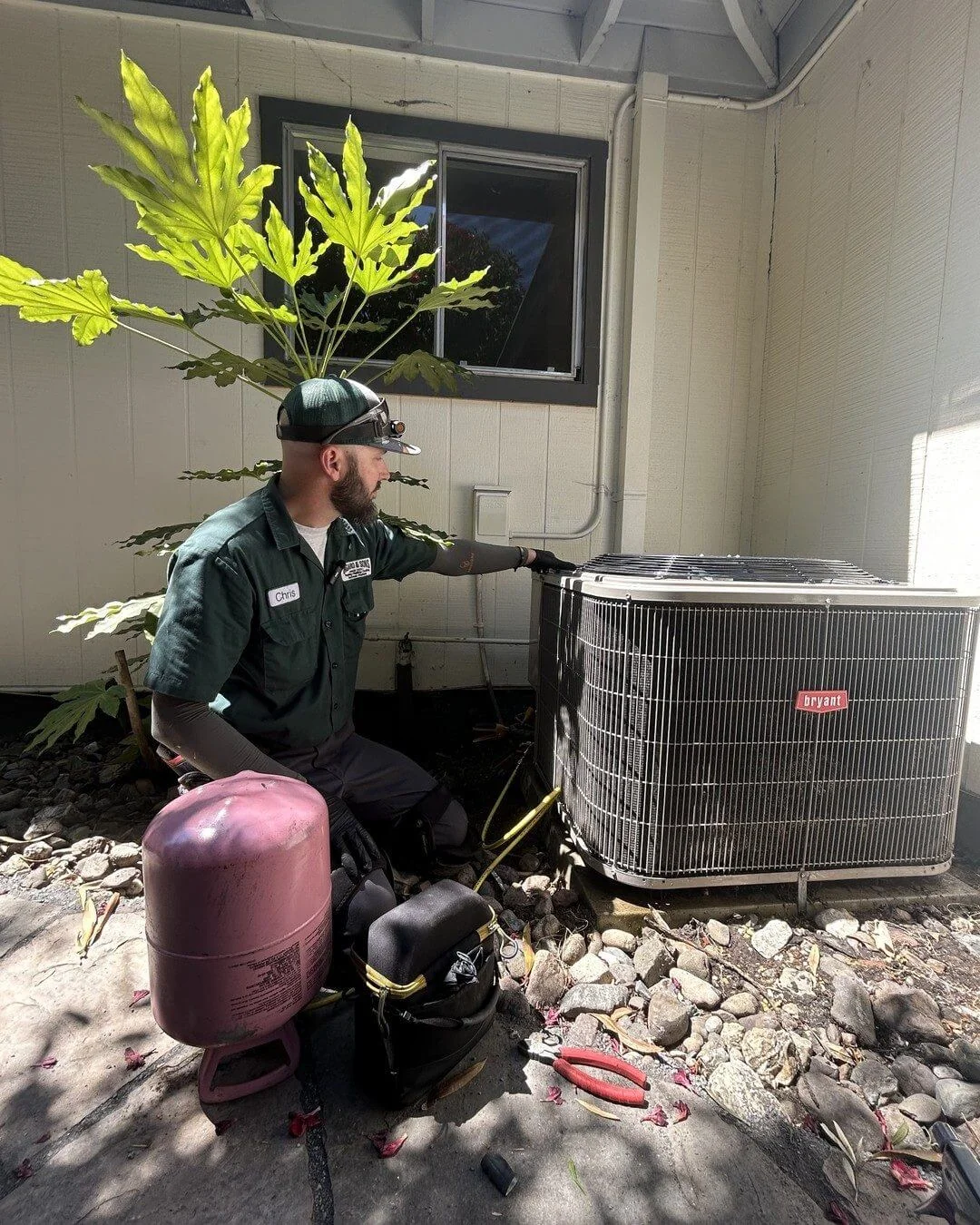
Refrigerant also decides a lot of Santa Rosa repairs. If a system went in before roughly 2010 it very likely runs on R-22, whose production and import in the United States ended in 2020, leaving only reclaimed or stockpiled supply for repairs. A significant leak on an R-22 system usually settles the repair-or-replace question by itself. Newer equipment uses R-410A, which is being phased down under the federal AIM Act as new residential equipment moves to lower global warming potential refrigerants, under a 700 GWP limit on newly manufactured residential and light commercial equipment. An existing R-410A system does not need replacing, and we service that equipment daily. It is simply context worth having before authorizing a large repair on a system already past twelve or fourteen years.
On time, very nice technician, cleaned up after himself and my hvac works again.
Jeanie M.
The whole-house sequence
Homeowners want a rule for when to replace. There is not one clean rule, but there is an order, and in Santa Rosa it runs through four questions rather than one.
One: what failed, and what does that component cost you to fix. A capacitor on a twelve-year-old system is a repair. A compressor, a heat exchanger, or a leaking evaporator coil on that same system usually is not. The component matters more than the calendar until the two disagree.
Two: what else in the mechanical room is the same age. This is the question that separates a Santa Rosa decision from a generic one. The furnace, the air conditioner, the water heater, and often the panel were installed within a few years of each other, which means they will reach the end of their lives within a few years of each other. Deciding one at a time, under pressure, is how homeowners end up paying for the same access three times.
Three: what your electrical service can carry. Every electric replacement path, heat pump or otherwise, lands on the same busbar as the range, the dryer, and increasingly an EV charger. This one gets its own section below, because it decides more Santa Rosa projects than any other technical factor.
Four: what the regulatory calendar says. Not as a reason to replace working equipment, but as information about what will be available and required when the equipment you have does reach the end of its life.
Most decisions resolve on question one or two. Questions three and four exist so the answer still looks right in five years.
The regulatory calendar, stated accurately
Santa Rosa sits fully inside the Bay Area Air Quality Management District, and the district has adopted zero-NOx standards for residential building appliances on a phased schedule. Water heaters fall under Regulation 9, Rule 6, amended in 2023, with residential standards that arrive by size and equipment type across 2027 and 2031, and that the district says apply "only upon burn out of one's current equipment".
The district itself puts it plainly: "These new requirements apply only upon burn out of one's current equipment. Additionally, any equipment manufactured after the new implementation date will be subject to the new standards." Nobody in Santa Rosa is being told to remove a working furnace. What changes is what may be manufactured and installed once your existing equipment reaches the end of its life.
The rule is also still moving, which is one more reason we confirm the requirement at project time rather than quoting last year's version.
The geography is the part contractors get wrong. This does not apply uniformly across Sonoma County. Cloverdale, Healdsburg, Guerneville, and the rest of northern Sonoma County sit in the Northern Sonoma County Air Pollution Control District, where the Bay Area appliance rules do not reach, and Windsor and Sebastopol straddle the boundary. Santa Rosa is entirely inside it, per the county's published district boundaries. If a bid tells you the rule applies countywide, it has not been checked.
Electrical capacity is the factor that decides most Santa Rosa projects
If ductwork decides whether a heat pump performs, electrical service decides whether the project happens at all, and on a whole-house view it is the constraint that ties every other decision together.
A rebuild-era home in Coffey Park or Fountaingrove generally carries modern service with room to spare, so an electric heating and cooling path is an equipment conversation. A 1965 tract house on the east side is a different exercise. A hundred-amp panel already committed to a range, a dryer, and increasingly an EV charger does not have obvious room for a heat pump, and it certainly does not have room for a heat pump and a heat pump water heater added a year apart without anyone running the numbers.
That is a load calculation, not a guess, and the order it is done in matters. A homeowner who adds an EV charger this year, converts the water heater next year, and then wants a heat pump the year after can end up paying for a service upgrade that a single planned sequence would have sized once. This is the practical argument for scoping the mechanical and the electrical together rather than separately.
Because we hold a C-20 HVAC license, a C-10 electrical license, and a C-36 plumbing license, that scoping happens inside one company. Panel capacity gets checked during the HVAC quote. If a service upgrade is genuinely needed it is one project, one schedule, and one permit conversation rather than two contractors coordinating around each other. See electrical panel upgrades in Santa Rosa if that is where your project is heading.
What drives the cost of HVAC work in Santa Rosa
We do not publish flat prices, because the same job title covers different work in this city. What moves the number:
What the visit is. A diagnosis and a repair, a maintenance visit, and an equipment replacement are three different scopes, and only the last one carries permits and testing.
The specific failure. A capacitor and a compressor are the two ends of a very wide range, which is why the diagnosis comes before the price rather than after it.
Refrigerant type and quantity. An R-22 system is materially more involved to service than a current-refrigerant system, for the supply reasons above, and larger systems hold more.
Equipment tier and configuration. Single-stage, two-stage, and fully modulating inverter equipment behave differently in this climate. Ducted, ductless single-zone, multi-zone, and hydronic are four different installations, not four prices for one thing.
What the duct system needs. Sealing to meet the code threshold, larger returns, replacing crushed or undersized runs, or in some houses a redesign. In older Santa Rosa housing this is the largest single variable.
Electrical scope. Circuit and disconnect only, or a load calculation and a service upgrade.
Access. An attic air handler in July, a tight closet, or rooftop equipment all take longer than a garage installation with the condenser on an open pad.
Permits, code compliance, and field verification. These belong in the quote rather than appearing after it, and a bid that omits them is incomplete rather than cheaper.
You are told the cost before the job begins, and a replacement can be paid over time.
Permits, the energy code, and who verifies the work
Straightforward repairs do not require a permit. Replacing equipment does. The City of Santa Rosa requires a permit to "erect, install, enlarge, alter, repair, remove, convert or replace any electrical, gas, mechanical or plumbing system," and the Building Division takes applications through its online Accela portal or in person at City Hall by appointment. Properties in the surrounding unincorporated county permit through Permit Sonoma instead.
Two details from the city are worth knowing before you gather bids. The first is convenient: "A single building permit application may be filed for all work on a project, including building, electrical, mechanical, and plumbing," which is precisely why a heat pump conversion that also needs a circuit or a panel upgrade does not have to become two separate permit tracks. The second is a filter: "Only properly licensed contractors or owner-builders may obtain building permits," and contractors working inside city limits are required to hold an active City of Santa Rosa Business License. A company doing this work should pull the permit under its own license as a matter of course.
Permitted HVAC work also carries an energy code dimension that changed this year. California's 2025 Building Energy Efficiency Standards took effect January 1, 2026, and field verification moved with them. The California Energy Commission's Energy Code Compliance Program "is used to demonstrate compliance with all versions of the Energy Code when required for residential building projects," it "replaces the HERS Program," and it "becomes effective with the 2025 Energy Code, which is expected to take effect on January 1, 2026." In practice that means duct leakage verification, refrigerant charge verification, and fan airflow and watt draw testing on many residential HVAC alterations, performed by a third party independent of the installing contractor and registered through the ECC Program.
That independence is worth something to you. Somebody other than the company that installed your system verifies that it was charged correctly and that the ducts seal. We pull the permits and coordinate the verification on the jobs that require it.
Rebates and incentives for Santa Rosa homeowners
Repairs do not carry rebates. Replacements can, and Sonoma Clean Power is the community choice energy provider for Sonoma County.
Sonoma Clean Power rebates heat pump space conditioning in four categories: ducted central split or packaged systems, ductless single-zone, multi-zone, and air-to-water hydronic, each with its own minimum SEER2 efficiency threshold. The eligibility details are where projects get tripped up. Read the conditions before the amount. The address must be an SCP account, a dual fuel system is ineligible, and new construction is outside the program apart from rebuilds. "Rebate applications must be submitted no more than 90 days after project completion," and documentation includes the finalized permit and the AHRI certificate, which is one more reason an unpermitted installation costs money rather than saving it. Customers enrolled in the CARE or FERA bill discount programs qualify for enhanced rebates covering a share of the project cost remaining after other rebates are applied.
Maintenance that earns its keep on this duty cycle
Generic maintenance advice is written for equipment that runs a few hundred hours a year. Santa Rosa equipment runs a great deal more than that, and the calendar here has two distinct halves.
Before summer, the work is airflow and heat rejection. Rinse the outdoor coil, because dust and cottonwood pack condenser fins in this valley and a blocked coil raises the operating temperature of every component behind it. Clear two feet around the condenser, since landscaping and new fencing grow into that clearance a little every year. Change the filter, have the condensate drain cleared before it matters, and run the system in April or May rather than discovering a fault in August. A problem found in spring is an appointment on your schedule. The same problem found during the first extreme week is a wait behind everyone else who postponed.
Before winter, the work is combustion and controls. A furnace tune-up checks the heat exchanger, the burners, the ignition and flame sensing, the venting, and the safety controls, and those are the items where a deferred inspection is a safety question rather than an efficiency one. It is also the right moment to reset filter habits, since heating season in Sonoma County overlaps the tail of fire season more often than anyone would like.
Year round, two things pay for themselves. Change filters on the system's actual schedule rather than the one on the box, because a filter in a house running eight hours a day does not last what a filter in a mild climate lasts. And treat any change in sound, run time, or comfort as the system talking while the repair is still small.
Power outages, and what they mean for an all-electric plan
Santa Rosa lived through the 2017 Tubbs Fire and the 2019 Kincade Fire, and PG&E Public Safety Power Shutoffs remain a regular part of the fire season in the hill neighborhoods. That belongs in the planning for any conversion away from gas heating, because an all-electric system heats, cools, and filters only while the power is on. It is also the season when the filtration side of the system matters most, which is the uncomfortable overlap: the days you most want the fan running are the days the power is least reliable.
There are real answers. Standby generation, battery storage, and solar paired with storage all keep a system running through an outage, and sizing them is an engineering exercise rather than a brochure choice. We are a Certified Generac Generator installer and hold a C-10 electrical license alongside the C-20, so backup power can be designed into the same project rather than bolted on later by someone else. See solar and battery storage in Santa Rosa if that is part of the plan.
Where we work in Santa Rosa
We serve every Santa Rosa neighborhood from our Petaluma headquarters, including Coffey Park, Fountaingrove, Rincon Valley, and Bennett Valley, along with Roseland and the surrounding unincorporated areas that permit through Permit Sonoma. That covers both ends of this city's housing: newer, frequently all-electric rebuild homes on one side, and postwar and 1960s tract houses with original ducts and dated panels on the other.
Scheduling is worth a word, because it is different in this market. Demand here is spiky rather than steady. Cooling work booked in spring and heating work booked in early fall get the appointment you want; the same request made during the first extreme week of a season goes into a queue behind every other household in the county.
How to choose an HVAC company in Santa Rosa
Ask what the diagnosis includes. A real visit measures refrigerant pressures, checks the electrical components, looks at both coils, and evaluates airflow before naming a failed part. A company that condemns a compressor without checking charge, airflow, and electrical is guessing.
Ask what refrigerant your system uses and what that means for your decision. If they cannot answer, they have not read the nameplate, and the most decisive factor in your repair-or-replace question is missing from their recommendation.
Ask whether they measured static pressure, particularly if anyone has recommended a thicker filter or a heat pump conversion. In this city's older ducted housing that measurement is the difference between a proposal and a price sheet.
Ask which permits your scope requires, whether they hold an active City of Santa Rosa Business License, and how the energy code verification will be handled and registered. A bid that omits those is not cheaper, it is incomplete.
Ask what the air district rules say. A company working in Santa Rosa should be able to explain the phased dates accurately, including that the requirements apply on burnout rather than to working equipment, and that the boundary does not cover all of Sonoma County.
We have answered questions like these the same way since 1932: look at the actual house, measure what needs measuring, explain what we find, price it before we start, and do the work to code. Ongaro & Sons is Diamond Certified, a Mitsubishi Diamond Contractor Elite, a Trane Comfort Specialist, and BBB A+ rated.
HVAC and home services across Santa Rosa and Sonoma County
One company, all trades: Santa Rosa home services, heating and cooling across Sonoma County, Santa Rosa plumbing, Santa Rosa electrical, and Santa Rosa solar. Specific Santa Rosa heating and cooling services: AC repair, furnace repair, and heat pump installation. Related work: electrical panel upgrades, EV charger installation, and water heaters. Nearby HVAC: Petaluma, Rohnert Park, Windsor, and Sebastopol.
Book HVAC service in Santa Rosa
Book online any time, or call during office hours and talk it through with a person first. An Ongaro & Sons technician will look at the whole system, explain what it needs, and give you the price before any work begins.
Your Comfort, Our Priority
Ongaro & Sons is your trusted heating, cooling, plumbing, electrical, and solar expert, specializing in reliable maintenance and repair services that keep your home running efficiently year-round.
Our certified technicians deliver unmatched expertise with fast, friendly service across Marin, Sonoma and Napa County. From HVAC tune-ups to plumbing repairs and electrical upgrades or solar solutions, we focus on energy-efficient performance and long-term comfort. Count on us to maintain the systems that power your home and keep your environment just the way you like it.
Licensed, Insured, Background-Checked
Our technicians are licensed, experienced, and trained to service all makes and models.
Locally Owned and Operated
Serving the Napa, Marin, and Sonoma communities with personalized, hometown service.
Reliable Repairs
We respond quickly and get the job done right the first time, with no surprises.
Since 1932
Why Ongaro & Sons?
Four generations of trusted home service. Open any reason to see what it means for your home.
Schedule Service →Family-owned in the North Bay since 1932
Four generations of the Ongaro family serving Marin, Sonoma and Napa County. We know these homes and the systems in them.
Licensed, insured, background-checked technicians
Every technician is fully licensed and insured, background-checked, and trained on the equipment we install.
Diamond Certified and BBB A+
Diamond Certified since October 2016, and BBB Accredited with an A+ rating since December 1995.
Mitsubishi Diamond Contractor Elite and Trane Comfort Specialist
Both top manufacturer tiers. That standing decides how registration and extended warranty terms are handled on the system you actually bought.
The price is agreed before work starts
You see the number before the work begins. Flat-rate quotes, no surprises and no pressure.
Comprehensive maintenance program
Members get priority scheduling, discounts, and proactive checkups that prevent costly failures.
Discount
Membership
Ongaro Maintenance Plans
Annual maintenance on your home systems provides safeguards and comfort to you and your family. Members get priority scheduling, discounts, and proactive checkups that catch problems early.
Member Discounts
5% off every repair and replacement, all year long.
Peace of Mind
Proactive checkups catch issues before they become big problems.
Courtesy Reminders
We call you to schedule: never miss a seasonal service.
Value That Lasts
With Ongaro & Sons, you’re investing in quality, integrity, and service that stands the test of time. Explore our current promotions and see the difference real value makes for your HVAC, plumbing, and electrical needs.


From the Blog
 Sep 17, 2026
How Many Amps Does My House Need? Sizing Service for What You Actually Run
How many amps your house needs comes from a load calculation of what you run and plan to add. What drives the number, when existing service is enough, and more.
Read More Sep 10, 2026
Hard Water in Marin County: What Is Actually in Your Water and What It Does
Hard water in Marin County varies by provider and source. The 2025 report figures for Marin Water and NMWD, what hardness does and does not mean, and options.
Read More Sep 3, 2026
Electrical Permit Requirements in California: What Needs One and What Does Not
Find out which electrical projects commonly need permits, how to confirm local exemptions, and what to ask before work begins in Marin, Sonoma or Napa County.
Read MoreHVAC in Santa Rosa: frequently asked questions
Who is the best HVAC company in Santa Rosa?
Ongaro & Sons has worked in the North Bay since 1932 and is Diamond Certified, a Mitsubishi Diamond Contractor Elite and a Trane Comfort Specialist, holding C-20 HVAC, C-10 electrical, and C-36 plumbing licenses, with 4.8 stars across 2,756 Google reviews and a BBB A+ rating. We diagnose the whole system before quoting, pull the permit, coordinate the energy code verification, and give you the full price before starting.
Does Santa Rosa's climate change what HVAC my home needs?
Yes, and more than most people expect. Inland Sonoma County runs into triple-digit afternoons all summer while winter demand is comparatively modest, so the cooling load is usually the larger of the two numbers. Equipment specified for a coastal climate underperforms here. We size to Santa Rosa's design conditions and to your specific house rather than to a county-wide average or to the tonnage of whatever is currently installed.
Should I repair or replace my Santa Rosa heating and cooling system?
Work it in order: what failed, what else in the mechanical room is the same age, what your electrical service can carry, and what the regulatory calendar says. A capacitor on a twelve-year-old system is a repair. Anything in the sealed system or the combustion path on that same machine is a replacement conversation, whatever the part costs on its own. Under about ten years with a minor failure, repair. Past fifteen in this climate, most systems have already given you their good years.
Do I need a permit for HVAC work in Santa Rosa?
Not for a straightforward repair. Equipment replacement does require one. The City of Santa Rosa requires a permit to "erect, install, enlarge, alter, repair, remove, convert or replace any electrical, gas, mechanical or plumbing system," a single application can cover the mechanical and electrical work together, and contractors working in city limits need an active City of Santa Rosa Business License. Unincorporated properties permit through Permit Sonoma. We take care of the permit and attend the inspection.
What filter should I use during smoke season?
The EPA suggests upgrading "to a MERV 13 or higher rated filter if your system can accommodate it," and that last clause is the part that matters. A higher-MERV filter adds resistance, and a duct system already fighting undersized returns can lose enough airflow to ice a coil or overwork a blower. Have static pressure measured first. Where a one-inch slot cannot carry a better filter, a deeper media cabinet or in-duct filtration usually can, because it adds surface area instead of resistance.
What should I do with my HVAC system when the air quality is bad?
The EPA's guidance is to close a fresh air intake or switch the system to recirculate, make sure the filter fits snugly and is in good condition, run the fan on "On" rather than "Auto" to keep moving air through the filter, and replace filters more often than the manufacturer's normal schedule during heavy smoke. Sealing leaky return ducts matters too, since a leaking return pulls unfiltered outside air in behind your filter.
Will gas furnaces be banned in Santa Rosa?
Not in the way that phrase suggests. Santa Rosa is inside the Bay Area Air Quality Management District, which has adopted zero-NOx standards for residential building appliances with implementation "beginning in 2027, 2029, and 2031, depending on size and equipment type," and furnaces under Rule 9-4 on a 2029 compliance date. We confirm the current requirement at the time of your project.
Do the air district rules apply everywhere in Sonoma County?
No, and it is a common mistake. Santa Rosa is fully inside BAAQMD. Head north and it changes. The upper county, Cloverdale and Healdsburg and Guerneville among it, answers to the Northern Sonoma County Air Pollution Control District, whose appliance rules are not BAAQMD's. Windsor and Sebastopol sit on the line itself, so the answer there depends on the parcel. The county publishes the district boundaries.
Do you install heat pumps in Santa Rosa?
Yes, ducted, ductless single-zone, multi-zone, and air-to-water hydronic. A heat pump replaces the furnace and the air conditioner with one machine, and that is the reason it comes up so often when both are aging. We run a load calculation and assess the duct system and the electrical panel before specifying equipment, because in this city's older housing those two things decide whether the system performs. As a Mitsubishi Diamond Contractor Elite we install and service this equipment throughout Santa Rosa.
Will a new system require an electrical panel upgrade?
It depends on the house, and it is worth finding out during the quote rather than on installation day. Fire rebuild homes generally have modern service with capacity to spare. A 1960s tract home with a hundred-amp panel already carrying a range, a dryer, and an EV charger often needs a load calculation and sometimes a service upgrade. We check capacity as part of the HVAC quote, and because we hold a C-10 electrical license, any panel work happens inside the same project.
What rebates are available for a new HVAC system in Santa Rosa?
Sonoma Clean Power rebates ducted, ductless single-zone, multi-zone, and hydronic heat pump systems that meet its minimum SEER2 thresholds, with enhanced rebates for customers enrolled in CARE or FERA. Read the conditions before the number. The address must be on an SCP account, a dual fuel system is out, and new construction is excluded "with the exception of fire rebuilds," and applications must be submitted no more than 90 days after project completion with the finalized permit and AHRI certificate.
Why do some rooms never get comfortable no matter what we do to the system?
Because it is usually distribution rather than equipment. Undersized or leaking ducts, inadequate returns, and static pressure the blower cannot overcome produce exactly that complaint, and a perfect repair to the outdoor unit will not change it. We measure airflow rather than assume, and we will tell you when the answer is duct work.
Will you service a Santa Rosa system another company installed?
Yes. We repair and maintain equipment across the major brands regardless of who installed it, including the inverter-driven and variable-capacity systems common in the rebuild neighborhoods, and we tell you what we find rather than what the previous installer said.
Should backup power be part of an HVAC project in Santa Rosa?
It is worth discussing here. Public Safety Power Shutoffs are a regular reality in the hill neighborhoods, and an electric heating and cooling system stops working, including its filtration, when the power does. Standby generation, battery storage, or solar with storage all address it. We are a Certified Generac Generator installer and hold a C-10 electrical license, so that side can be designed as part of the same project and the same schedule.