AC Repair in San Rafael
Ongaro & Sons is the AC repair company San Rafael homeowners call when they want the fault found before a part is sold. We have been in Marin since the company opened in Fairfax in 1932, we are Diamond Certified, we hold a C-20 HVAC license, we are a Mitsubishi Diamond Contractor Elite, and we carry 2,756 Google reviews averaging 4.8 stars. We test the whole system before quoting a part, and you see the price before any work begins.
On this page
Why AC repair in San Rafael is its own problem
Most air conditioning advice is written for a house that cools hard for four or five months a year. San Rafael is not that house, and the difference changes what fails, what is worth fixing, and when you should be calling.
Start with the hill. Terra Linda, Lucas Valley, and the northern neighborhoods sit past Puerto Suello Hill and see the most consistent warmth in the city. Bayside neighborhoods like Peacock Gap catch afternoon air off the bay and stay meaningfully cooler on the same afternoon. Two houses ten minutes apart can have genuinely different cooling loads, which is why a system sized off square footage alone will be right for one of them and wrong for the other. When a homeowner in Terra Linda tells us the system runs all afternoon and never quite catches up, the fault is often not a fault at all. It is a design that borrowed a bayside assumption.
Then there is how little the equipment actually runs. A San Rafael air conditioner typically sits from October through May and is asked to perform on the first warm week of the year. That produces a specific failure pattern we see here far more than in the hot inland parts of our service area: the system did not wear out, it sat. Capacitors age out while idle, contactor points corrode, fan motor bearings lose their lubrication film, and rodents make a home in an outdoor unit nobody has opened since last summer. All of it stays hidden until load is applied, which is exactly the week every HVAC calendar in Marin is full.
The third factor is the housing itself. Much of San Rafael's stock is detached homes from around the late 1960s, and that includes the Eichlers of Terra Linda and Lucas Valley: concrete slabs with radiant heating cast into the floor, post-and-beam ceilings, flat or low-slope roofs, and no attic and no duct chase. Central air was never part of that design. For those owners, "fix my AC" is usually a ductless conversation rather than a repair to a ducted system that does not exist. A contractor who only works on conventional split systems is not equipped for a large share of this city.
Finally, air near the water is harder on equipment than run hours suggest. Bayside condensers corrode at the electrical connections and on the coil fins while sitting perfectly still, so a unit in Peacock Gap can look older inside than a unit of the same age north of the hill.
What the air district rules touch, and what they do not
San Rafael sits fully inside the Bay Area Air Quality Management District, and the appliance rules people have been hearing about matter less to an air conditioner than most homeowners expect.
Those rules govern nitrogen oxide emissions from combustion equipment. An air conditioner burns nothing. Neither does a heat pump. Nothing in the district's building appliance program regulates the cooling side of your system, so a compressor, a coil, a capacitor, or a refrigerant leak is a straightforward mechanical decision with no compliance clock attached.
The gas equipment sharing the same system is where the calendar lives. That is worth knowing because in a conventional split system the evaporator coil sits on the furnace, so the two often get replaced together, and a district date that has nothing to say about your cooling can still shape the project the cooling failure starts.
San Rafael has also legislated on its own, and the history is worth knowing because it still gets repeated incorrectly. The city adopted an all-electric building code in December 2022 and, in its own words, "has since repealed the all-electric portion of the building code due to a 9th Circuit Court ruling against the City of Berkeley." What remains is real: the city's green building and electrification page describes May 2024 codes "that address reductions in energy in existing homes," a streamlined FlexPath for single-family remodels, and the 2025 codes that took effect January 1, 2026.
The practical takeaway for a repair call is short. Nobody is going to require you to electrify because your condenser stopped working. If the conversation becomes a full system replacement, or your project is part of a remodel, the code path is worth confirming before you plan around anything you heard secondhand.
The symptoms, in the order the season produces them
The first warm week. The system does nothing, or the outdoor unit hums without the fan turning. That hum is close to a signature here. It usually means a run capacitor that quietly aged out over nine idle months. A scraping or rattling condenser on first startup is debris, a nest, or a bearing announcing itself, and it is far cheaper to answer in May than in July.
The first real heat spell. The system runs continuously and the house never reaches setpoint. North of Puerto Suello Hill this is often capacity rather than a broken part. It can also be low refrigerant, a dirty coil, or an airflow restriction, and those are distinguishable with instruments rather than opinion.
Midseason. Short cycling, meaning the system starts and stops without completing a cooling cycle, points at electrical controls, airflow, or an oversized system fighting itself. Ice on the refrigerant lines or the indoor coil is always downstream of something else: low charge from a leak, or restricted airflow from a filter or coil. Melting the ice fixes nothing.
Any time. Water around the indoor equipment means the condensate drain is blocked. In San Rafael's slab-on-grade homes that water goes into flooring rather than showing up on a ceiling below, so it tends to be discovered later and cost more.
Late in the season. A summer electric bill that jumped without a change in habits usually means the system is working harder for the same output: a fouled coil, a failing capacitor, a charge problem, or duct losses.
Needed bid on replacing air conditioning and furnace. Nick was able to come out that morning. Appreciate the responsiveness and Nick was very thorough in his work up.
Thomas W.
What fails on a system that mostly sits
Component failure here skews differently from a high-run-hour market, and knowing the pattern changes what a technician should check first.
The idle-season electrical group. Capacitors, contactors, and relays account for a large share of San Rafael calls. In hot climates capacitors die from sustained heat. Here they die from age and disuse, which means a system that runs a couple hundred hours a year can still need one at year eight. Contactors fail differently: the points pit and corrode, and near the bay that corrosion accelerates. Both are inexpensive parts relative to the rest of the system and both are proper repairs at almost any equipment age.
Motors and bearings. A condenser fan motor or blower motor that sits for most of the year can seize, scream on startup, or draw high amperage without quite failing. Amperage draw under load tells you which, and it is measurable rather than a judgment call.
Pest and debris damage. Idle outdoor equipment is shelter. Chewed low-voltage wiring and nesting material in the condenser are routine findings in the first inspection of the season, and they are the reason we open the unit rather than diagnosing from the thermostat.
Refrigerant leaks. Refrigerant is not consumed. If a system is low, it is leaking somewhere, and on a lightly used system a slow leak can hide for years. Adding refrigerant without locating the leak is buying the same repair again next summer. The charge should be measured against the manufacturer's target, not topped off by feel.
The indoor half. This is the part homeowners rarely see and the part that decides comfort more often than the condenser does. The evaporator coil, the blower, the filter, and the condensate path all live indoors, frequently in a closet shared with other equipment, and the coil is the surface where airflow problems become ice.
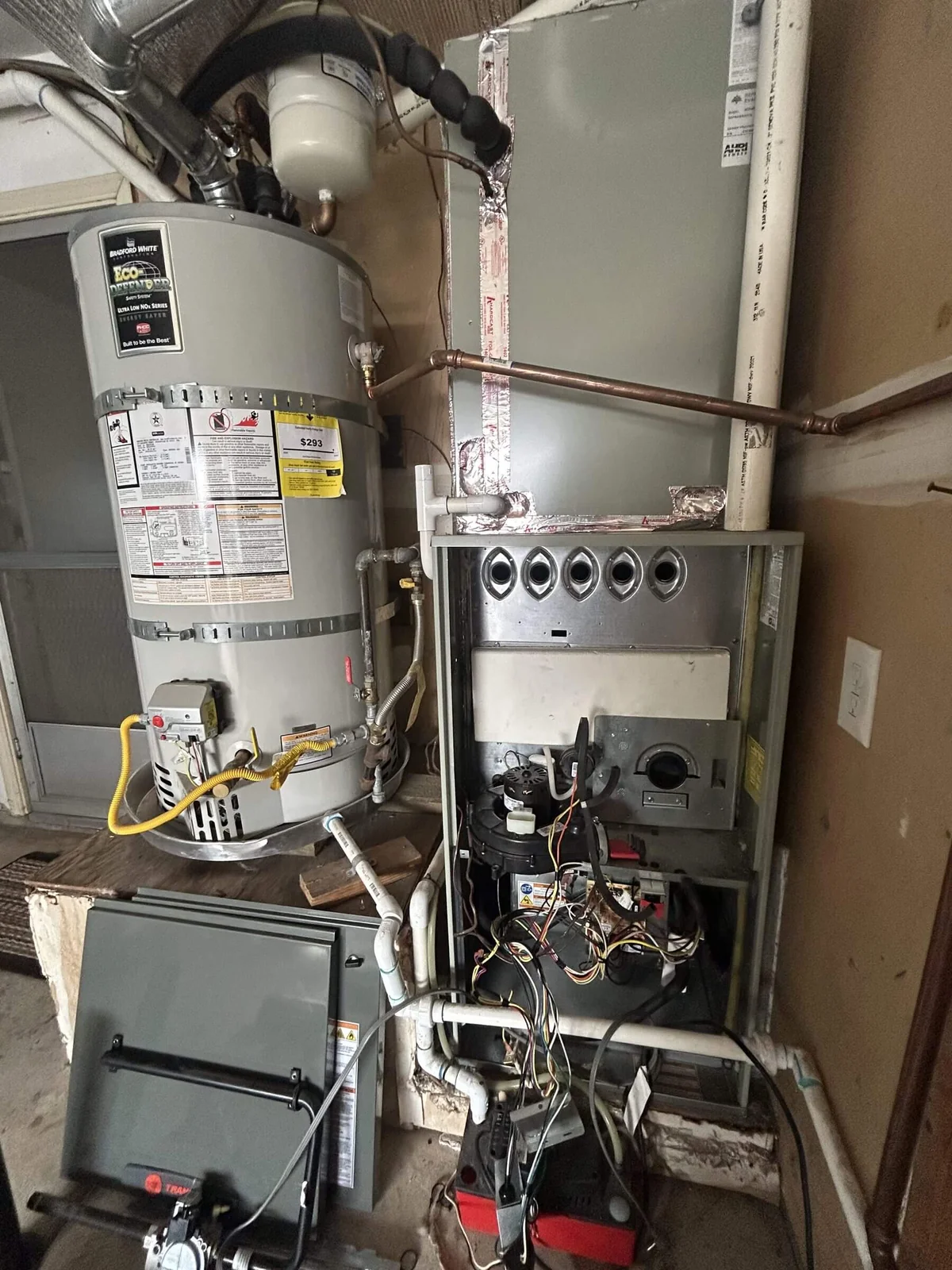
Shared closets are common in this housing stock, and they are worth understanding before work starts. Combustion equipment in that space needs its own air, clearances have to be maintained, and a coil replacement or an air handler swap has to respect both. When a closet is tight, access is a real part of the job rather than an afterthought.
Compressors. Less common here than in markets that run all summer, and usually decisive when they happen. On an older San Rafael system, a failed compressor almost always favors replacement.
The Eichler and ductless reality
For a meaningful share of San Rafael, this section is the whole answer.
Eichler homes in Terra Linda and Lucas Valley were built on slabs with radiant heat cast into the floor, and that radiant system is now more than sixty years old. There is no attic, no duct chase, and no ducted system to repair. Where cooling exists, it is almost always a ductless mini-split. Where it does not, adding it means a ductless design rather than "installing central air."
What we find on ductless equipment in these homes:
- One indoor head asked to cool the whole house. No repair fixes an undersized design. That is a zoning discussion, not a parts discussion.
- Filter neglect. Ductless heads have washable filters that are easy to forget, and a loaded filter degrades performance quickly.
- Condensate problems. Wall-mounted heads drain by gravity, and a line that clogs or was pitched wrong announces itself as water on an interior wall.
- Placement and access. Outdoor units on flat roofs or in tight side yards were often sited without thinking about service access or noise, which affects both maintenance and what a repair costs.
As a Mitsubishi Diamond Contractor Elite we work on ductless systems constantly, and we service them regardless of who installed them. If the conversation turns toward adding or expanding cooling, our Eichler home services page covers the whole picture, including the radiant heating and the electrical capacity that comes with it.
Repair or replace starts with run hours
The familiar advice, replace at fifteen years, was written for climates where a system runs half the year. San Rafael needs a different frame, so we work through four questions in this order.
1. How many hours has this system run? Condition beats the date on the label. A twenty-year-old system in a bayside home that runs a few weeks a year can be mechanically healthier than a ten-year-old unit north of the hill that runs every afternoon. We judge what we measure.
2. What failed, specifically? Capacitors, contactors, fan motors, and condensate faults are repairs at nearly any age. Compressors and evaporator coils on an older system usually are not.
3. What refrigerant is in it? This one overrides the other three often enough that it gets its own section below.
4. Would you rebuild the same system? This is the San Rafael-specific question. If the ductwork is poor, or there is no ductwork at all, the real choice is not repair versus replace. It is repair versus moving to a heat pump that handles both heating and cooling and qualifies for incentives that a gas system does not. That is a different and usually better conversation, and it is the one worth having before you spend on a system you were already unhappy with.
Mark is very knowledgeable and gave us a few options for us to choose from and we felt very informed in making the right decision for our air conditioning system. We are very happy.
Marc M.
Refrigerant decides it more than anything else
If your system was installed before roughly 2010, it most likely runs R-22. Production and import of R-22 ended in the United States in 2020, so any R-22 used in a repair today comes from reclaimed or stockpiled supply. On a lightly used San Rafael system with a slow leak, this is frequently the fact that settles the decision: the equipment is mechanically sound, and recharging it still does not make sense.
Newer systems use R-410A, which is being phased down under the federal AIM Act as new residential equipment moves to lower global warming potential refrigerants, because newly manufactured residential and light commercial equipment has to sit under a 700 GWP limit. Your R-410A system does not need replacing and will be serviceable for years. It is simply worth being aware of which side of that line you are on before you authorize a large repair.
We identify the refrigerant in your system and explain what it means for the decision, because it changes the arithmetic more often than anything else on this page.
What drives the cost of AC repair in San Rafael
We do not publish flat repair prices, because the answer depends entirely on what failed. What moves the number:
The specific fault. A capacitor and a compressor are not variations on one job. Neither can be responsibly priced over the phone before anyone has tested the system.
Refrigerant type and quantity. R-22 service costs materially more than R-410A for the supply reasons above, and the amount a system holds varies.
System type. Ducted and ductless diagnostics diverge immediately, and a multi-head ductless system takes longer to test properly than a single condenser and coil.
Access. Roof-mounted equipment on a low-slope Eichler roof, a hillside placement, or a tight side yard all add time compared with a condenser sitting beside a garage.
What the repair does not solve. If the system was undersized for your side of the hill, or the ducts leak badly, a perfect repair still leaves you uncomfortable. We would rather say that before you pay than after.
You see the exact price before we begin, and financing is available on system replacements.
Permits, Title 24, and energy code verification
Component-level repairs generally do not require a permit. Equipment replacement does, and inside city limits it goes through the City of San Rafael Building Division. The city's building permits page puts work of this kind in its minor category, described as "Minor to No Plan Review Required (Reroof, Elect. Service, Water Heater, Furnace, etc)," and since February 23, 2026 all new permit applications are submitted through the city's OpenGov portal. Homes in the unincorporated areas around the city, including Marinwood and the county pockets north of Terra Linda, permit through the Marin County Community Development Agency instead. We confirm which authority covers your address before we file.
California's energy code applies on top of that. The 2025 Building Energy Efficiency Standards took effect January 1, 2026, and many residential HVAC alterations require independent field verification. That verification has just changed shape: the California Energy Commission notes that as of January 1, 2026 the compliance demonstration functions of the Home Energy Rating System program transitioned to the Energy Code Compliance Program under Title 24, Part 6. In the Commission's own words, "Depending on the work being done, HERS testing may be mandatory. Properly permitted work will trigger any necessary HERS testing," and "a homeowner has the right to find and hire a rater who is independent of the contractor."
Two things follow from that. A bid that quietly omits permitting and verification is not a cheaper bid, it is an incomplete one, and the gap tends to surface at resale. And the verification itself is a genuine quality check: it is a third party confirming your system was charged and your ducts sealed the way the paperwork claims. We pull permits and coordinate verification on the jobs that require it.
Rebates and incentives for San Rafael homeowners
Repairs do not carry rebates. If the conversation becomes a replacement, particularly a heat pump, incentives are worth mapping before you commit, and published advice on this dates quickly.
MCE is the community choice electricity provider for San Rafael and the rest of Marin, and it runs a residential rebate and incentive finder that accounts for household income and location. It is the right starting point for a Marin heat pump project.
A straight cooling repair attracts nothing at all, which is worth saying before you go looking. MCE's heat pump rebates reach cooling only when the equipment is a heat pump rather than an air conditioner, and the conditions are specific: twelve months of ownership and residency in a single-family detached home, a participating contractor who files the paperwork before installation, and, if the home already has solar or EV charging, that equipment must have been in place for at least twelve months.
Maintenance that matters in a low-run-hour city
- Run the system for an hour in May, before you need it. This is the highest-value item on this list in San Rafael. A fault found in spring is an appointment. The same fault found during a July heat spell is a wait.
- Open the outdoor unit after winter. Nests, debris, and chewed wiring are common in equipment that sat untouched for nine months.
- Rinse the coil, and rinse it more often near the bay. Salt-laden air and accumulated debris both cost capacity, and bayside equipment benefits more than inland equipment does.
- Change or wash filters before the season. Restricted airflow is the most common cause of a frozen coil, and it makes the compressor work harder for less cooling.
- Wash ductless head filters monthly while the system is in use. They are washable, easy to forget, and quick to choke performance.
- Keep two feet of clearance around the condenser. Vegetation and stored items both starve it of the air it needs to reject heat.
- Do not ignore a new sound. On lightly used equipment, a noise that was not there last year is usually a bearing or a contactor telling you it is finished.
Where we work in San Rafael
We serve every San Rafael neighborhood from our Petaluma headquarters, including Terra Linda, Lucas Valley, Peacock Gap, Sun Valley, Gerstle Park, and the Canal area, along with the unincorporated pockets north of the city. Because cooling demand here is compressed into a few weeks, the practical advice is to schedule anything you already suspect in spring rather than during the first heat spell.
Backup power belongs in the conversation for hillside addresses, and for an unobvious reason: a planned shutoff tends to land in exactly the weather that makes you want the air conditioner. PG&E de-energizes lines when wind, low humidity and dry fuel line up, which is a hot dry September afternoon rather than a cold January one. Cooling equipment runs on electricity and nothing else, so the outage and the demand arrive together. Holding the C-10 classification alongside the C-20, and being a Certified Generac Generator installer, means that conversation can happen once rather than across two companies and two schedules.
How to choose an AC repair company in San Rafael
Ask whether they diagnose the entire system before quoting a part, or arrive with a conclusion. A compressor quoted without measured refrigerant pressures, airflow, and electrical readings is a guess with a price on it.
Ask whether they work on ductless systems and Eichler homes, not only conventional ducted equipment. In this city that single question determines whether a company can help a large share of homeowners.
Ask what refrigerant your system uses and what that means for the repair. A company working in San Rafael should be able to answer that without hedging.
Ask whether they pull permits and coordinate energy code verification on replacements, or leave both out to look less expensive.
We have answered those the same way since 1932: test the system, show you what we found, price the work before doing it, and say plainly when a repair is not worth your money. We are Diamond Certified, a Trane Comfort Specialist and a Mitsubishi Diamond Contractor Elite, and BBB A+ rated.
AC repair and HVAC across San Rafael and Marin County
One company, all trades: San Rafael heating and cooling, HVAC across Marin County, San Rafael home services, San Rafael plumbing, and San Rafael electrical. Related San Rafael services: furnace repair, heat pump service, electrical panel upgrades, and Eichler home services.
Book AC repair in San Rafael
The quickest route is to book online. Calling during office hours works too if you would rather explain it first. An Ongaro & Sons technician will test your system, show you what failed, and give you the price before any work begins.
Your Comfort, Our Priority
Ongaro & Sons is your trusted heating, cooling, plumbing, electrical, and solar expert, specializing in reliable maintenance and repair services that keep your home running efficiently year-round.
Our certified technicians deliver unmatched expertise with fast, friendly service across Marin, Sonoma and Napa County. From HVAC tune-ups to plumbing repairs and electrical upgrades or solar solutions, we focus on energy-efficient performance and long-term comfort. Count on us to maintain the systems that power your home and keep your environment just the way you like it.
Licensed, Insured, Background-Checked
Our technicians are licensed, experienced, and trained to service all makes and models.
Locally Owned and Operated
Serving the Napa, Marin, and Sonoma communities with personalized, hometown service.
Reliable Repairs
We respond quickly and get the job done right the first time, with no surprises.
Since 1932
Why Ongaro & Sons?
Four generations of trusted home service. Open any reason to see what it means for your home.
Schedule Service →Family-owned in the North Bay since 1932
Four generations of the Ongaro family serving Marin, Sonoma and Napa County. We know these homes and the systems in them.
Licensed, insured, background-checked technicians
Every technician is fully licensed and insured, background-checked, and trained on the equipment we install.
Diamond Certified and BBB A+
Diamond Certified since October 2016, and BBB Accredited with an A+ rating since December 1995.
Mitsubishi Diamond Contractor Elite and Trane Comfort Specialist
Both top manufacturer tiers. That standing decides how registration and extended warranty terms are handled on the system you actually bought.
The price is agreed before work starts
You see the number before the work begins. Flat-rate quotes, no surprises and no pressure.
Comprehensive maintenance program
Members get priority scheduling, discounts, and proactive checkups that prevent costly failures.
Discount
Membership
Ongaro Maintenance Plans
Annual maintenance on your home systems provides safeguards and comfort to you and your family. Members get priority scheduling, discounts, and proactive checkups that catch problems early.
Member Discounts
5% off every repair and replacement, all year long.
Peace of Mind
Proactive checkups catch issues before they become big problems.
Courtesy Reminders
We call you to schedule: never miss a seasonal service.
Value That Lasts
With Ongaro & Sons, you’re investing in quality, integrity, and service that stands the test of time. Explore our current promotions and see the difference real value makes for your HVAC, plumbing, and electrical needs.


From the Blog
 Sep 17, 2026
How Many Amps Does My House Need? Sizing Service for What You Actually Run
How many amps your house needs comes from a load calculation of what you run and plan to add. What drives the number, when existing service is enough, and more.
Read More Sep 10, 2026
Hard Water in Marin County: What Is Actually in Your Water and What It Does
Hard water in Marin County varies by provider and source. The 2025 report figures for Marin Water and NMWD, what hardness does and does not mean, and options.
Read More Sep 3, 2026
Electrical Permit Requirements in California: What Needs One and What Does Not
Find out which electrical projects commonly need permits, how to confirm local exemptions, and what to ask before work begins in Marin, Sonoma or Napa County.
Read MoreAC repair in San Rafael: frequently asked questions
Who is the best AC repair company in San Rafael?
Ongaro & Sons has been in Marin since its 1932 founding and is Diamond Certified, with a C-20 HVAC license, a C-10 electrical license, and 4.8 stars across 2,756 Google reviews. We are a Mitsubishi Diamond Contractor Elite and a Trane Comfort Specialist, which matters in San Rafael because so many homes here cool with ductless systems rather than conventional ducted air conditioning. Nothing gets condemned on a hunch here, and nothing gets started before you have the number.
My AC worked last September and will not start now. What is wrong?
This is the most common call we get in San Rafael. Systems that sit from October through May most often fail at the capacitor, the contactor, or a fan motor bearing, and pests sometimes damage low-voltage wiring in an outdoor unit nobody has opened. It is usually a repair rather than a replacement, and it is much easier to schedule in spring than during the first heat spell.
Do I need a permit for AC work in San Rafael?
Not for a straightforward repair. Equipment replacement does require one. Inside city limits that goes through the City of San Rafael Building Division, which lists work of this type under "Minor to No Plan Review Required (Reroof, Elect. Service, Water Heater, Furnace, etc)" and has required all new applications to be submitted through its OpenGov portal since February 23, 2026. Unincorporated addresses permit through the Marin County Community Development Agency. We handle the permit as part of the job.
Does San Rafael's electrification code mean I cannot replace my gas furnace?
No. The city adopted an all-electric building code in December 2022 and states that it "has since repealed the all-electric portion of the building code due to a 9th Circuit Court ruling against the City of Berkeley." Its green building page describes the codes that remain, including May 2024 provisions addressing energy reductions in existing homes and the 2025 codes effective January 1, 2026. We confirm the requirements for your specific project rather than working from a general rule.
Do the Bay Area air district rules apply to my air conditioner?
No. Those rules regulate nitrogen oxide emissions from combustion equipment, and an air conditioner burns nothing. They reach the gas equipment in your home instead. Where it matters for a cooling project is the equipment on the other side of the system: if the furnace sharing your ductwork is due for replacement, the two decisions belong in one conversation rather than two.
Can you repair air conditioning in an Eichler?
Yes, and it is a specialty. Eichlers in Terra Linda and Lucas Valley sit on slabs with radiant heat in the floor and have no attic or duct chase, so cooling is almost always a ductless mini-split. We service ductless systems regardless of who installed them, and when the conversation turns to adding or expanding cooling we handle the design and the electrical work in the same project.
Should I repair or replace an air conditioner that barely gets used?
Run hours matter more than age here, so a lightly used older system can be worth keeping. The exceptions are compressor and evaporator coil failures, and R-22 systems with leaks, where refrigerant supply usually decides it. If your ductwork is poor or there is no ductwork at all, moving to a heat pump is often a better use of the money than repairing what is there.
What refrigerant does my system use and why does it matter?
Systems installed before roughly 2010 typically use R-22, which has not been produced or imported in the United States since 2020, so repairs that require it draw on reclaimed or stockpiled supply. Newer systems run on R-410A, and the AIM Act is stepping that down too, with a 700 GWP ceiling now applying to newly built residential and light commercial equipment. An existing R-410A system does not need replacing. We identify yours and explain the implications before you decide.
Why does my San Rafael AC freeze up?
Almost always low refrigerant from a leak, or restricted airflow from a loaded filter or a dirty coil. The ice is a symptom rather than the fault, so melting it changes nothing. We find the underlying cause, and if the charge is low we locate the leak instead of topping the system off.
Does living near the bay shorten the life of an air conditioner?
It can. Air near the water accelerates corrosion at electrical connections and on coil fins, so equipment in bayside neighborhoods often shows wear ahead of its run hours. Rinsing the coil regularly and catching a corroded contactor early make a real difference in how long that equipment lasts.
What is energy code verification and will my job need it?
California requires independent field verification on many residential HVAC alterations. As of January 1, 2026 the compliance functions of the HERS program moved to the Energy Code Compliance Program under Title 24, Part 6. The Energy Commission's guidance is that "Depending on the work being done, HERS testing may be mandatory. Properly permitted work will trigger any necessary HERS testing." The rater does not have to be one the contractor picked, either. Repairs generally do not trigger it. Replacements often do, and we coordinate it when it applies.
Are there rebates if I replace the system?
For heat pumps, sometimes. For an air conditioner repair or a like-for-like condenser swap, no. MCE serves San Rafael and runs heat pump rebates conditioned on twelve months of ownership and residency in a single-family detached home, a participating contractor filing the application, and no retroactive claims. So the incentive question really only opens up if you are switching technology rather than repairing what you have.
Does my part of San Rafael really need air conditioning?
It depends which side of Puerto Suello Hill you are on. Terra Linda, Lucas Valley, and the northern neighborhoods see the most consistent warmth and benefit clearly. Bayside areas like Peacock Gap catch cooling air off the water and often need considerably less capacity. We size to your address and how your house behaves rather than to a city-wide average.
Should backup power be part of an HVAC project here?
It is worth discussing if you are on one of San Rafael's hillsides, where elevated fire-hazard zones are subject to PG&E Public Safety Power Shutoffs. Cooling and heat pump equipment only runs while the power is on. Because we hold a C-10 electrical license and are a Certified Generac Generator installer, generator or battery backup can be folded into the same project.