How Long Does a Furnace Last? When to Repair and When to Replace
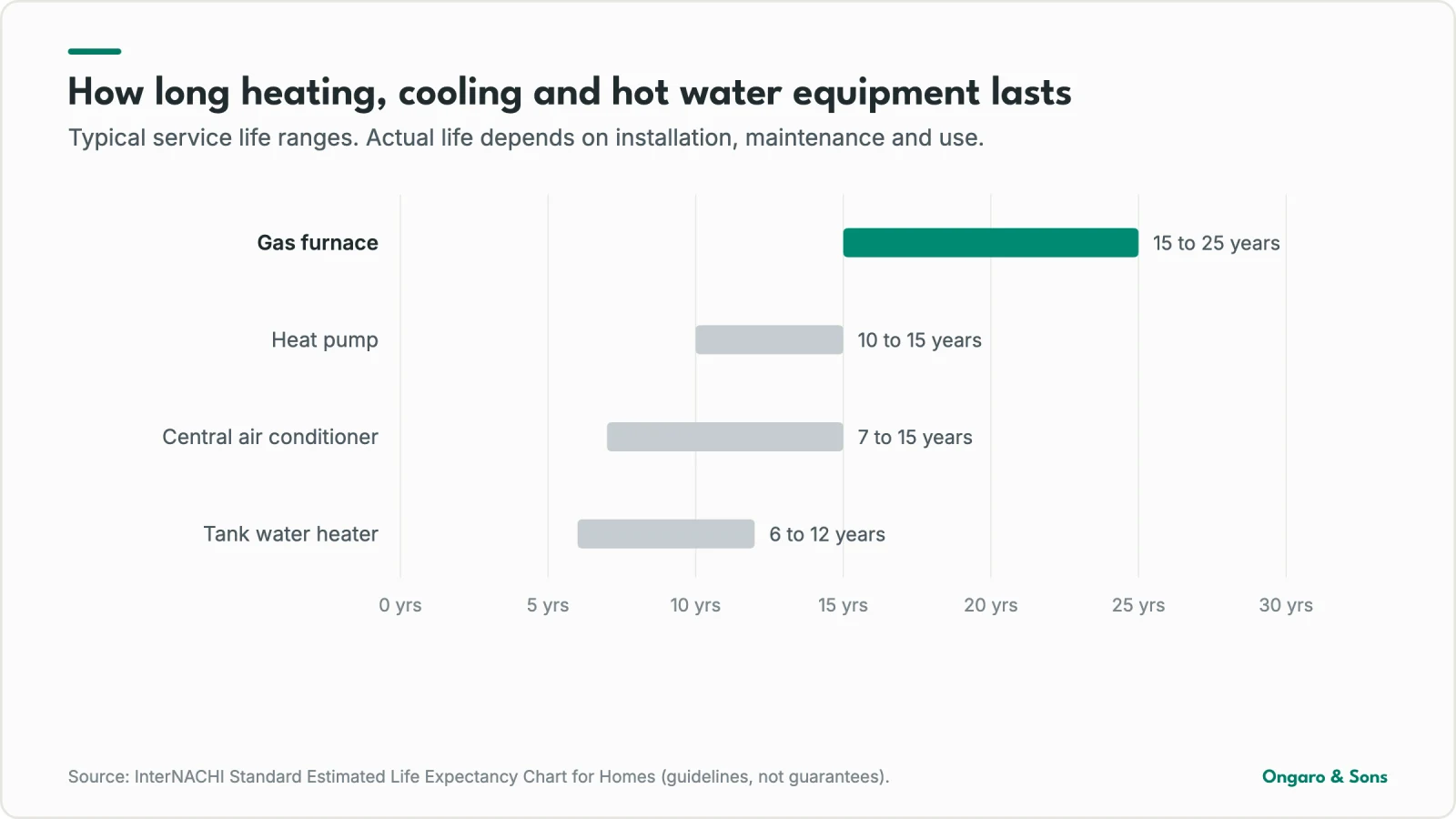
Most gas furnaces last 15 to 20 years, according to manufacturers including Trane and Bryant, and a well-maintained furnace can last longer. InterNACHI, the home inspectors' association, puts the range at 15 to 25 years. Age alone is not a reason to replace a furnace that runs safely. Age combined with a major repair, a safety problem or repeated breakdowns usually is.
Quick answer.
- Plan on 15 to 20 years for a gas furnace, and up to 25 with good maintenance.
- Under 10 years old, most repairs are worth making.
- Past 15 years, compare a replacement quote with any major repair quote before deciding.
- A cracked heat exchanger is usually a reason to replace.
- Plan a replacement before the furnace fails in the middle of winter.
North Bay winters are mild, so a furnace here runs fewer hours each year than one in Chicago or Minneapolis. Fewer hours generally mean less wear on the burners, blower and heat exchanger. A furnace in a dusty garage, on undersized ducts and a clogged filter, can still wear out early.
How Long Does a Gas Furnace Last?
InterNACHI's Standard Estimated Life Expectancy Chart for Homes puts furnaces at 15 to 25 years. The same chart gives shorter ranges for the equipment around a furnace. That matters because a furnace and an air conditioner often wear out on different schedules.
These factors push a furnace toward the short or long end of the range:
| Factor | Shortens life | Extends life |
|---|---|---|
| Factor Sizing | Shortens life An oversized unit that turns on and off in short cycles | Extends life Sized from a room-by-room load calculation |
| Factor Airflow | Shortens life Clogged filters, closed registers, undersized return ducts | Extends life Clean filters, open registers, ducts sized for the blower |
| Factor Maintenance | Shortens life No service for years | Extends life Annual inspection and cleaning before heating season |
| Factor Location | Shortens life Dusty garage, damp crawl space, cramped closet | Extends life Clean, dry, accessible space |
| Factor Installation | Shortens life Poor venting, wrong gas pressure, unsealed ducts | Extends life Installed and tested to the manufacturer's specifications |
Restricted airflow makes the heat exchanger run hotter than it was designed to, which stresses the metal over many heating seasons. Checking the filter is the simplest way to prevent it.
How Do You Tell How Old Your Furnace Is?
- Switch the furnace off at its service switch, which usually looks like a light switch on or near the unit.
- Remove the front panel and find the data plate, a label inside the cabinet or on its side.
- Read the manufacture date if the plate prints one.
- Decode the serial number if it does not. Most manufacturers encode the year and week of manufacture, and the code varies by brand, so check the manufacturer's website or call them.
- Check other records if the plate is unreadable: an installation sticker on or near the unit, service tags inside the door, a home inspection report, or the permit record at your city or county building department.
Manufacture date and install date can differ by a few months, but either one tells you where the furnace sits in its service life.
What Are the Signs a Furnace Needs Replacing?
One sign alone rarely decides it. Two or three together, on a furnace past 15 years, usually do.
First, two situations that are not a service call. If a carbon monoxide alarm sounds, do not look for the source. Get everyone outside to fresh air, call 911 from outside, and stay out until responders say it is safe to go back in, as the Consumer Product Safety Commission's CO alarm guidance advises. Do not run the furnace again until a technician has serviced it. If you smell gas, a rotten-egg odor, leave the house without turning lights or switches on or off, and call 911 and then PG&E from outside, following PG&E's gas safety guidance.
| Sign | What it can mean | What to do |
|---|---|---|
| Sign Cracked heat exchanger | What it can mean Combustion gases, including carbon monoxide, can mix with the air in your home | What to do Stop using the furnace. See the section on heat exchangers below |
| Sign More than one breakdown in a season | What it can mean Several parts are reaching the end of their life together | What to do Get repair and replacement quotes side by side |
| Sign Heating bills rising without a rate change | What it can mean Efficiency loss, duct problems or a failing part | What to do Have the system and ducts tested |
| Sign Rooms heating unevenly, or the furnace short cycling (turning on and off every few minutes) | What it can mean Sizing, airflow or control problems | What to do Diagnose first. This is not always a furnace problem |
| Sign Yellow or flickering burner flame, or soot around the burners | What it can mean A combustion problem | What to do Turn it off and call for service |
| Sign Rust or corrosion on the cabinet or vent | What it can mean Moisture or venting problems | What to do Have the venting and heat exchanger inspected |
| Sign Parts hard to find | What it can mean Older models may no longer have parts in production | What to do Ask how long parts will remain available |
If you are troubleshooting a furnace that will not start, our guide to safe furnace checks covers what you can look at yourself, and 7 warning signs you need heating repair covers symptoms that need a technician. If one or two of the signs above sound familiar, the next question is whether a repair is worth it.
Is It Worth Repairing an Older Furnace?
Two things decide most repair-or-replace calls: how old the furnace is and how big the repair is. Minor repairs are parts like the ignitor (which lights the burners), the flame sensor (which confirms they are lit), the capacitor and the thermostat. Major repairs are the blower motor, the control board and the inducer motor (which pushes exhaust out through the vent).
| Furnace age | Minor or major repair | Heat exchanger failure |
|---|---|---|
| Furnace age Under 10 years | Minor or major repair Minor: repair. Major: repair, and check warranty coverage first | Heat exchanger failure Check the heat exchanger warranty, which is often longer than parts coverage |
| Furnace age 10 to 15 years | Minor or major repair Minor: repair. Major: compare repair and replacement quotes | Heat exchanger failure Replace in most cases |
| Furnace age Over 15 years | Minor or major repair Minor: repair if the furnace is otherwise sound. Major: replacement is usually the better value | Heat exchanger failure Replace |
A common rule of thumb: if a repair would cost more than half the price of a new furnace, and the furnace is past 10 years old, replacement usually makes more sense.
For example, a 12-year-old furnace with a failed blower motor sits in the middle row, so ask for both a repair quote and a replacement quote. A 7-year-old furnace with the same failure sits in the top row, so repair it and check the warranty first.
Two more questions help: how many years do you plan to stay in the home, and do you also need air conditioning? If the air conditioner is close to the end of its life too, replacing both with a heat pump is an option to price. Our comparison of heat pumps and furnaces in the North Bay covers that choice.
Why Is a Cracked Heat Exchanger Usually a Reason to Replace?
The heat exchanger is the metal chamber that keeps combustion gases separate from the air your blower sends through the house. A crack can let those gases, including carbon monoxide, into your living space. Carbon monoxide has no color or smell. The Consumer Product Safety Commission's carbon monoxide information center recommends having heating systems inspected each year and installing CO alarms. California law requires carbon monoxide alarms in homes with gas appliances, a fireplace or an attached garage.
Replacing the heat exchanger on an older furnace costs a large part of a new furnace's price, and every other aging part stays in place. That is why replacement is usually the recommendation. A technician can show you camera images of the crack, the results of a combustion analysis, or both.
How Can You Make Your Current Furnace Last Longer?
- Schedule an annual check before heating season. ENERGY STAR's maintenance checklist recommends a pre-season checkup by a contractor, with the heating system checked in the fall.
- Check the filter monthly during heating season and replace it when it is dirty.
- Keep the area around the furnace clear. Storage boxes, paint and laundry do not belong near a burner or blocking a return.
- Keep supply and return registers open and unblocked. Closing registers in unused rooms raises pressure in the system.
- Test your CO alarms as the manufacturer's instructions direct, and replace each alarm by the age its maker recommends. Changing the clocks is an easy reminder.
A maintenance plan puts the annual visit on the calendar. Our article on whether an HVAC maintenance plan is worth it covers what a plan includes, and signs a furnace needs cleaning covers what to watch for between visits.
If You Are Replacing: How Much More Efficient Is a New Furnace?
Furnace efficiency is rated as AFUE (annual fuel utilization efficiency), the percentage of a year's fuel energy that becomes heat in your home. The first federal minimum, 78 percent AFUE, took effect in 1992. Today's standard gas furnaces must reach 80 percent, and high-efficiency condensing furnaces reach the upper 90s. ENERGY STAR's furnace guide says certified gas furnaces sold for California and other southern states are up to 16 percent more efficient than standard models.
The fuel savings follow from simple arithmetic. Replacing an 80 percent furnace with a 95 percent model uses about 16 percent less gas for the same amount of heat (80 divided by 95 is about 0.84). A furnace installed before 1992 may be rated below 78 percent, so replacing it can save more. Leaky ducts can cancel much of that gain, which is why duct testing belongs in any replacement quote.
Condensing furnaces also change the installation. They vent through plastic pipe, produce water that needs a drain, and may need a new vent route. Ask whoever quotes the job to explain the venting plan.
If You Are Replacing: What Changes in the Bay Area?
Bay Area Air District. Under Rule 9-4, a gas furnace manufactured after January 1, 2029 must be zero-NOx to be sold or installed in the Air District. That includes wall furnaces, but not furnaces for mobile homes. The Air District's 2026 appliance rule fact sheet summarizes the rules. NOx, short for nitrogen oxides, is a pollutant released when gas burns, and the Air District notes that the only zero-NOx appliances currently available are electric. The rule covers Marin County, Napa County and southern Sonoma County, including Santa Rosa and Petaluma. It does not require anyone to replace a working furnace. The Air District has said it will complete a cost and technology assessment for furnaces before the 2029 date.
Federal efficiency standard. The Department of Energy finalized a rule in 2023 that raises the minimum for most new residential gas furnaces to 95 percent AFUE, for furnaces manufactured from December 18, 2028. A federal appeals court upheld the standard in November 2025. On June 8, 2026 the U.S. Supreme Court vacated that decision and sent the case back for further consideration. Separately, gas industry groups petitioned the Department in February 2026 to move the date to 2030 or later, and on April 27, 2026 the Department asked for public comment on that petition. It has not changed the December 18, 2028 date. The Department's announcement of the final rule has the background. The Air District's 2029 date is set in its own rule and does not depend on the federal standard.
In practice: a new gas furnace installed now can run for its full service life. A heat pump already meets the Air District's 2029 standard. A dual fuel system, a heat pump with a gas furnace as backup, is another option to price.
Rule status checked October 27, 2026.
What Should You Ask Before Replacing a Furnace?
- Is the new furnace sized from a load calculation, or matched to the old one's size?
- What condition are the ducts in, and will they be tested and sealed?
- Would a heat pump or dual fuel system work in this house? Get both options priced if you also use air conditioning.
- What is the venting and condensate plan for a high-efficiency model?
- Who pulls the permit, and when is the final inspection?
- How long will the installation take? Our guide to how long furnace installation takes explains what affects the timeline.
The first question matters most. Most of the furnaces we replace were oversized when they were installed. A correctly sized furnace runs in longer, quieter cycles, holds the temperature more evenly and costs less to run.
Frequently Asked Questions
Is it worth repairing a 15-year-old furnace?
It depends on the repair. A minor repair, such as an ignitor or flame sensor, on a 15-year-old furnace that runs safely is often worth making. A major repair or a cracked heat exchanger at that age usually points to replacement.
How many years should a furnace last in California?
There is no California-specific estimate. Manufacturers put gas furnaces at 15 to 20 years. Furnaces in mild North Bay winters often run fewer hours than furnaces in colder places, which can mean less wear.
How do I know if my heat exchanger is cracked?
You usually cannot tell by looking. Signs include soot around the burners and a burner flame that flickers or changes when the blower starts. A technician confirms it with a camera inspection and combustion testing. Ask to see the images or test results. If a CO alarm goes off, leave the house and call 911 from outside first. The furnace inspection comes after responders have cleared the house.
Can I replace my furnace and keep my air conditioner?
Yes, if the air conditioner is in good condition and compatible with the new furnace's blower. If the air conditioner is more than about 10 years old, ask for a quote that replaces both, or that replaces the air conditioner with a heat pump.
Should I replace my furnace before 2029?
Only if it needs replacing. The Air District rule does not affect a working furnace. If your furnace is past 15 years and showing several of the signs above, it makes sense to compare a gas furnace and a heat pump now rather than at a breakdown.
Where to Start With an Aging Furnace
Find your furnace's age on the data plate or serial number, and write down any repairs from the past few years. If it is past 15 years, schedule an inspection before the coldest weeks of the season, so a replacement can be planned instead of rushed.
Ongaro & Sons is a family-owned company based in Petaluma, serving Marin, Sonoma, and Napa County since 1932, licensed C-20 HVAC, C-10 electrical and C-36 plumbing. Our furnace page covers the repair and replacement work we do, and we service furnaces across the North Bay, including Santa Rosa, Petaluma, Napa, San Rafael and Novato.