Furnace Repair in Santa Rosa, CA
Ongaro & Sons has repaired furnaces in the North Bay since 1932, working out of our Petaluma headquarters. We are Diamond Certified, licensed C-20, and averaging 4.8 stars across 2,756 Google reviews on HVAC work. We diagnose the whole system, show you the failed part, and price the work before anything is opened up.
On this page
The brand on the cabinet tells you very little about how a repair in this city will go. The house tells you almost everything. Santa Rosa's heating stock spans close to a century of construction, from prewar cottages with a single grate in the hallway floor to sealed-combustion equipment installed in the last few years. A blower motor is the same part in all of them. Reaching it, venting the appliance correctly afterward, and deciding whether the repair is worth making are different jobs in each.
Four kinds of Santa Rosa house, four different furnace jobs
Prewar and early postwar homes on the east and west sides. These are the houses running equipment well past its service life, and often not running a central furnace at all. A floor furnace, a wall furnace, or a gravity system later converted to forced air is common. What we find here is undersized or nonexistent return ducting, combustion air drawn from the living space rather than outside, and venting into an unlined masonry chimney. The repair itself is usually small. Whether the appliance is still safe to operate is the real work, and it is answered with a combustion analyzer and a draft test, not by looking at the flame.
Postwar ranch tracts. Hall closet or garage installations, one central return, a natural-draft furnace around 80 percent efficient, and very often a gas water heater sharing the same flue. Access is easy and parts are usually available, so these are the systems where a repair is most likely to be the right answer. They are also the ones where a future replacement carries a hidden second project, covered further down this page.
Nineteen-eighties through two-thousands two-story homes. The furnace moves to an attic or a garage platform, the duct becomes flexible line run through unconditioned space, and a cooling coil sits directly on top of the furnace in the supply plenum. These fail in their own way: condensate overflows into the cabinet and corrodes the board, rodents open flex duct, and the coil has to come off before anyone can inspect the heat exchanger underneath.
Post-2017 rebuild homes. Coffey Park, Fountaingrove, and the other neighborhoods rebuilt after the Tubbs Fire carry newer high-efficiency and often all-electric systems, built to a far newer energy code. The equipment is sealed-combustion, PVC-vented, and frequently run by a communicating thermostat talking to the board in a proprietary protocol. Nothing here is worn out. When these systems fail it is electronics, sensors, condensate, or a commissioning setting left wrong at installation.
What fails, and how each house shows it
Symptoms read differently depending on the vintage of the equipment, which is why a generic checklist sends people to the wrong conclusion.
On older atmospheric equipment, the classic pattern is a burner that lights and drops out after thirty to ninety seconds. That is almost always a dirty flame sensor losing its microamp signal, and it is a cleaning, not a part. What matters more is heat that works but a flame that lifts, rolls, or changes color when the blower starts. That is a draft or heat exchanger problem, and it is the one situation where we shut a furnace down rather than patch it. Rust flakes in the burner compartment and staining above the draft hood belong in the same category.
On postwar closet furnaces, the repeat offender is the high limit switch tripping. The unit heats, gets too hot, shuts the burner off, runs the blower to cool, and restarts. Homeowners describe it as short cycling and assume the thing is dying. Usually it is fine and the air path is choked: a filter left in too long, a blocked return, registers closed in unused rooms, or ductwork undersized when the house was built. Replacing good equipment because of a duct problem is one of the more expensive mistakes available in this trade, and a static pressure reading catches it in about five minutes.
On attic and garage-platform installations, we see blower wheels loaded with dust throwing the motor out of balance, inducer bearings that scream on startup, and pressure switches that will not close because a condensate trap is partly blocked. Because the coil sits above the furnace, any repair reaching the heat exchanger means breaking into the refrigerant side, a different scope entirely. That is one of the places where a heating call turns into a conversation about AC repair in Santa Rosa at the same time.
On recent high-efficiency equipment, the fault code starts the diagnosis rather than ending it. A pressure switch code on a condensing furnace frequently means a plugged drain or a sagging vent holding water, not a failed switch. A communicating system throwing a comms fault often has a wiring or grounding issue rather than a bad board. Swapping the part named in the code without finding what killed it produces a second failure a few months later.
The service provided by Chris Ostrom Juvencia was excellent. We will always request him in the future. He serviced our furnace, explained everything and took pictures to back up . He is very knowledgeable.
Leslie K.
Our repair-or-replace framework
Every furnace decision runs through the same four checks, in this order. A safety failure ends the conversation regardless of what the other three say.
Safety. Is the heat exchanger sound, does the appliance draft properly with the exhaust fans and dryer running, and is there adequate combustion air? A cracked heat exchanger is not repairable in place and is not a judgment call. If a carbon monoxide alarm sounds, get everyone outside first and make the call from outside the house.
Parts. Can the component still be sourced? Furnaces from the mid-1990s through the mid-2000s are the hard cases, because integrated control boards and proprietary gas valves from that era are discontinued and aftermarket supply is thinning. A serviceable furnace with an unobtainable board is finished, and no amount of labor changes that.
The system around the furnace. A furnace sharing a coil with an air conditioner is half of one machine. If the condenser is a pre-2010 unit on R-22, the math shifts: R-22 production and import in the United States ended in 2020, so those repairs depend on reclaimed or stockpiled refrigerant. R-410A is now being phased down under the AIM Act as new equipment moves to refrigerants under the 700 global warming potential limit that now applies to newly manufactured residential and light commercial equipment, though an existing R-410A system is fine as it stands.
The rule clock. The Bay Area Air Quality Management District has adopted zero-NOx standards for gas appliances, and Santa Rosa sits fully inside the district, per Sonoma County's air quality district map. Your working gas furnace is not banned: the district states the requirements "apply only upon burn out of one's current equipment." This is also a live rule still in development, so we confirm what is in force at the time of your project.
The rule clock cuts both ways. It makes a sound repair on a mid-life unit more attractive, since the repair keeps a legal appliance running. It also means that if safety or parts have already ruled out a repair, price a heat pump in Santa Rosa alongside the gas replacement rather than after it.
The shared flue is what usually decides the job
One factor determines more Santa Rosa outcomes than any other, and it belongs to one kind of house.
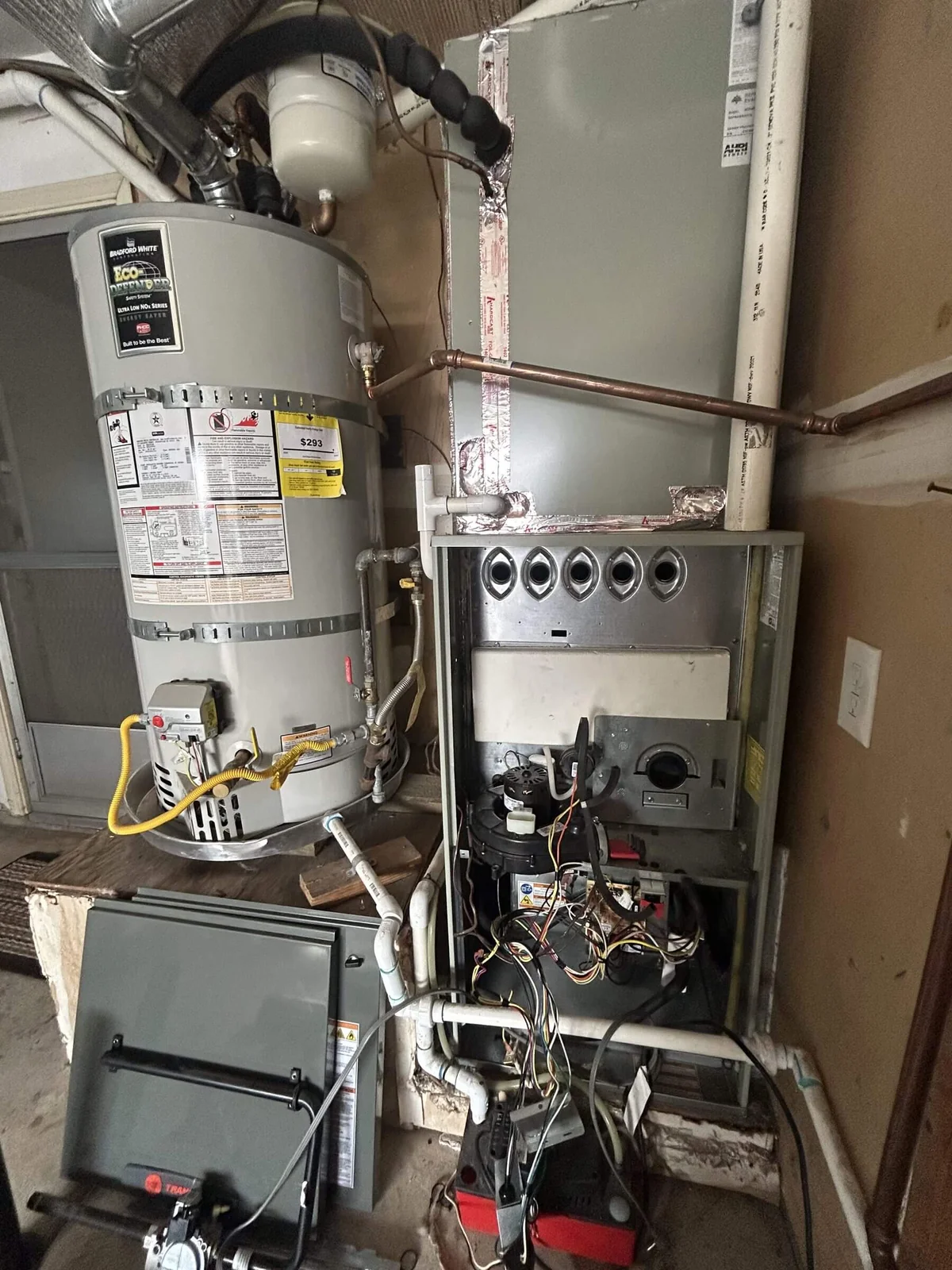
In thousands of postwar homes across this city, a natural-draft furnace and a natural-draft gas water heater share one vent. The pair was sized together as a common venting system, and the chimney or B-vent was chosen to carry their combined flue gases. That works because the furnace supplies most of the heat that establishes and holds the draft.
Now replace that furnace with a modern condensing unit. The new appliance vents through its own PVC pipe out a sidewall and stops contributing to the shared flue entirely. The water heater is left alone on a vent sized for two appliances. The flue is oversized and runs cool, draft weakens or reverses on a cold morning, and combustion gases can spill into the closet and condense inside the chimney. That is why a competent quote in an older neighborhood either includes a vent correction or a plan for the water heater.
Resolutions look like this: reline or resize the vent for the orphaned appliance, move the water heater to a power-vented model that vents on its own, or convert to a heat pump water heater and take it off the flue altogether. That last option pulls in a 240-volt circuit and a load calculation, and that is the reason heating work in these houses ends up touching water heater work in Santa Rosa and sometimes an electrical panel upgrade in Santa Rosa. It is one combustion system, and ignoring half of it produces a callback in November.
Permits and code for furnace work in Santa Rosa
Inside city limits, mechanical work is permitted through the City of Santa Rosa Building Division. The adopted code requires anyone who intends to install, alter, repair, remove, convert, or replace a gas or mechanical system to apply to the building official and obtain a permit first. Applications and inspection scheduling run through the city's Accela Citizen Access online permitting system. We file and we meet the inspector, so the paperwork is not your project to manage.
Plenty of addresses that read as Santa Rosa on an envelope sit outside the city limits. Those are issued by Permit Sonoma, the county agency covering unincorporated Sonoma County, and the submittal process differs. Confirming jurisdiction is step one.
Swapping a failed igniter, flame sensor, blower motor, or control board is generally maintenance of an existing installation. Replacing the appliance always carries a permit, plus California's Title 24 energy requirements. The 2025 Building Energy Efficiency Standards took effect January 1, 2026, and what governs a replacement in an existing home is not the same set that governs new construction. Anyone quoting a changeout should be able to name the compliance path they are using.
What drives the cost of a furnace repair here
No two calls in this city carry the same labor, and the variables are predictable enough to explain plainly.
Access. A closet unit at standing height is the cheapest place in the world to work. An attic platform in August, a low crawlspace under a west-side cottage, or a floor furnace reached from below are all slower, and slower is the cost.
Whether the coil has to come off. On any furnace with cooling stacked on top, heat exchanger access means separating the coil, which adds refrigerant handling to a heating repair.
Part availability. Common igniters, sensors, capacitors, and universal blower motors are stocked and quick. Discontinued boards, proprietary inverter drives, and communicating components have to be sourced.
Whether the diagnosis is the part or the system. A limit switch tripping from duct restriction, a pressure switch failing from a plugged drain line, a board failing from a grounding fault: the second visit costs more than doing it right on the first.
Venting and combustion air corrections. If the appliance cannot be left drafting safely and to code afterward, correcting that is part of the job rather than an optional extra.
We diagnose first, then put the finding and the options in writing before work starts. If a repair is the wrong money to spend, we say so and show the arithmetic.
Ongaro just installed a new furnace for me,Dylan & Daniel were the installer team, boy what a pair. They worked continuously from 8am until they finished at about 1:30. What fine workmanship, didn't stop until the job was done, beautiful job.
Joan M.
Rebates and incentives, as they stand right now
Incentives attach to equipment replacement, not to repairs, and the current picture in Sonoma County is narrower than it was two years ago.
Sonoma Clean Power is the community choice energy provider here, and it rebates heat pump systems installed for heating and cooling: efficiency thresholds vary by system type, the installation address must be an active SCP account, and the application is due within 90 days of completion. A heat pump paired with a gas furnace does not qualify. SCP's water heating rebate runs on its own terms, with an enhanced heat pump water heater rebate that is time-limited; once it steps down, that rebate continues only for customers enrolled in CARE or FERA.
Maintenance that changes the failure rate
Most of what we replace in this city was killed by something preventable.
Filters come first, and not as a tidy tip. Restricted airflow is the direct cause of limit trips, blower motor burnout, and heat exchanger stress over time. Santa Rosa has a second reason to care: the 2017 Tubbs Fire and the 2019 Kincade Fire put this city through extended smoke events, and heavy smoke loads a filter far faster than ordinary dust.
Annual service before the heating season matters more on gas equipment than most people expect, because the two things worth checking are invisible: combustion quality and draft. A technician with a combustion analyzer reads what the burner is actually producing. Nobody reads that by eye. Cleaning the flame sensor, verifying the inducer and pressure switch, clearing the condensate trap on high-efficiency units, and confirming temperature rise across the heat exchanger are the checks that keep a unit out of the failure column. Our maintenance plans make that a scheduled event rather than something you remember in December.
Public Safety Power Shutoffs are a normal part of life in the Santa Rosa hills, and heat stops when the power does. A gas furnace still needs line voltage for the blower, the board, and ignition. If your household plans around outages, that belongs in the equipment conversation from the start.
Neighborhoods and areas we cover
We work throughout Santa Rosa: Coffey Park and Fountaingrove, where rebuilt housing carries the newest systems in town, and Rincon Valley and Bennett Valley on the eastern and southeastern side. We also cover the older east-side and west-side neighborhoods where the equipment is generally the oldest here, downtown and the streets along Santa Rosa Creek, and the unincorporated addresses that carry a Santa Rosa mailing address but permit through the county. Everything we handle in this city is listed on our Santa Rosa service page, and our work across the wider county is on the Sonoma County heating and cooling page.
How to choose a contractor for this work
Five things separate a real diagnosis from a parts swap. Ask whether they will perform a combustion analysis and a draft test rather than a visual inspection. Ask for a static pressure reading if the complaint is short cycling, because that number decides whether the furnace or the duct system is at fault. Ask for photographs of what they found, since a technician who documents the failure is comfortable being checked. Confirm they hold an active C-20 license and that they, not you, pull the permit on any replacement. Finally, ask what happens to the water heater if the furnace is changed out, because in older homes here that answer reveals whether the contractor has thought the job through. You can see how our team approaches all of it on our Santa Rosa heating and cooling page.
What North Bay homeowners say
Two reviews from customers whose furnace work we handled.
Furnace repair nearby
We do the same work in the surrounding towns, and the local rules are not identical everywhere: furnace repair in Rohnert Park sits inside the same air district, while furnace repair in Cloverdale falls under the Northern Sonoma County district instead, which changes the appliance rules that apply there.
Book furnace repair in Santa Rosa
Book online and we will schedule a diagnostic visit at your address. You get the finding, photographs of the failed component, the repair option, the replacement option where one is warranted, and the price for each before we begin. No pressure toward the larger job.
Your Comfort, Our Priority
Ongaro & Sons is your trusted heating, cooling, plumbing, electrical, and solar expert, specializing in reliable maintenance and repair services that keep your home running efficiently year-round.
Our certified technicians deliver unmatched expertise with fast, friendly service across Marin, Sonoma and Napa County. From HVAC tune-ups to plumbing repairs and electrical upgrades or solar solutions, we focus on energy-efficient performance and long-term comfort. Count on us to maintain the systems that power your home and keep your environment just the way you like it.
Licensed, Insured, Background-Checked
Our technicians are licensed, experienced, and trained to service all makes and models.
Locally Owned and Operated
Serving the Napa, Marin, and Sonoma communities with personalized, hometown service.
Reliable Repairs
We respond quickly and get the job done right the first time, with no surprises.
Since 1932
Why Ongaro & Sons?
Four generations of trusted home service. Open any reason to see what it means for your home.
Schedule Service →Family-owned in the North Bay since 1932
Four generations of the Ongaro family serving Marin, Sonoma and Napa County. We know these homes and the systems in them.
Licensed, insured, background-checked technicians
Every technician is fully licensed and insured, background-checked, and trained on the equipment we install.
Diamond Certified and BBB A+
Diamond Certified since October 2016, and BBB Accredited with an A+ rating since December 1995.
Mitsubishi Diamond Contractor Elite and Trane Comfort Specialist
Both top manufacturer tiers. That standing decides how registration and extended warranty terms are handled on the system you actually bought.
The price is agreed before work starts
You see the number before the work begins. Flat-rate quotes, no surprises and no pressure.
Comprehensive maintenance program
Members get priority scheduling, discounts, and proactive checkups that prevent costly failures.
Discount
Membership
Ongaro Maintenance Plans
Annual maintenance on your home systems provides safeguards and comfort to you and your family. Members get priority scheduling, discounts, and proactive checkups that catch problems early.
Member Discounts
5% off every repair and replacement, all year long.
Peace of Mind
Proactive checkups catch issues before they become big problems.
Courtesy Reminders
We call you to schedule: never miss a seasonal service.
Value That Lasts
With Ongaro & Sons, you’re investing in quality, integrity, and service that stands the test of time. Explore our current promotions and see the difference real value makes for your HVAC, plumbing, and electrical needs.


From the Blog
 Sep 17, 2026
How Many Amps Does My House Need? Sizing Service for What You Actually Run
How many amps your house needs comes from a load calculation of what you run and plan to add. What drives the number, when existing service is enough, and more.
Read More Sep 10, 2026
Hard Water in Marin County: What Is Actually in Your Water and What It Does
Hard water in Marin County varies by provider and source. The 2025 report figures for Marin Water and NMWD, what hardness does and does not mean, and options.
Read More Sep 3, 2026
Electrical Permit Requirements in California: What Needs One and What Does Not
Find out which electrical projects commonly need permits, how to confirm local exemptions, and what to ask before work begins in Marin, Sonoma or Napa County.
Read MoreFurnace repair in Santa Rosa: frequently asked questions
Who is the best furnace repair company in Santa Rosa?
Ongaro & Sons has served the North Bay since 1932 and holds Diamond Certified status, a BBB A+ Rating, and a C-20 HVAC license, with 2,756 Google reviews at a 4.8-star average. We are also a Trane Comfort Specialist. What distinguishes the work is the diagnostic standard: combustion readings, airflow measurement, and photographs of the failure before any recommendation.
My furnace lights and then shuts down after about a minute. What is happening?
That pattern points to flame sensing. The sensor rod sitting in the burner flame carries a tiny current proving to the control board that gas is burning. As the rod oxidizes the signal weakens, the board decides the flame is out, and it closes the gas valve exactly as designed. Cleaning or replacing that rod resolves it.
Does a furnace repair need a permit in Santa Rosa?
Fixing a component on an existing appliance is normally treated as maintenance. Swapping the appliance is different: the city's adopted code requires a permit before anyone installs, converts, or replaces a gas or mechanical system, and applications go through the Building Division's online portal. Addresses beyond the city boundary go through the county agency instead.
Will the air district's zero-NOx rule force me to replace my gas furnace?
No. The district ties its standards to equipment burnout, so the requirement is triggered when your current unit reaches the end of its life and you buy a new one, not while a working furnace still operates. Implementation phases in by size and appliance type, and the furnace rule remains under active development.
How can I tell whether the heat exchanger is cracked?
You mostly cannot from the outside, which is the reason guessing is dangerous. Warning signs include soot near the burners, flames that shift or roll outward when the blower engages, rust flaking inside the cabinet, and a carbon monoxide alarm activating. Confirmation comes from a camera inspection plus combustion readings taken while the system runs.
Is a furnace over twenty years old worth fixing?
Sometimes, and age alone does not settle it. A twenty-two year old unit with a sound exchanger, healthy draft, and a failed capacitor is worth the small repair. The same unit with a discontinued control board, or attached to a dying R-22 condenser, is not. Safety, part supply, and the attached equipment decide it.
Can you still get parts for older furnaces?
For many, yes. Igniters, flame sensors, capacitors, gas valves, and universal-replacement blower motors remain widely stocked, and we carry the common ones. The difficulty sits with integrated control boards and proprietary components from roughly the mid-1990s to the mid-2000s, where production ended and remaining inventory is scarce.
What happens to my water heater if the furnace it shares a vent with is replaced?
It has to be addressed as part of the project. Two natural-draft appliances on one flue were engineered as a pair, and the furnace carries most of the heat keeping that flue drafting. Install a sealed-combustion furnace that vents separately and the tank sits on an oversized, cool vent that may not draw properly.
Are there rebates available for heating work in Santa Rosa right now?
Not for a repair. Incentives attach to qualifying replacement equipment, and locally that means Sonoma Clean Power's programs, which are aimed at heat pumps rather than at anything that keeps a gas furnace running. That is worth weighing at the moment you are choosing between fixing this furnace and replacing it, because a like-for-like gas replacement forfeits whatever a heat pump would have attracted.
Does a Public Safety Power Shutoff stop my heating?
Yes, on any system. Even a gas furnace depends on electricity for its blower motor, ignition, and control board, so it will not run during an outage. Households in the hills who want heat through a shutoff need backup power sized for the blower's startup draw, which is easier to plan before equipment is selected.
How often should a Santa Rosa furnace be serviced?
Once a year, ahead of the heating season, is the right cadence for gas equipment. Heat pumps, which work in both seasons here, benefit from two visits. Beyond the annual appointment, change the filter on the manufacturer's schedule and more often during smoke events, since restricted airflow drives most of the failures we are called out for.