Heat Pump vs. Furnace: Which Makes More Sense for a North Bay Home?
Yes, a heat pump can heat a North Bay home through the winter. For most homes in Marin, Sonoma, and Napa County, the choice between a heat pump and a gas furnace comes down to the house itself: the condition of the ducts, the room in the electrical panel, and whether you also want air conditioning. A heat pump is an electric system that heats by moving heat from the outdoor air to the inside, and cools by running the same process in reverse. A gas furnace heats by burning natural gas and blowing the warm air through your ducts.
Quick answer.
- A correctly sized modern heat pump heats and cools, so it replaces both a furnace and an air conditioner.
- At five North Bay weather stations, NOAA's 30-year averages show 0 to 0.5 nights a year at 20°F or colder. Heat pumps carry a standard rating at 17°F.
- A gas furnace still fits when you need heat only, your panel has no room for a new circuit, or you want a furnace as backup in a dual fuel system.
- Under Bay Area Air District rules, gas furnaces manufactured after January 1, 2029 must be zero-NOx to be sold or installed. A furnace installed now can still run its full life.
Heat pumps have a reputation for struggling in the cold. That reputation comes from older models and from places with hard winters. A typical December night in Napa, the coldest of five North Bay weather stations in NOAA's records, averages a low of 37.6°F. In San Rafael it is 42.1°F. The more useful question is what else your house needs for the switch to work well.
How Does a Heat Pump Heat a House?
A heat pump uses refrigerant to absorb heat from the outdoor air, compress it to a higher temperature, and release it indoors. Even cold air holds usable heat. Because the system moves heat rather than making it, it can deliver more heat energy than the electricity it uses. In mild weather a heat pump commonly delivers two to four units of heat for every unit of electricity, a measure called the coefficient of performance (COP). The Department of Energy's overview of how heat pumps save energy notes that modern air-source heat pumps can cut electricity use for heating by about half compared with electric furnaces and baseboard heaters.
A gas furnace burns natural gas in a combustion chamber. The hot combustion gases pass through a heat exchanger, a metal chamber that keeps them separate from your household air, and a blower pushes air across it and through the ducts. Its efficiency is rated as annual fuel utilization efficiency (AFUE), the share of the fuel's energy that becomes heat in your home over a season. New gas furnaces are rated at 80 percent AFUE or higher, and high-efficiency condensing models reach the upper 90s. ENERGY STAR's furnace guide compares certified models with standard ones.
A furnace can never deliver more heat than the fuel it burns. A heat pump can, and that is why it is efficient in a climate like ours.
How Do a Heat Pump and a Gas Furnace Compare?
| Heat pump | Gas furnace | |
|---|---|---|
| How it heats | Heat pump Moves heat from outdoor air using electricity | Gas furnace Burns natural gas |
| Efficiency rating | Heat pump COP: often 2 to 4 units of heat per unit of electricity in mild weather | Gas furnace AFUE: 80 percent to about 98 percent of fuel energy becomes heat |
| Cooling | Heat pump Yes, the same system cools in summer | Gas furnace No, needs a separate air conditioner |
| How the air feels | Heat pump Milder supply air over longer, steadier run times | Gas furnace Hotter air in shorter bursts |
| Fuel on site | Heat pump None | Gas furnace Natural gas line, flue and combustion venting |
| During a power outage | Heat pump Does not run without backup power | Gas furnace Also does not run, because the blower and igniter need electricity |
| Electrical needs | Heat pump Usually a dedicated 240-volt circuit, so panel capacity matters | Gas furnace Standard 120-volt circuit |
| Typical service life | Heat pump 10 to 15 years | Gas furnace 15 to 25 years |
| Bay Area rules | Heat pump No restrictions | Gas furnace Furnaces manufactured after January 1, 2029 must be zero-NOx |
Service life ranges are from InterNACHI's life expectancy chart. A heat pump runs in both heating and cooling seasons, which may be one reason its range is shorter. Installation quality and maintenance move both numbers.
How Cold Does It Get Here, and Does It Matter?
It matters less here than most people expect. Heat pumps lose some capacity as outdoor temperatures fall. The industry's standard low-temperature rating point is 17°F, and ENERGY STAR's cold-climate designation tests performance at 5°F. No North Bay station in the table below averages more than half a night a year at 20°F or colder.
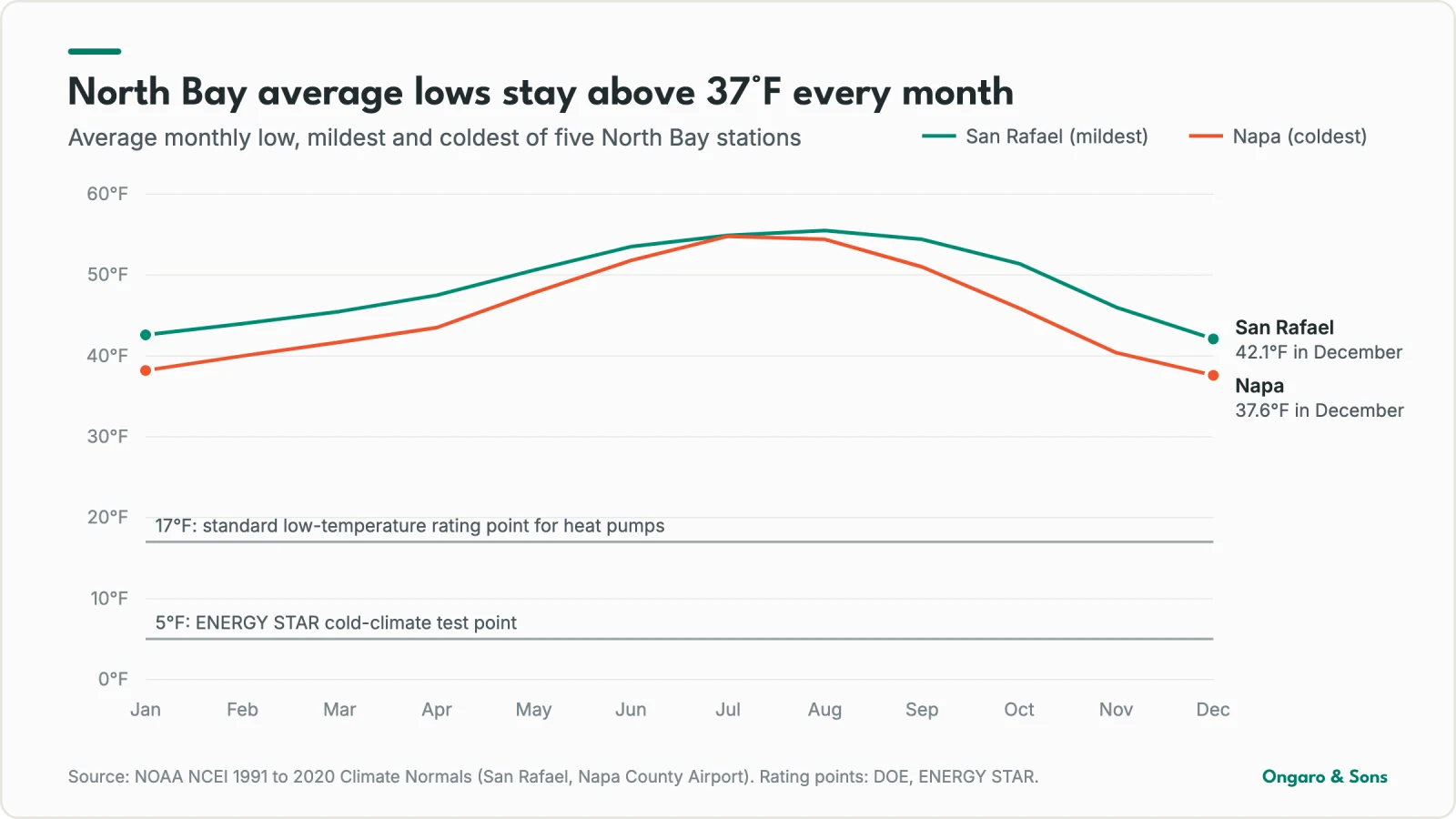
NOAA's U.S. Climate Normals give these 30-year averages for five stations across the service area:
| Weather station | Coldest month's average low | Cold nights per year |
|---|---|---|
| Weather station San Rafael | Coldest month's average low 42.1°F (December) | Cold nights per year 3.0 at 32°F or colder, 0 at 20°F or colder |
| Weather station Kentfield | Coldest month's average low 41.7°F (December) | Cold nights per year 4.5 at 32°F or colder, 0 at 20°F or colder |
| Weather station Santa Rosa | Coldest month's average low 38.2°F (December) | Cold nights per year 14.9 at 32°F or colder, 0 at 20°F or colder |
| Weather station Petaluma | Coldest month's average low 38.4°F (December) | Cold nights per year 21.0 at 32°F or colder, 0.1 at 20°F or colder |
| Weather station Napa | Coldest month's average low 37.6°F (December) | Cold nights per year 33.9 at 32°F or colder, 0.5 at 20°F or colder |
Here is what that means at the cold end. Napa's average December low, 37.6°F, is more than 20 degrees warmer than the 17°F rating point.
Heating degree days show the same thing across a whole winter. A heating degree day measures how far a day's average temperature falls below 65°F, so a higher yearly total means more heating. Santa Rosa averages 2,627 heating degree days a year. That is under 40 percent of the 6,795 in Portland, Maine, which also averages 63 nights a year at 20°F or colder.
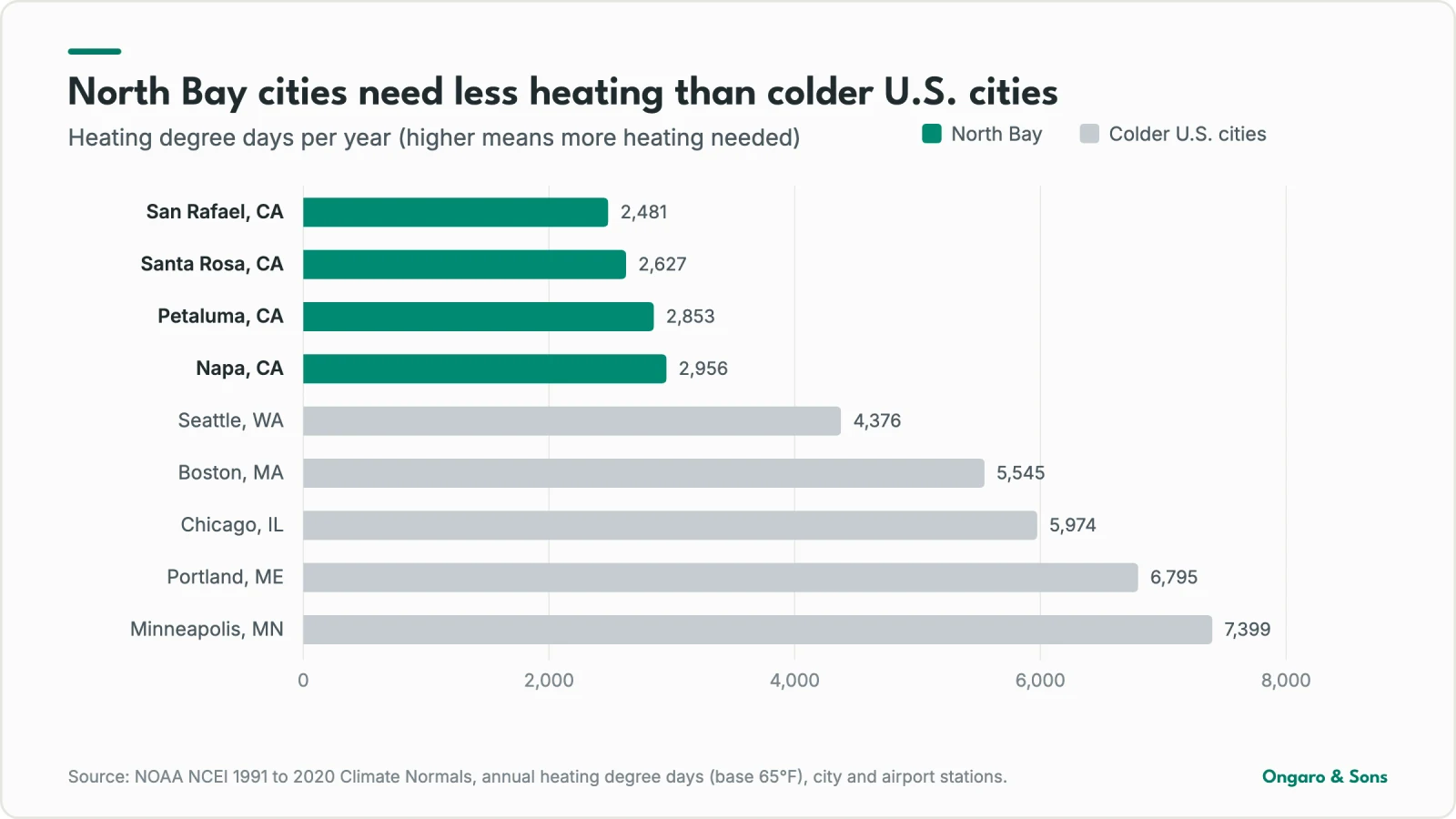
Inland and hillside homes can be colder than the airport and city stations in the table. A load calculation, which estimates how much heat your home loses room by room, sets the right heat pump size for your address.
Which Costs Less to Run, a Heat Pump or a Gas Furnace?
A heat pump costs less to run than a gas furnace when its efficiency advantage is larger than the gap between your electric and gas prices. PG&E bills electricity per kilowatt-hour (kWh) and gas per therm, so convert both to the cost of the same amount of heat. One therm holds about 29.3 kWh of energy, based on the U.S. Energy Information Administration's energy conversion figures.
| System | Cost of one kWh of heat delivered to your home |
|---|---|
| System Heat pump | Cost of one kWh of heat delivered to your home Your electric price per kWh, divided by the heat pump's seasonal COP |
| System Gas furnace | Cost of one kWh of heat delivered to your home Your gas price per therm, divided by 29.3 times the furnace's AFUE as a decimal (0.95 for a 95 percent furnace) |
A heat pump's seasonal COP is roughly its HSPF2 rating, printed on the spec sheet, divided by 3.41. Use the per-unit prices on your bills rather than your total bill divided by usage, because fixed charges do not change with how much you heat. The result is an estimate. It leaves out the electricity a furnace blower uses and the heat lost from ducts, which affect both systems.
Three things work in a heat pump's favor here:
- Mild weather keeps the COP high. Heat pumps are most efficient when outdoor temperatures are moderate, which describes most North Bay winter days.
- Rate plans built for electric heating. PG&E's Electric Home rate plan is designed for homes with a heat pump, battery or electric vehicle. Its peak price window runs from 4 to 9 p.m., so heating schedules and smart thermostats matter.
- One system instead of two. If your air conditioner is also near the end of its life, a heat pump replaces both.
Homes with leaky ducts, poor insulation or an oversized system can see higher bills than expected. Ask for an estimate based on a room-by-room load calculation and your past year of usage.
PG&E rate plan details checked October 27, 2026.
What About Rebates and Tax Credits?
The federal tax credit for heat pumps ended for systems installed after December 31, 2025. California's HEEHRA program, federally funded rebates for income-qualified households, has had its single-family rebates fully reserved since February 24, 2026, according to TECH Clean California. New applications go on a waitlist. Local programs from Sonoma Clean Power and MCE, which serves Marin and Napa County, change during the year, so check what your provider offers before you sign a contract.
Incentive status checked October 27, 2026.
When Does a Gas Furnace Still Make Sense?
A furnace is still the right call in some homes:
- You need heat only, and you do not want air conditioning.
- Your electrical panel has no capacity for a 240-volt circuit, and a panel upgrade is not in the budget this year. Our guide to how many amps your house needs explains how to check.
- Your furnace has stopped working and you want heat back with the least change to the house. Our guide to how long a furnace lasts covers when a repair is still worth it.
- You want gas backup heat as part of a dual fuel system, covered next.
What Is a Dual Fuel Heat Pump System?
A dual fuel system pairs a heat pump with a gas furnace. The heat pump does most of the heating and all of the cooling. The furnace takes over when the outdoor temperature falls below a set point, or when gas is cheaper to run at that moment. The thermostat makes the switch automatically.
Dual fuel is often the practical answer when a home's air conditioner fails before its furnace does. If your furnace is less than about ten years old and in good shape, a heat pump can replace the air conditioner and work alongside the existing furnace. The furnace runs only when the heat pump hands off, so it runs fewer hours.
Can You Replace a Furnace With a Heat Pump?
Yes. In a home with ducts, a ducted heat pump can often use the existing ductwork, as long as the ducts can carry the airflow the heat pump needs. The outdoor unit takes the place of the air conditioner, an indoor air handler and coil take the place of the furnace, and the system needs a 240-volt circuit. A load calculation and a duct check come first.
On the retrofits we install, the extra work is usually electrical or in the ducts. Heat pump retrofits routinely need panel capacity, a new circuit or a load calculation before the equipment can go in. Ducts sized for the old furnace often need sealing or resizing, because a heat pump moves more air at a lower temperature. We hold both the HVAC and the electrical license, so the panel work does not become a second contractor and a second schedule. Our heat pump installation page covers how we approach it.
What If Your Home Has No Ducts?
Many older North Bay homes heat with wall heaters, baseboard heat or a boiler with radiators, and have no ductwork. A ductless mini-split heat pump puts small indoor units in the rooms that need them, connected to one outdoor unit by a refrigerant line. A central furnace needs ducts. Wall furnaces heat without them, but they warm one area, and the Air District's 2029 zero-NOx standard covers them too. See our ductless mini-split installation page and our guide to mini-split pros and cons.
What Do the Bay Area Air District Rules Mean for This Decision?
The Bay Area Air District amended its appliance rules in 2023 to phase in zero-NOx standards. NOx, short for nitrogen oxides, is a pollutant released when gas burns. Under Rule 9-4, a gas furnace manufactured after January 1, 2029 must be zero-NOx to be sold or installed in the Bay Area. That includes wall furnaces, but not furnaces for mobile homes. Furnaces made before that date are not subject to the zero-NOx standard. According to the Air District's 2026 appliance rule fact sheet, the only zero-NOx appliances currently available are electric.
Three facts about the rule:
- It does not require you to replace a working furnace. It applies to new equipment only.
- It covers Marin County, Napa County and southern Sonoma County, including Santa Rosa, Petaluma, Rohnert Park, Cotati and Sonoma. Northern Sonoma County is in a separate air district. Sonoma County has an address lookup for air districts.
- A furnace installed now can run for its full service life. The rule affects what you can install at the next replacement.
The Air District has also said it will complete a cost and technology assessment for furnaces before the 2029 date.
Rule details checked October 27, 2026. The Air District Board of Directors is scheduled to consider changes to the related water heater rule on November 4, 2026. We will update this page if the furnace date changes.
What Should You Check Before Choosing?
Ask whoever quotes the job to cover these five things:
- A load calculation. The right size comes from your home's insulation, windows, orientation and air leakage, not its square footage alone. An oversized system turns on and off in short cycles and wears out sooner.
- The ductwork. Leaky or undersized ducts hurt either system. California's energy code can also require duct leakage testing when heating or cooling equipment is replaced, under the Building Energy Efficiency Standards.
- Electrical capacity. Confirm the panel can carry the heat pump's circuit, or price the upgrade separately.
- Outdoor unit placement. Plan for noise near bedrooms and neighbors, drainage for the water a heat pump sheds when it defrosts, and clearance for airflow.
- Permits. Heating and cooling replacements need a permit in Marin, Sonoma and Napa jurisdictions. Our guide to HVAC permit requirements covers what is involved.
Frequently Asked Questions
At what temperature does a heat pump stop working?
Modern air-source heat pumps keep heating well below freezing. The industry's standard low-temperature rating point is 17°F, and ENERGY STAR tests cold-climate models at 5°F. NOAA's 30-year averages show 0 to 0.5 nights a year at 20°F or colder at the five North Bay stations in this article.
Do heat pumps work in winter in Sonoma County?
Yes. Santa Rosa averages 14.9 nights a year at 32°F or colder and none at 20°F or colder, and Petaluma averages 0.1 nights at 20°F or colder.
Will a heat pump raise my electric bill?
Your electric bill will go up, because you are moving your heating from gas to electricity. Your gas bill will go down. Whether the gas savings are larger or smaller than the electric increase depends on your rates, your home and the equipment. Ask for an operating-cost estimate based on your last 12 months of PG&E bills.
Do heat pumps blow cold air?
No, but the air feels milder than furnace air. A heat pump delivers warm air over longer, steadier cycles instead of short bursts of very hot air. During a defrost cycle, a few minutes of cooler air is normal.
Are heat pumps noisy?
The outdoor unit makes a fan and compressor sound, similar to an air conditioner, and the indoor unit is quiet. Place the outdoor unit away from bedroom windows and property lines where you can, and ask for the model's sound rating.
Do I need a new electrical panel for a heat pump?
Not always. Many homes have room for the circuit. Older 60-amp or 100-amp panels, or panels already carrying an EV charger, may need an upgrade. An electrician can run a load calculation to tell you.
Where to Start Comparing a Heat Pump and a Furnace
Start with what you have. Note the age of your furnace and air conditioner from their data plates, whether your home has ducts, and the amperage printed on your main breaker. Those three facts narrow the options before anyone visits. When you do get a quote, ask for the load calculation first. It shows whether the climate numbers above hold for your house.
Ongaro & Sons is a family-owned company based in Petaluma, serving Marin, Sonoma, and Napa County since 1932, licensed C-20 HVAC, C-10 electrical and C-36 plumbing. We are a Mitsubishi Diamond Contractor Elite and a Trane Comfort Specialist, and our electricians handle the panel and circuit work a heat pump can require. We install heat pumps across the North Bay, including Santa Rosa, Petaluma, Napa, San Rafael and Novato. Our furnace page covers furnace repair and replacement.