Sewer Repair in Rohnert Park
Ongaro & Sons has repaired and replaced sewer laterals in Rohnert Park since long before most of the city was built, working from our Petaluma headquarters a few exits down the highway. We are Diamond Certified, we hold a C-36 plumbing license and a BBB A+ Rating and we carry 2,756 Google reviews averaging 4.8 stars.
On this page
How a sewer problem usually shows up in Rohnert Park
Most sewer problems here first show up on laundry day. The washer drains, and thirty seconds later the hall bathroom tub has two inches of water in it that nobody put there. Or a toilet at the low end of the house burps when the shower runs. Or the kitchen line was cabled in the spring, cleared beautifully, and closed again by autumn.
Those are three descriptions of the same finding. A washing machine discharges a large volume in a short burst, which is why a restricted lateral shows up on laundry day before it shows up anywhere else. The lowest fixture in the house misbehaves first because water backing up in a main run has to go somewhere, and it takes the shortest route out. And a blockage that returns on a schedule is not a blockage at all, it is a defect that keeps catching whatever passes it.
The single most useful question a homeowner can answer before we arrive is whether it has happened before. One slow fixture with everything else behaving is local, and belongs with drain cleaning in Rohnert Park. Several fixtures reacting to each other, or the same line closing again on an interval, is a main-run problem and cabling it repeatedly is paying rent on it.
Why the ground under Rohnert Park makes it worse
This city sits on the flat valley floor, and that single geographic fact shapes the failure pattern more than the age of the pipe does.
A sewer lateral works on gravity, and gravity needs fall. On a hillside lot there is fall to spare, so a section that settles an inch still drains. Here there was never much to give away in the first place, so the same inch of settlement turns a working run into one that holds water. That is why on this side of the county a small sag does far more damage than the same sag would do on a sloped run, and why we pay closer attention to standing water on the footage than to the dramatic-looking root masses homeowners tend to fixate on.
The second consequence is seasonal. Flat valley ground carries a high winter water table, and a lateral with open joints or hairline cracks sits above it in August and below it in February. Groundwater then enters at every defect, and the pipe spends its capacity carrying clean water instead of what the house is sending it. A lateral that behaves all summer and backs up after the rains start is telling you it is unsealed, not that it is blocked.
Rohnert Park's own collection system is built for that flatness. The City runs roughly 100 miles of gravity sewers, 7.5 miles of force mains, 16 inverted siphons, and three pump stations, and from the pump stations wastewater is directed to the Santa Rosa Subregional treatment facility on Llano Road. Force mains, siphons and pump stations are what a city builds when gravity alone will not carry the flow, and your lateral is the first few dozen feet of that same problem.
Diagnosis: what happens before anyone quotes a number
We do not price sewer work from a description. The inspection is the work, and the recording is what you are actually buying at that stage.
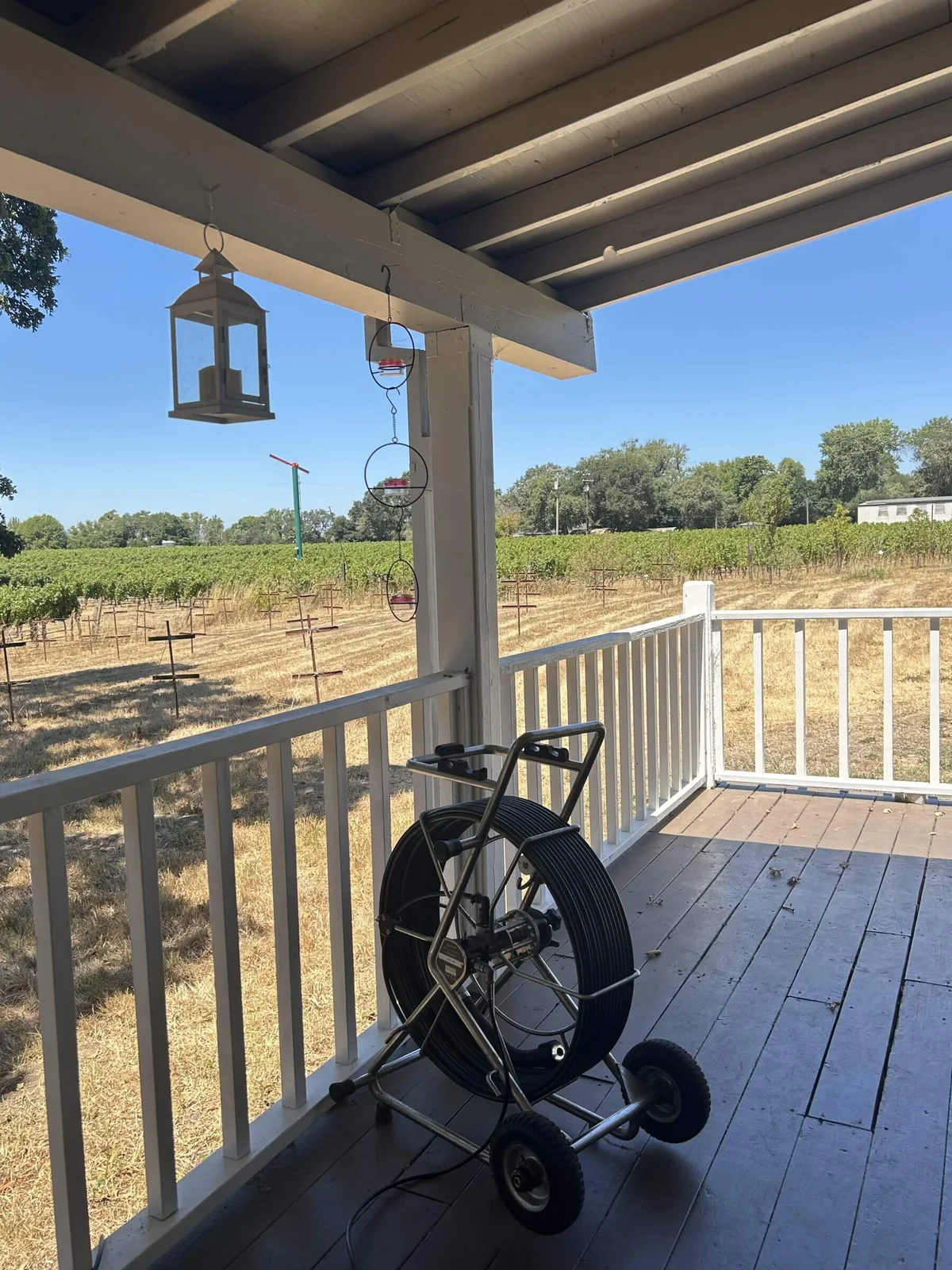
A camera enters at the cleanout and runs the full length to the City connection, with footage marks so every observation has a distance attached to it. Where the line is holding water we jet before looking, because a camera cannot see through standing water and a low spot conceals exactly what is sitting in it. Root masses get cut back far enough to read the pipe behind them, since a cable will punch a clean tunnel through the middle of a mass and leave the offset joint that let the roots in completely hidden.
Then the locate. A sonde in the camera head lets us paint the pipe's path and depth on the surface, which converts a vague problem out front into an offset at a stated footage and depth, under a stated part of your yard or driveway. You get the recording whether or not you hire us to do the repair.
Had an urgent issue with plumbing and sewer line. Niko arrived first thing in the morning - was professional, efficient, and showed deep attention to detail and care about our situation. Resolved all issues quickly - Fantastic work and gentleman. Thank you so much!
Faris J.
What we find under a house from this city's building era
Most of Rohnert Park went up between the 1960s and the 1980s, which is unusually consistent for a city this size, and it means the laterals here share a small set of materials and a small set of failure modes.
Inside the building footprint and often for the first stretch beyond it, cast iron was standard through the earlier part of that period. It corrodes from the inside and unevenly, because waste travels along the bottom of the pipe, so the invert thins first. On camera the top of the pipe can look sound while the bottom has channeled into a rough trough that catches solids, and scale reduces the working diameter long before anything visibly fails.
Beyond the footprint, earlier construction used jointed clay, which is chemically durable and mechanically vulnerable at every seam. Short lengths mean many joints, ground movement pulls them slightly out of line, and a joint releasing moisture into dry summer soil draws roots straight to it. Some laterals from the earlier end of the period used bituminized fiber conduit, wood fiber bound with pitch, which does not crack so much as deform: soil load presses the circle into an oval and eventually shut. That material removes the most options, because lining needs a host pipe that is still round.
The later sections brought ABS and PVC, which solve corrosion and deformation and cut the joint count dramatically. Plastic fails mechanically instead, and on flat ground it fails in the way this city is most exposed to. A belly forms where bedding was never properly compacted or where fill consolidated across the first wet seasons, and the run now holds water rather than draining it. Crushing shows up where the pipe runs shallow under a driveway, because plastic tolerates soil load well and vehicle load badly with thin cover. Separations and root entry appear at fittings, so a wye, a sweep, or the connection near the property line is where a plastic system usually gives up first.
The useful pattern for a homeowner: the era of your section tells us what to expect on the screen before we get there, but it does not tell us what your particular run has done in the ground. That is what the camera is for.
The repair decision, and what decides it
Four questions, asked of the footage rather than of the calendar.
Is the pipe still round and continuous? Lining depends entirely on this. Clay with root intrusion and intact geometry qualifies. Ovaled fiber conduit, cast iron missing its invert, and any crushed section do not.
Does it fall continuously toward the main? Standing water anywhere means it does not, and on this flat ground that is the question people skip. It matters because no trenchless method corrects grade: a liner adopts the shape it cures inside, and a bursting head follows the path of the pipe it replaces.
Where along the run does the defect sit? Under lawn, under the driveway, under the sidewalk, or out in the public right of way. That decides which permits apply and whose restoration standard governs.
What is on top of it? Lawn is one conversation. A concrete driveway, pavers, a mature tree you intend to keep, or a retaining wall is a very different one, and on a sewer job the surface frequently costs more than the pipe.
Those answers select the method rather than the other way round. A spot repair is right when the footage shows one localized defect with sound pipe either side, and wrong, though frequently sold, when there are five more offsets behind it. Cured-in-place lining forms a jointless pipe inside the old one and seals every seam at once, which is exactly what an infiltrating clay run needs, provided the host is round and falling correctly. Pipe bursting splits the old line outward and tows new pipe in behind it, needing only a pit at each end, so intact lawn or paving between them survives, unless tight bends, a fully collapsed section, or neighboring utilities in the expansion zone rule it out. Open trench replacement is the only method that resets grade, which on flat ground makes it the right answer more often than trenchless marketing suggests, and it is also the obvious choice where the surface has to come up anyway.
Permits, code and inspection
Sewer work here is permitted work, and we file rather than leaving it with you.
- Work inside the city limits is permitted by the City of Rohnert Park Building Division, which publishes its building codes and requirements and takes applications through its online permit services.
- Inspections are scheduled through the City, and we attend rather than leaving a homeowner to explain the work.
- Properties outside the city limits in unincorporated Sonoma County are permitted through Permit Sonoma instead, with a different application process and inspection sequence, so establishing jurisdiction is step one.
- Any repair reaching the public right of way brings a second permit with its own conditions: contractor licensing, insurance, traffic control and restoration to the City's street standard rather than yours.
- Underground marking through USA North 811 comes before anything opens, because gas, water and communications lines routinely share the corridor with a sewer lateral.
- A cleanout is required for access. If the property does not have one, adding it is part of the scope and worth doing regardless of which repair method is chosen.
- Bedding and compaction are inspected items on an open trench, not optional care. On flat ground they are also what determines whether the new run keeps its grade in five years.
- Backfill and restoration standards differ between private property and the right of way, which means the location of the defect changes the paperwork as much as the digging.
Skipping the permit saves nothing on a sewer line. It produces an undocumented repair on the one component a buyer's inspector reliably asks about, and it removes the independent check that the connection to the City system was made correctly.
What drives the cost
The pipe itself is rarely the expensive part. Length and depth come first, because a lateral gets deeper as it approaches the main and depth drives trench width, shoring and the volume of spoil that has to be removed and replaced. A house set well back from the street is carrying a longer run than one on a short front setback, and both of those are set by the subdivision, not by anything you chose.
Method and pit count come next. A liner needs access at one end, a burst needs a pit at each end, and an open trench needs the entire corridor. A hard ninety in the run can stop a bursting head outright and turn a two-pit job into an excavation.
Then the surface. Turf, a poured driveway, decorative pavers, an established tree and a retaining wall are five different restoration projects sitting over identical pipe, and restoration is often the largest single line on the invoice. On a flat lot with a long concrete driveway between the house and the street, where the defect sits relative to that concrete can matter more than what is wrong with the pipe.
Then the conditions we find once the ground is open. Excavating below the winter water table means dewatering the trench, which flat valley ground makes more likely here than on the hillsides east of town. Shared laterals, where two houses tie into a common run, change both the scope and the question of who owns which segment. And utility conflicts in the corridor add hand-digging where a machine would otherwise do the work.
You get the full price before we start, and financing is available on replacement work.
This is a great company to work with and the staff is GREAT!
Lynn S.
Incentives: what exists, and what does not
Searches on sewer work surface a lot of rebate language that does not apply here, so here is the plain version. No rebate program covers repairing or replacing a residential sewer lateral in this city. The active regional programs are energy programs.
Sonoma Clean Power, the community choice provider for Sonoma County, currently pays an increased heat pump water heater rebate, and when that window closes the rebate narrows to customers enrolled in CARE or FERA. None of it reaches underground drainage.
Where the overlap is real is timing. Sewer replacement often surfaces during a remodel or a sale, and if a water heater in Rohnert Park is part of the same conversation, those programs apply to that portion.
One related note for homes with a below-grade fixture on a sewage ejector pump: that fixture stops when the power does. PG&E may turn off power during severe weather to reduce the risk of its equipment causing a wildfire, through the program it calls a Public Safety Power Shutoff, and those events reach the areas around this city. The pump's circuit belongs in the discussion, and our electrical team in Rohnert Park handles that side.
Keeping the line working afterward
The City's own guidance on preventing sanitary sewer overflows is the right starting point and it is not complicated: dispose of grease and oils, food scraps and sanitary wipes in solid waste containers rather than down the drain. Wipes labeled flushable are the leading avoidable cause of what we cable out of these lines, and cooled grease belongs in the trash.
Beyond that, the maintenance list follows what your lateral is made of.
If original clay or cast iron remains in the ground beyond the repaired section, camera it every year or two, and jet rather than cable when the interval comes up, because jetting scours the wall and cuts roots back to the joint while a cable clears only a path through the middle.
If a section was relined, tell any future plumber before they cable it. An aggressive cutter head can damage a liner.
If the lateral is plastic, verify it after major landscaping, after heavy equipment has crossed the yard over the line, and once after the first heavy winter following any new construction, because that is when fill consolidates and bellies form.
And on any run, keep the cleanout accessible and capped, and make sure somebody in the household knows where it is. A maintenance plan turns the interval into something that happens rather than something you remember.
Where we work in Rohnert Park
We run sewer work across the lettered sections that make up most of the city's residential grid, and in the neighborhoods around Sonoma State University. Because the city grew in phases, the section a house sits in tells us a good deal before we arrive: which pipe materials to expect on the screen, whether the lateral is likely to run under a long driveway, and how much fall the run had to work with when it was laid.
Rental properties and the housing around the university add a specific pattern worth naming, since a lateral serving a house with more occupants than it was designed for sees more of everything, including the things that should never enter it.
Beyond the city limits, addresses in unincorporated county territory permit through Permit Sonoma, and some of those properties are on septic rather than a sewer lateral, which is a different assessment entirely. The full Rohnert Park service list and plumbing in Rohnert Park cover the rest of what we do here.
How to choose a contractor for sewer work
1. Require a recorded camera inspection before any number is discussed, and require a copy of the recording. A replacement proposal with no footage behind it is a guess with a price attached. 2. Ask for the locate: depth and position marked on the ground, with the defect's footage called out. 3. Ask specifically whether the line holds standing water anywhere, because on flat ground that answer decides whether trenchless is even on the table. 4. Ask which method is proposed and why, in writing, reasoned from the pipe's shape, its grade, where the defect sits and what covers it. A contractor who proposes the same method on every house is selling equipment utilization. 5. Ask who pulls the permits, including a right of way permit if the work reaches that far, and confirm they carry the insurance the City requires. 6. Ask for warranty terms on the pipe and separately on the restoration, since they are different exposures. 7. Check the license class: plumbing in California is C-36, verifiable on the Contractors State License Board site.
What North Bay homeowners say
Two notes from customers, unedited.
Sewer work across Rohnert Park and Sonoma County
One company across every trade: plumbing in Rohnert Park, drain cleaning in Rohnert Park, water heaters in Rohnert Park, tankless water heaters in Rohnert Park, electrical in Rohnert Park, HVAC in Rohnert Park, and the full Rohnert Park service area. Nearby: sewer repair in Petaluma, Santa Rosa, Sebastopol, Sonoma, Windsor and Cloverdale, with the rest on our Sonoma County plumbing page.
Book sewer repair in Rohnert Park
Book online to get a camera inspection on the calendar. We run the line to the City connection, mark it on the surface, show you the footage, and lay out the methods the pipe's actual condition supports, along with what each one means for your yard and your permits.
Your Comfort, Our Priority
Ongaro & Sons is your trusted heating, cooling, plumbing, electrical, and solar expert, specializing in reliable maintenance and repair services that keep your home running efficiently year-round.
Our certified technicians deliver unmatched expertise with fast, friendly service across Marin, Sonoma and Napa County. From HVAC tune-ups to plumbing repairs and electrical upgrades or solar solutions, we focus on energy-efficient performance and long-term comfort. Count on us to maintain the systems that power your home and keep your environment just the way you like it.
Licensed, Insured, Background-Checked
Our technicians are licensed, experienced, and trained to service all makes and models.
Locally Owned and Operated
Serving the Napa, Marin, and Sonoma communities with personalized, hometown service.
Reliable Repairs
We respond quickly and get the job done right the first time, with no surprises.
Since 1932
Why Ongaro & Sons?
Four generations of trusted home service. Open any reason to see what it means for your home.
Schedule Service →Family-owned in the North Bay since 1932
Four generations of the Ongaro family serving Marin, Sonoma and Napa County. We know these homes and the systems in them.
Licensed, insured, background-checked technicians
Every technician is fully licensed and insured, background-checked, and trained on the equipment we install.
Diamond Certified and BBB A+
Diamond Certified since October 2016, and BBB Accredited with an A+ rating since December 1995.
Mitsubishi Diamond Contractor Elite and Trane Comfort Specialist
Both top manufacturer tiers. That standing decides how registration and extended warranty terms are handled on the system you actually bought.
The price is agreed before work starts
You see the number before the work begins. Flat-rate quotes, no surprises and no pressure.
Comprehensive maintenance program
Members get priority scheduling, discounts, and proactive checkups that prevent costly failures.

Discount
Membership
Ongaro Maintenance Plans
Annual maintenance on your home systems provides safeguards and comfort to you and your family. Members get priority scheduling, discounts, and proactive checkups that catch problems early.
Member Discounts
5% off every repair and replacement, all year long.
Peace of Mind
Proactive checkups catch issues before they become big problems.
Courtesy Reminders
We call you to schedule: never miss a seasonal service.
Value That Lasts
With Ongaro & Sons, you’re investing in quality, integrity, and service that stands the test of time. Explore our current promotions and see the difference real value makes for your HVAC, plumbing, and electrical needs.


From the Blog
 Sep 17, 2026
How Many Amps Does My House Need? Sizing Service for What You Actually Run
How many amps your house needs comes from a load calculation of what you run and plan to add. What drives the number, when existing service is enough, and more.
Read More Sep 10, 2026
Hard Water in Marin County: What Is Actually in Your Water and What It Does
Hard water in Marin County varies by provider and source. The 2025 report figures for Marin Water and NMWD, what hardness does and does not mean, and options.
Read More Sep 3, 2026
Electrical Permit Requirements in California: What Needs One and What Does Not
Find out which electrical projects commonly need permits, how to confirm local exemptions, and what to ask before work begins in Marin, Sonoma or Napa County.
Read MoreSewer repair in Rohnert Park: frequently asked questions
Who is the best sewer repair company in Rohnert Park?
Judge it on evidence rather than claims. Ongaro & Sons has served the North Bay since 1932, holds a C-36 plumbing license, is Diamond Certified with a BBB A+ Rating, and carries 2,756 Google reviews at a 4.8 average. More usefully: we camera and locate before quoting, hand over the footage either way, mark the run on the ground, and file the permits the City requires.
How do I tell a clog from a broken lateral?
Count the fixtures and count the repeats. One slow drain with everything else behaving is local. Several fixtures reacting together, with the lowest going first, points at the main run. And any blockage that returns weeks or months after being cleared describes a defect that keeps catching debris rather than a one-time obstruction.
Why does my sewer only back up in winter?
That timing points to infiltration rather than blockage. Cracks and open joints that sit above the water table through a dry summer sit below it once the rains arrive, and groundwater enters at every defect. The line then spends its capacity carrying clean water, leaving less room for what the house sends. Flat valley ground makes this pattern more common here than on the hillsides.
What is a belly and why does it matter so much on this side of the county?
A belly is a length of pipe that has settled below the run's grade line and now holds standing water. Solids drop out in the low spot until the line packs. It matters here because the ground is flat, so the run never had much fall to spare, and losing an inch of it can be the difference between a line that drains and one that does not.
Can my line be relined instead of dug up?
Only if the existing pipe can host a liner, which means still round, still continuous, and still falling toward the main. Clay with roots and intact geometry is a strong candidate. A flattened section, a cast iron run that has lost its invert, or any belly is not, because a cured liner takes on whatever slope it sets inside.
What is pipe bursting?
A cone-shaped head is winched through the old pipe, splitting it outward into the surrounding soil while towing new pipe in behind it. Only the two end pits get excavated, so lawn or paving between them stays intact. It suits long straight runs of clay or fiber conduit. Sharp bends, sections already closed shut, and adjacent utilities inside the expansion zone are what disqualify it.
Will my driveway have to come up?
Not necessarily, and the locate answers it rather than a guess. If the defect sits under concrete but the pipe is otherwise round and draining, trenchless methods can often reach it from access points either side. If the run has lost grade or the pipe is gone in places, the surface above has to come up. We mark the footprint before you approve anything.
Do I need a permit for sewer work in Rohnert Park?
Yes. Work inside the city limits is permitted and inspected by the City's Building Division, with applications filed through its online permit services. Work reaching the public right of way carries additional conditions including insurance and street restoration. Addresses in unincorporated county territory go through Permit Sonoma instead.
My house is from the seventies. Is that pipe due?
Not automatically, and age alone is a poor predictor. What matters is the material, whether the run has kept its grade, and what has grown near it in the intervening decades. Cast iron from that era is usually thinning at the invert, and early plastic may be carrying a belly. A camera run tells you where yours stands, which is worth knowing before the first backup rather than during it.
Are there rebates for replacing a sewer line?
Not for the pipe itself. Sonoma Clean Power funds electrification and the water utility funds conservation, and a wastewater line is neither of those things. Where a project also touches water heating equipment, those programs apply to that portion only. For the excavation and the pipe, financing is the practical tool, and the real saving comes from doing enough of the line in one pass to pass inspection the first time rather than returning to open the same trench.
Should I camera the line before buying a house here?
Yes. It is inexpensive relative to what it can find, and on same-era housing the finding is frequently repeated across a street. An older lateral with a belly or offsets is a known quantity you can price into the transaction. The same pipe discovered a year after closing is a surprise you own outright, along with whatever surface has to come up to reach it.
How long does the work take?
A spot repair on a shallow defect inside your property can be a single day including backfill. A liner is generally a day for the cure plus reinstating branch connections. A full replacement depends on run length, depth and restoration, with permit issuance and inspection scheduling inside that window, and right of way work adds traffic control coordination. We give a date range attached to the scope.