Furnace Repair in Sebastopol, CA
Ongaro & Sons is the furnace repair company Sebastopol homeowners call when the heat quits, and the company, founded in 1932, works across Marin, Sonoma and Napa counties. A Diamond Certified company holding the C-20 HVAC license, with 2,756 Google reviews averaging 4.8 stars. We diagnose the whole system, show you the part that failed, and price the options before anything is replaced.
Below is the actual sequence of a furnace job here, from the first visit through the inspection and the year after it. Sebastopol makes a good place to explain that sequence, because the town sits on a regulatory seam. Sonoma County's own air quality district map lists Sebastopol as only partly inside the Bay Area Air Quality Management District, with surrounding west county falling to the Northern Sonoma County Air Pollution Control District. Two houses a few miles apart can face different appliance rules on the same replacement.
On this page
The diagnostic visit
The fault a homeowner sees is almost never the fault that needs fixing. The visible symptom sits at the end of a chain, and the diagnostic works backward along it.
A technician starts at the thermostat and confirms the call for heat is reaching the control board, because a failed transformer or a chewed low-voltage wire in a crawlspace produces the same silence as a dead board. From there the sequence follows the furnace's own startup logic: inducer spins up, pressure switch proves draft, igniter glows, gas valve opens, flame sensor confirms a flame within seconds, blower engages once the exchanger warms. Each step has its own failure mode, and modern boards store a code naming which one stopped.
Then come the measurements a code reader cannot give you. Manifold gas pressure shows whether the burner fires at rated input. Temperature rise, read at the return and the supply, shows whether the furnace moves the air it was designed to move. Combustion analysis at the flue shows whether the burn is clean. And the heat exchanger gets inspected, which is where a repair conversation sometimes ends: that component separates combustion gases from the air your family breathes, and once it cracks, no repair restores the separation. We test for spillage at the draft hood, confirm working carbon monoxide alarms are present, and red-tag a compromised furnace rather than leave it running through a cold week.
What fails, described the way homeowners describe it
It clicks, then nothing. Usually a hot surface igniter at the end of its cycle life, or a pressure switch that will not close because a condensing unit's condensate drain is blocked. Igniters die from thermal cycling rather than age, so a furnace that short cycles burns through them faster.
It runs two minutes, quits, retries. Flame sensor. The rod reads a tiny current through the flame itself, oxide film drops that current below the board's threshold, and the board closes the gas valve exactly as designed. Cleaning restores it. A repeat inside one season points upstream at combustion, not at the sensor.
It heats, then trips off before the room warms. The high limit switch, meaning the exchanger runs hotter than design. That is airflow: a loaded filter, a crushed flex run, closed registers, an undersized return.
It is loud. A metallic scrape at startup is often an inducer or blower bearing. A boom a second after ignition is delayed ignition, gas pooling before the burner lights, and that one is a safety finding rather than a comfort complaint.
Rooms are uneven and the gas bill climbed. Rarely the furnace. Duct leakage, missing insulation, or equipment sized for a house that has since been remodeled.
Smells. Dust burning off the exchanger on the first cold morning clears in minutes. A persistent acrid or sulfurous odor does not, and the response is to shut the unit off at the switch, ventilate, and have it examined before it runs again.
Repair or replace, in order
Once the fault has a name, the question is whether to fix this furnace or plan a different one. We check four things in order, and the first one that fails ends the discussion.
Combustion integrity. Is the exchanger sound, is the venting correct for the appliance category, is the burn clean? A failure here is not a cost comparison.
Parts and platform. Can the component be sourced, and is the control platform still supported? Igniters, sensors, capacitors and blower motors are widely available. Proprietary integrated boards on discontinued models are not always. If the furnace shares a cabinet with an air conditioner charged with R-22, the math shifts further, because R-22 production and import in the United States ended in 2020 and only reclaimed or stockpiled supply remains for the cooling side.
Distribution. A furnace is a heat source bolted to a duct system, and the ducts usually decide how long the heat source lasts.
The next decade at this address. Is cooling coming? Is the panel full? Is a water heater or range change on the horizon? A repair that buys two years is a sound decision when the larger project is genuinely two years out and a poor one when it is next spring.
Ongaro has excellent health and safety procedures in place-which I found out when our furnace failed in the latest COVID surge. Anthony, the tech who came to help us, followed them all.
Karen F.
The measurement that settles most repeat failures
External static pressure decides these jobs in west county more than anything else, and it is measured rather than estimated.
Static pressure is the resistance the blower fights to move air through the filter, the coil, the supply trunk and the returns. Residential systems are generally designed around roughly half an inch of water column of total external static. Many older systems around Sebastopol read well above that, because ducts were extended over decades, filters grew thicker and more restrictive, and returns were never enlarged to match.
High static is the mechanism behind complaints that look unrelated to each other. The blower draws more current and runs hotter, so it fails early. Airflow across the exchanger drops, so the metal runs hotter, trips the limit, and fatigues faster. With a cooling coil in the cabinet, the evaporator runs colder and can ice. Swapping the failed part without correcting the pressure only resets the clock on the same failure.
Sebastopol housing produces this from two directions. Older in-town homes were heated by floor and wall units long before central systems arrived, so ductwork was retrofitted into crawlspaces and attics never designed for it. Rural properties across the apple-country hills carry long runs to distant rooms, often through unconditioned space. The correction is duct-side: a properly sized filter cabinet, an added return, sealing the trunk, replacing a collapsed flex run.
Sizing, if the job becomes a replacement
If the four checks land on replacement, the next step is a load calculation, not a reading of the old nameplate. Copying existing capacity is the most common error in this trade, because that capacity was frequently guessed at originally and because the house has changed since. A calculation accounts for square footage, orientation, glazing, insulation, air leakage and the local design temperature.
Sebastopol's west-county setting is cooler and more coastal than inland Santa Rosa, though summer still brings warm stretches. That produces a modest heating load and long mild spells where a house wants a little heat rather than a lot, and oversized equipment handles that badly: it satisfies the thermostat in minutes, shuts down, and repeats. Correctly sized equipment, or modulating equipment that runs at partial capacity, spends more time running gently.
This is also where a heat pump in Sebastopol deserves a look instead of a like-for-like gas swap, since the mild coastal climate sits close to its ideal operating envelope and one system covers both seasons. Panel capacity, duct condition and the outage question below all bear on it.
The permit, and which counter it goes to
Furnace replacement is permitted work in California, and any repair that swaps the appliance or alters venting or gas piping crosses into permit territory.
Where the application lands depends on the address rather than the mailing city. Inside city limits it goes to the City of Sebastopol Building and Safety Department, which directs applicants to its online permit portal. For the surrounding unincorporated west county, which covers a large share of properties with a Sebastopol address, it goes to Permit Sonoma. We pull the permit and schedule the inspection as part of the job.
The standards the work is judged against are state standards. California's 2025 Building Energy Efficiency Standards, Title 24 Part 6, took effect January 1, 2026 per the California Energy Commission, and a replacement furnace has to meet what is in force when the permit issues. The verification steps attached to a given scope get confirmed with the building department at application rather than assumed.
The air district rule that is coming, and why your side of town matters
Inside BAAQMD, Regulation 9, Rule 4 governs nitrogen oxide emissions from fan-type residential central furnaces. The district's board adopted amendments to that rule at a public hearing on March 15, 2023 establishing a zero-NOx standard with a compliance date of January 1, 2029. It works at the point of sale, governing what may be sold and installed once it takes effect, when an appliance is replaced. Nobody is required to remove working equipment, and no existing gas furnace is banned.
It is also a live rule rather than a settled one. We confirm the requirement actually binding your address at the time of your project instead of quoting a date from a page written years earlier. If your property falls in the Northern Sonoma County district, that standard is not the one that applies to you.
I expected to be told that my reasonably old furnace needed to be replaced but was pleasantly surprised. Informed about worn parts and what to look for in the future. Absolutely no up-sales pressure!
Ann D.
What drives the number on the estimate
You get a price before work starts. What moves that price is worth understanding, because the same nominal job varies house to house here.
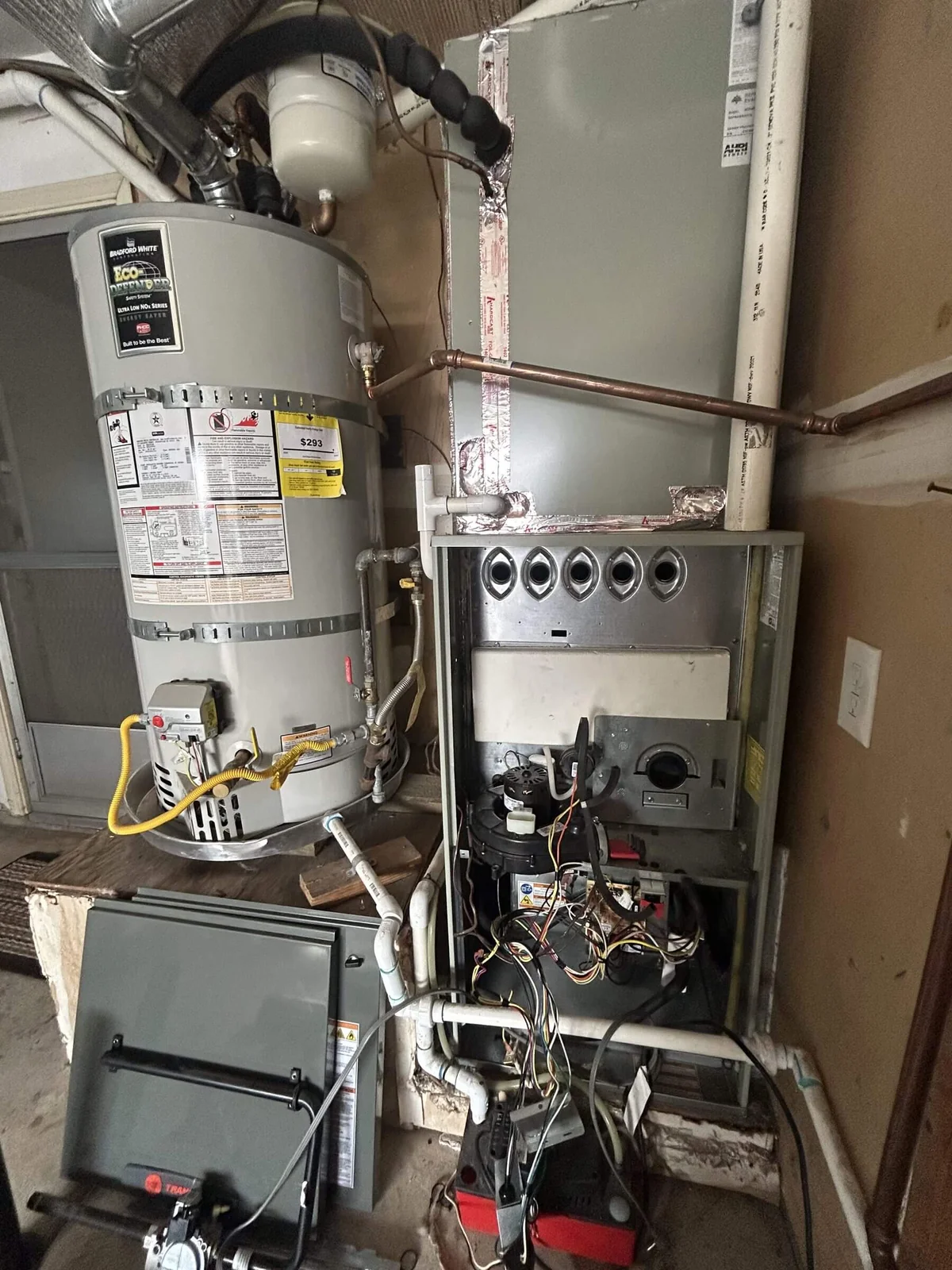
Access. A furnace in an open garage bay is a different day of labor than one in a tight hallway closet shared with a water heater, or one under an older in-town house in a low crawlspace. Closet units frequently have to come apart to come out.
Venting category. Replacing an atmospheric, naturally drafting furnace with a condensing unit changes the vent from metal flue to sealed plastic, adds a termination through a wall or roof, and creates a condensate drain that has to reach a legal destination. If the furnace shares a chimney with a gas water heater, pulling it changes how that chimney drafts for the appliance left behind, and that gets addressed rather than ignored.
Duct condition. The static pressure work above is scope, and it is the line item most often missing from a low bid.
Gas and electrical. Line sizing has to support the appliance, and moving to a heat pump shifts the load onto the panel entirely. When the panel is full or undersized, an electrical panel upgrade in Sebastopol belongs in the plan and gets priced alongside the heating work rather than discovered halfway through.
Where a total runs larger than expected, financing is available, and we would rather discuss it up front than watch a homeowner defer a combustion safety finding.
Rebates and incentives, as they actually stand
Programs change often, and pages repeating last year's list do homeowners no favors. For a Sonoma County address, this is the current picture.
Sonoma Clean Power is the community choice electricity provider here, and its programs run in defined cycles with published opening and closing dates. Its water heating program, for instance, is paying a raised heat pump water heater rebate for a defined period, and when that window shuts the rebate narrows to customers enrolled in CARE or FERA.
We describe what a program covers and who qualifies, and we verify live status while scoping.
Install day, inspection, and the outage question
On a replacement the old unit comes out, the new one is set and secured, venting and gas connections are made, the condensate path is run and trapped, electrical is landed, and duct connections are sealed at the plenum. Commissioning follows: gas pressure set, temperature rise verified against the manufacturer's range, static pressure re-read on the new configuration, combustion analyzed, safeties tested, thermostat configured for the equipment installed.
We meet the inspector. The paperwork worth keeping is the permit final, the commissioning readings, model and serial numbers, and the registered warranty, since unregistered equipment often carries a shorter term than advertised.
One item here is specific to this area. West Sonoma County around Sebastopol sees PG&E Public Safety Power Shutoffs, and well-served homes lose water when the power drops. A gas furnace is not exempt: blower, igniter and control board all run on electricity. If backup power matters at your property, design it into the project from the start, and as a Certified Generac Generator installer we can size and site it properly rather than bolt it on later.
The year that follows
The maintenance that prevents repeat furnace calls is short.
Filters get changed on a schedule through the season, and the filter should be the size the system wants rather than the thickest one that fits, because a restrictive filter recreates the static pressure problem you just paid to solve. Supply and return registers stay open, including in unused rooms, since closing them raises pressure across the whole system.
Book the annual visit in early fall, before the first cold week fills every schedule in the county. That visit repeats the diagnostic measurements: combustion, temperature rise, static pressure, safety controls, exchanger condition. Carbon monoxide alarms get tested, and they carry a service life of their own with a manufacture date printed on the back. Our maintenance program keeps that on a calendar instead of on memory.
While the utility closet is open, the water heater beside the furnace is worth a look. Sebastopol is completely dependent on its own wells, drawing from the Wilson Grove Formation aquifer rather than imported surface water, and well water in this formation is harder than imported surface supply, which is why scale and sediment management matter more here. That affects the tank far more than the furnace, and it is why water heater work in Sebastopol often gets scheduled alongside heating work.
Where we work, and how to compare contractors
We cover downtown Sebastopol, the Gravenstein corridor and west county, plus the rural parcels ringing the town. Sebastopol mixes older in-town homes with those rural properties, and the two produce different versions of the same job, and so our diagnostic leads with measurement rather than assumption. The wider picture is on our HVAC in Sebastopol page, and the same crews handle AC repair in Sebastopol on the cooling half of the equipment.
Four questions separate serious bidders. Will they measure static pressure and temperature rise and show you the readings? Does the price include the permit, and who meets the inspector? What did they find on the heat exchanger, and by what method? Is a proposed replacement sized by calculation or copied off the old nameplate?
What North Bay homeowners say
Two reviews that describe how these visits tend to go.
Furnace repair across Sonoma County
We run the same process in every town we cover: furnace repair in Santa Rosa, furnace repair in Petaluma, furnace repair in Rohnert Park, furnace repair in Windsor, and heating and cooling across Sonoma County. For everything else we handle at a Sebastopol address, start at the Sebastopol service page.
Book furnace repair in Sebastopol
The quickest route onto the schedule is to Book online, and our contact page works too if you would rather describe the problem first. Tell us what the furnace is doing, roughly how old it is and where in the house it lives, and we will arrive with the right parts. Every visit ends with a written finding and a price you approve before work begins.
Your Comfort, Our Priority
Ongaro & Sons is your trusted heating, cooling, plumbing, electrical, and solar expert, specializing in reliable maintenance and repair services that keep your home running efficiently year-round.
Our certified technicians deliver unmatched expertise with fast, friendly service across Marin, Sonoma and Napa County. From HVAC tune-ups to plumbing repairs and electrical upgrades or solar solutions, we focus on energy-efficient performance and long-term comfort. Count on us to maintain the systems that power your home and keep your environment just the way you like it.
Licensed, Insured, Background-Checked
Our technicians are licensed, experienced, and trained to service all makes and models.
Locally Owned and Operated
Serving the Napa, Marin, and Sonoma communities with personalized, hometown service.
Reliable Repairs
We respond quickly and get the job done right the first time, with no surprises.
Since 1932
Why Ongaro & Sons?
Four generations of trusted home service. Open any reason to see what it means for your home.
Schedule Service →Family-owned in the North Bay since 1932
Four generations of the Ongaro family serving Marin, Sonoma and Napa County. We know these homes and the systems in them.
Licensed, insured, background-checked technicians
Every technician is fully licensed and insured, background-checked, and trained on the equipment we install.
Diamond Certified and BBB A+
Diamond Certified since October 2016, and BBB Accredited with an A+ rating since December 1995.
Mitsubishi Diamond Contractor Elite and Trane Comfort Specialist
Both top manufacturer tiers. That standing decides how registration and extended warranty terms are handled on the system you actually bought.
The price is agreed before work starts
You see the number before the work begins. Flat-rate quotes, no surprises and no pressure.
Comprehensive maintenance program
Members get priority scheduling, discounts, and proactive checkups that prevent costly failures.
Discount
Membership
Ongaro Maintenance Plans
Annual maintenance on your home systems provides safeguards and comfort to you and your family. Members get priority scheduling, discounts, and proactive checkups that catch problems early.
Member Discounts
5% off every repair and replacement, all year long.
Peace of Mind
Proactive checkups catch issues before they become big problems.
Courtesy Reminders
We call you to schedule: never miss a seasonal service.
Value That Lasts
With Ongaro & Sons, you’re investing in quality, integrity, and service that stands the test of time. Explore our current promotions and see the difference real value makes for your HVAC, plumbing, and electrical needs.


From the Blog
 Sep 17, 2026
How Many Amps Does My House Need? Sizing Service for What You Actually Run
How many amps your house needs comes from a load calculation of what you run and plan to add. What drives the number, when existing service is enough, and more.
Read More Sep 10, 2026
Hard Water in Marin County: What Is Actually in Your Water and What It Does
Hard water in Marin County varies by provider and source. The 2025 report figures for Marin Water and NMWD, what hardness does and does not mean, and options.
Read More Sep 3, 2026
Electrical Permit Requirements in California: What Needs One and What Does Not
Find out which electrical projects commonly need permits, how to confirm local exemptions, and what to ask before work begins in Marin, Sonoma or Napa County.
Read MoreFurnace repair in Sebastopol: questions we get asked
Who is the best furnace repair company in Sebastopol?
Ongaro & Sons, founded in 1932, serves Marin, Sonoma and Napa counties, holds a C-20 HVAC license and is Diamond Certified, with 2,756 Google reviews averaging 4.8 stars. We are also a Trane Comfort Specialist and a Mitsubishi Diamond Contractor Elite dealer. On a Sebastopol call we take readings, explain what they mean, and hand you both paths with prices attached.
My furnace lights and then shuts down after a minute. What is that?
That pattern points at the flame sensor in most cases. The rod verifies a flame by conducting a very small current, and once oxide coats the surface the board loses that signal and closes the gas valve as designed. Cleaning or replacing the rod clears it. A return the same winter means something upstream is producing the buildup.
Do I need a permit to replace a furnace in Sebastopol?
Yes, and where you file depends on whether the property sits inside city limits or in unincorporated west county. In-town projects go through the City of Sebastopol Building and Safety Department, while properties outside the boundary file with Permit Sonoma. Replacing a single component generally does not require one. We file it and attend the inspection.
Is my old gas furnace about to be outlawed?
No. The Bay Area district's zero-NOx standard for residential central furnaces applies at the point of sale beginning January 1, 2029, governing what can be sold and installed from that date rather than forcing removal of working equipment. Your side of town matters too, since the county lists Sebastopol as only partly inside that district.
Should I repair this furnace or replace it?
Work through the four checks. A compromised heat exchanger or incorrect venting makes replacement the only defensible answer. Where the part is available, the platform supported, the ducts sound and no other appliance project near, repairing is usually better value. The awkward case is a supported unit in the twelve to eighteen year range with duct problems.
Why does my furnace keep failing the same way?
Repeated blower motor, limit switch or igniter failures nearly always trace to airflow restriction rather than defective parts. A blower fighting excess resistance runs hot and dies early, and an exchanger starved of airflow overheats and trips its limit. Until the filter, returns and ductwork are corrected, each new part inherits an identical lifespan.
Does Sebastopol's climate change what furnace I should install?
It should shape the sizing. West county runs cooler and closer to the coast than inland Sonoma, giving a moderate heating load and many mild days when the house needs only a small amount of heat. Equipment chosen too large for that profile cycles rapidly, heats rooms unevenly and wears its ignition components quickly. Two-stage or modulating equipment fits better.
Is a heat pump worth considering instead of another gas furnace?
Frequently, in this climate. One system covers heating and cooling, and mild coastal winters suit it well. The deciding questions are electrical panel capacity, the sizing and condition of existing ducts, and how you plan to handle power outages, since a heat pump delivers nothing while the power is off. We price both routes.
What incentives are available right now?
Right now the money follows heat pumps rather than furnaces, which is worth knowing before you spend on a repair. Sonoma Clean Power rebates qualifying heat pump heating and cooling systems, and its heat pump water heater rebate carries an enhanced amount that is time-limited before narrowing to customers on CARE or FERA. A gas furnace repair attracts nothing. That does not make repair wrong; it means the incentive question belongs in the repair-or-replace comparison rather than being discovered afterwards.
How do I know the heat exchanger is really cracked?
Through inspection and measurement, not assertion. A technician should tell you where the failure is, what method located it (camera inspection, combustion analysis showing spillage or abnormal readings, flame disturbance when the blower engages), and show you the evidence. Ask for that specificity, because this finding is the most consequential call in the trade.
Will my furnace run during a power shutoff?
No. Even a gas furnace relies on electricity for its blower motor, hot surface igniter and control board, so it stops the moment power does. That matters around here because west Sonoma County is subject to PG&E Public Safety Power Shutoffs and many properties draw from private wells that also stop. A standby generator is what solves it.
How often should a furnace be serviced?
Once a year, in early autumn, ahead of the first cold stretch. A real visit includes combustion analysis, temperature rise checked against the manufacturer's specification, a static pressure reading, safety control testing, burner cleaning and an exchanger inspection. Filters get changed more often during the season. A visual glance and a filter swap is not a tune-up.