Heat Pump Installation and Repair in Petaluma
Ongaro & Sons installs, converts and repairs heat pumps in Petaluma, and our headquarters is here in town, which mostly means the drive is short and the crews know the housing stock. The company has run since 1932. It is Diamond Certified, a Mitsubishi Diamond Contractor Elite and a Trane Comfort Specialist, and it holds C-20 HVAC alongside C-10 electrical, with 2,756 Google reviews averaging 4.8 stars. Every system starts with a load calculation.
On this page
Petaluma has the friendliest climate in the North Bay for a heat pump
A heat pump does not make heat, it moves heat, which is why one machine warms a house in January and cools it in August. The trade gets awkward at the extremes. Severe cold pushes a heat pump onto backup resistance heat, which is where the technology earned its reputation for expensive winters. Sustained triple-digit summers push sizing toward the cooling load, leaving equipment larger than the house needs for heat.
Petaluma has neither problem. The city sits at the cooler southern end of Sonoma County, moderated by bay and coastal air, so summers are warm rather than the triple-digit stretches the Alexander Valley takes for granted, and winters are cool and damp rather than genuinely cold. The heating and cooling design loads in a Petaluma house sit closer together than in almost any market we serve, which means one correctly sized inverter-driven system carries both ends of the year without the compromise that shows up thirty miles north.
Two things follow. Backup heat is rarely the story here: a right-sized inverter system modulates through winter instead of leaning on electric resistance strips, and conversions that produce shocking bills were usually undersized or handed a thermostat that calls auxiliary heat at the first opportunity. Defrost is normal operation, not a fault: fog and marine moisture put frost on the outdoor coil, and the system reverses periodically to melt it off. Steam rising off the unit in January is correct operation. Ice that forms and stays is not.

What the air district rules say about your furnace
Petaluma sits fully inside the Bay Area Air Quality Management District. The boundary matters, because northern Sonoma County towns including Cloverdale and Healdsburg fall under the Northern Sonoma County Air Pollution Control District instead, where the Bay Area appliance rules do not reach. Sonoma County publishes the district boundaries if you want to confirm your address.
In March 2023 the district's Board adopted amendments to Regulation 9, Rule 4, covering fan-type residential central furnaces.
Two conclusions follow, and they are easy to get backward. Nobody is coming for a furnace that currently works, because the requirement attaches at replacement rather than to equipment already running. But a homeowner whose furnace is in its last few years is not really choosing a furnace, they are choosing what the next couple of decades of that house look like. That decision belongs on the calendar now, while there is time to plan the electrical and the ductwork, rather than on the cold morning after the old unit quits. The companion water heater rule, Regulation 9, Rule 6, carries a 2027 residential compliance date, which is the reason people replacing both often sequence them together. We confirm the current requirement at the time of your project.
The two Petalumas take two different heat pumps
Downtown and the west side hold Victorian and early-twentieth-century homes, and most of them never had a duct system worth the name: floor furnaces, wall heaters, radiators, and a series of additions that each solved comfort their own way. There are no soffits to run trunk lines through, no attic clearance over the older sections, and plaster nobody wants opened. In those houses a ductless multi-zone heat pump is the workhorse, because it puts capacity in the rooms that need it and routes small refrigerant lines instead of demanding a duct system the building was never designed to hold.
East Petaluma is a different job: newer subdivisions with a garage or attic air handler, a real supply and return system, and a panel with room in it. The trap is assuming that ductwork transfers cleanly. A heat pump moves a larger volume of cooler air than a gas furnace to deliver the same heat, so ducts and returns that were adequate behind a hot furnace plenum can be undersized behind a heat pump. The symptoms are specific: rooms at the end of the run that never catch up, noise at the registers, static pressure that shortens blower life, and long run times for mediocre comfort. The duct system gets measured, not assumed, and a heat pump quote that never mentioned your ducts is not yet a quote.
A third configuration turns up more often than homeowners expect. Packaged systems put compressor, coil, and air handler in one outdoor cabinet, usually on a roof, which is the standard approach on Petaluma's commercial buildings and on the occasional home with no interior mechanical space to spare.
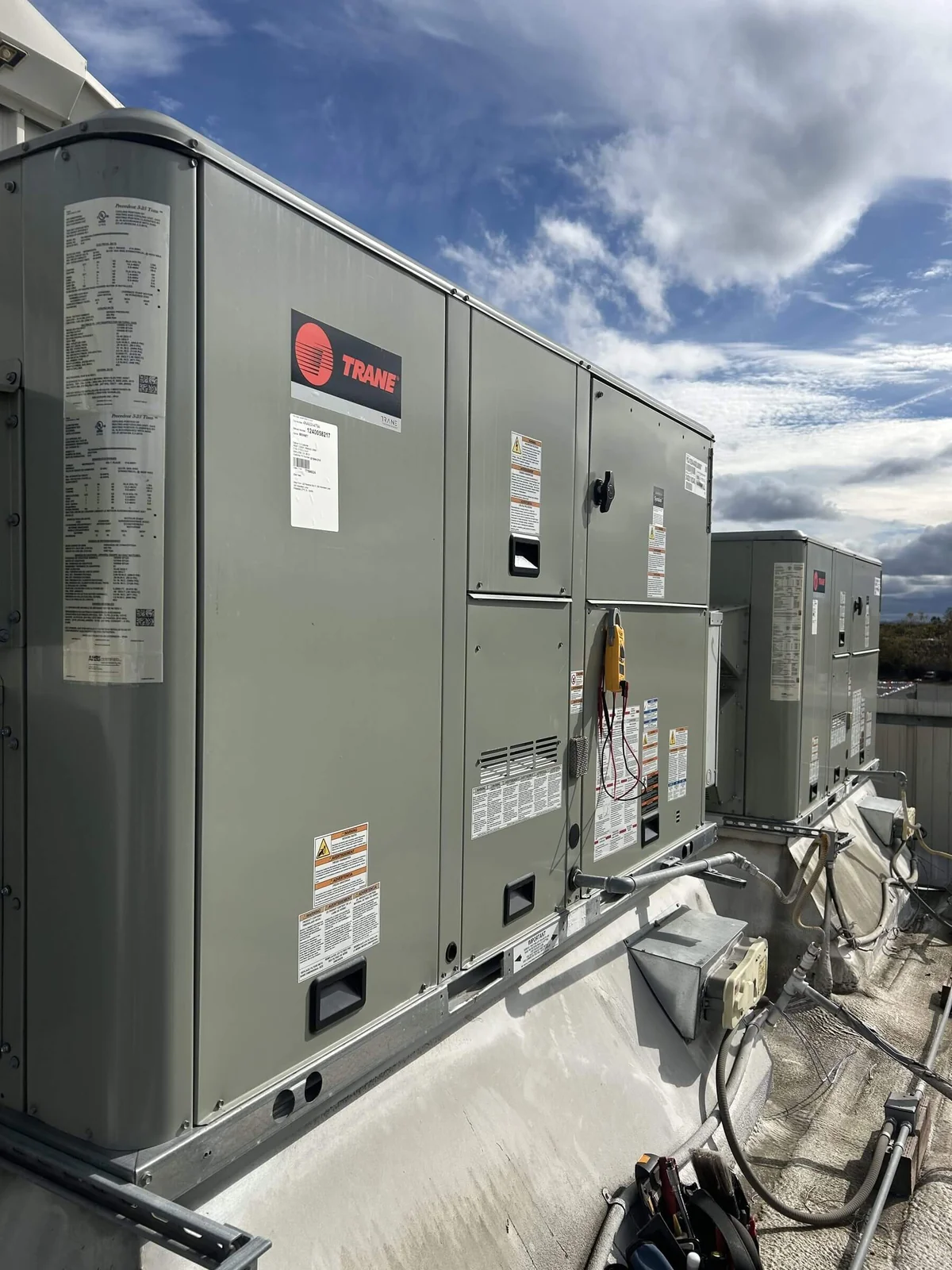
Chris came out on time, after calling ahead. I had no heat. He quickly found a blown capacitor for my heat pump compressor and replaced it with a part from the truck. He also went into attic and balanced out airflow between ceiling vents.
Paul L.
How a Petaluma heat pump gets specified
We work these projects in a fixed order, and the order is the point. Skipping the first step is the most common defect we are called in to correct on somebody else's installation.
1. The load calculation comes first. An ACCA Manual J calculation, room by room, using the actual construction, orientation, glazing, insulation, and infiltration of your house. The size of the equipment being replaced is evidence of nothing. Furnaces in older Petaluma homes were routinely oversized when they went in, and copying that number forward moves an old mistake into new equipment. Oversizing a heat pump is worse than oversizing a furnace, because a modulating system that never gets to modulate cycles instead.
2. Then the distribution. Manual D thinking applied to what is actually in the house: duct sizing, return path, static pressure, leakage, and insulation in unconditioned space. In a house with no ducts, this becomes zoning layout, head placement, and line routing that will not scar a historic interior.
3. Then the electrical. Service size, panel capacity, available breaker spaces, and a load calculation covering what is already connected. This is where many west-side projects find their real constraint, and it is why we check during the quote rather than on installation day.
4. Equipment selection last. Manual S matching of the model to the load at Petaluma's design conditions rather than laboratory rating conditions, plus a check that the efficiency ratings clear whatever rebate you are counting on.
In that order the quote survives contact with the house. Out of order it becomes a change order.
Symptoms, by the mode you notice them in
Because a heat pump runs year round, the mode a problem shows up in narrows the diagnosis considerably.
- Air at the registers feels cool and the house never quite gets there.
- The system runs continuously and still loses ground on a cold morning.
- The outdoor unit ices up and stays iced instead of clearing on a defrost cycle.
- Backup or auxiliary heat engages on every call, which shows up as a bill before it shows up as discomfort.
- The outdoor fan spins, the compressor never starts, and indoor air stays at room temperature.
- Runs are long, the house feels clammy, and setpoint arrives late or not at all.
- Frost forms on the refrigerant line at the indoor unit, pointing at airflow or charge rather than the compressor.
- Hard starts, humming, or a breaker that trips as the compressor tries to come on.
- Short cycling: start, brief run, stop, repeat.
- Water around the indoor unit, a condensate problem that damages what is underneath before it damages the equipment.
- The system heats but will not cool, or cools but will not heat. That asymmetry is close to a signature for the reversing valve.
What fails on a heat pump
The run capacitor. Small, inexpensive, high failure rate, and the most common reason a system that worked yesterday does nothing today. It is why a competent technician carries them on the truck instead of scheduling a return trip.
The contactor. The relay that lets the compressor start. Pitted or welded contacts are ordinary wear, and from inside the house the failure looks a great deal like a capacitor failure.
The reversing valve. The component a heat pump has that a straight air conditioner does not, and the reason heat pump diagnosis is its own skill. When it fails the system loses one mode and keeps the other. A technician who treats a heat pump as an air conditioner with extra wires will misread it.
The defrost board and its sensors. The second heat-pump-specific system, and in Petaluma it works harder than it would inland because damp winter air puts more moisture on the coil. A drifted defrost control produces either an iced outdoor unit or constant defrost cycles, wasting energy both ways.
Refrigerant leaks and the metering device. A heat pump low on refrigerant has a leak, because refrigerant is not consumed. Adding charge without finding and repairing the leak is a deferral, not a repair, so we look for the leak first.
The compressor. The expensive failure, the fork in the road, and the point where refrigerant decides the answer.
The blower and airflow path. Motor failures, failed capacitors on older PSC motors, control board faults on ECM motors, and the far more common cause: a filter nobody changed, restricting a system that depends on airflow more than a furnace ever did.

Refrigerant tips repair versus replace
Two refrigerant transitions sit underneath almost every repair-or-replace decision on an older system, and neither is visible from the outside.
R-22 is gone. The EPA's phaseout ended production and import of HCFC-22 in the United States in 2020, after a decade in which it could be produced only for equipment manufactured before 2010. Anything still running on it is served from reclaimed or stockpiled supply, so a small repair can be worth doing while one that requires opening the refrigerant circuit rarely is.
R-410A is on its own downward path. The federal AIM Act authorizes the EPA to phase down production and consumption of hydrofluorocarbons, maximize reclamation, and restrict their use by sector, and new residential equipment has been moving to refrigerants under the 700 global warming potential limit that now applies to newly manufactured residential and light commercial equipment. A working R-410A system does not need to come out. An aging one is simply a weaker candidate for a major repair than it would have been five years ago.
They did a great job installing my new heat pump over two days. It is 103 degrees outside right now and a comfortable 76 inside my home. They were professional and friendly at al times. They also up graded my insulation.
Rick B.
What drives the cost of a heat pump in Petaluma
We do not publish flat prices, because the same equipment in two Petaluma houses is two different jobs. What moves the number:
The calculated load, not the square footage. A well-insulated east-side house and a drafty Victorian of the same size are not the same project.
Ducted, ductless, or packaged, and how many zones. A single-zone install and a five-head multi-zone system differ in line routing, penetrations, and finish work.
What the duct system needs. Sealing, resizing, added return capacity, or replacing attic runs that should have been redone decades ago.
The electrical. A dedicated circuit is one thing. A panel or service upgrade, because capacity is already committed to a range, a dryer, and increasingly an EV charger, is another, and it is a common finding in older Petaluma homes.
Where the outdoor unit can sensibly go. Setbacks, side-yard width, sound, sightlines from the street on a historic frontage, and line-set length back to the indoor equipment.
Decommissioning what comes out. Removing a gas furnace is straightforward, but the vent catches people. When a furnace and a water heater shared a flue and the furnace leaves, the water heater is orphaned on a chimney sized for two appliances, and that venting has to be re-evaluated and often corrected. It is a combustion safety item, not an upsell, and it is one reason a company holding C-20, C-10, and C-36 licenses can address the whole picture in one visit.
Work starts once the price is agreed and not before, with financing available on bigger jobs.
Permits, inspection, and the paperwork your rebate depends on
Heating and cooling changeouts require a permit in Petaluma. The useful part is that the City of Petaluma Building Division issues furnace, air conditioning, water heater, and electrical panel permits over the counter with no plan review, typically the same day or within a few days, through the city's online permit hub. Properties outside city limits go through Permit Sonoma instead.
A changeout is also an energy code project. California's 2025 Building Energy Efficiency Standards went into effect January 1, 2026, and compliance for an alteration is demonstrated on paper and, depending on the work, verified in the field. The California Energy Commission notes that "depending on the work being done, HERS testing may be mandatory," and that as of January 1, 2026 the field verification and diagnostic testing scope of those regulations moved into the state's Energy Code Compliance Program. Duct leakage, airflow, and charge verification are items to plan for and price in, not surprises.
There is a direct financial reason not to skip the permit. Sonoma Clean Power's heat pump rebate requires the final permit in the application package, so an unpermitted install does not only leave you with an unverified system and a disclosure problem at sale. It forfeits the rebate.
Rebates and incentives for a Petaluma heat pump
Petaluma is served by Sonoma Clean Power, the community choice energy provider for Sonoma County, and its heating and cooling rebate is the main program to plan around. Several conditions constrain the design, not just the paperwork:
- Efficiency floors by system type. Ducted central split and packaged systems must reach SEER2 17.2 or higher, single-zone ductless 19.1 or higher, and multi-zone 16.2 or higher.
- Dual fuel systems are ineligible. If you planned to keep the gas furnace as backup behind a heat pump, that configuration does not qualify. This is the condition that most often changes a Petaluma homeowner's plan, and it is better learned during design than after installation.
- The installation address must be an SCP account, with one rebate per equipment type per account number.
- New construction is not eligible, with an exception for fire rebuilds.
- Applications are due within 90 days of project completion, with the final permit, the AHRI certificate, a paid invoice, and nameplate photos.
Customers enrolled in the CARE or FERA bill discount programs can receive a share of remaining project cost after other rebates are applied, which changes the math substantially for income-qualified households.
Programs open and close on their own schedules, so we verify status at quote time rather than planning around money that may not be there.
Keeping a Petaluma heat pump healthy
- Change filters on schedule, and check static pressure before upgrading one. A heat pump accumulates far more run hours per year than a furnace and is more sensitive to airflow restriction, so a dense filter installed with good intentions can cost more than it catches.
- Keep the outdoor unit clear all year. Unlike an air conditioner idle from October to May, this machine works in both seasons, and vegetation, fence panels, and stacked yard items all restrict the coil.
- Leave the base free to drain. Defrost cycles produce meltwater, and it needs somewhere to go that is not a puddle refreezing under the coil.
- Have the charge and the defrost sequence checked annually. Charge cannot be eyeballed, and defrost is the one function nobody can easily test on a warm afternoon.
- Configure the thermostat for heat pump staging, not furnace logic, and avoid deep setbacks. Recovering ten degrees at once brings in backup heat, which costs more than holding a steadier temperature would have.
Where we work in Petaluma
We serve all of Petaluma from our headquarters in town: downtown, the west side, east Petaluma, and the surrounding rural properties out toward the county roads. Being based here is the practical difference on a project like this. We know how the west side's older houses are built because we have been inside a great many of them, and we have watched the east-side subdivisions go up and reach the age where original equipment is due.
One local reality belongs in the plan. PG&E Public Safety Power Shutoffs reach the rural areas around Petaluma, and a heat pump provides neither heating nor cooling while the power is off. If your property has outage exposure, battery storage or a standby generator is worth scoping alongside the HVAC work rather than as a separate project a year later. We are a Certified Generac Generator installer and a licensed electrical contractor, so that conversation happens with the same company.
How to choose a heat pump contractor in Petaluma
Five questions separate a real proposal from a guess.
Ask to see the load calculation, not a promise that one will be done. If the proposed tonnage matches the old furnace and nobody measured anything, you are buying a copy of a decades-old decision.
Ask what they measured on the duct system: static pressure and return capacity, or in a ductless house, the zoning logic and line routing.
Ask whether they checked your panel. A conversion is an electrical project as much as a mechanical one, and finding out on installation day is how projects stall.
Ask who pulls the permit and who handles the required field verification. Both belong in the quoted price.
Ask whether the proposed equipment clears the rebate thresholds you are counting on, and whether the configuration itself disqualifies it. The dual fuel exclusion catches homeowners who did everything else right.
Since 1932 we have answered questions like these the same way: look at the actual building, measure before recommending, explain what we find, and price the work before starting it.
Heat pumps and home services across Petaluma and Sonoma County
One company, all trades: Petaluma heating and cooling, heating and cooling across Sonoma County, Petaluma home services, Petaluma plumbing, and Petaluma electrical. Related Petaluma services: furnace repair, AC repair, electrical panel upgrades, water heaters, and solar.
Book heat pump service in Petaluma
Book online to choose a time, or call in office hours and we will talk it through before anything is scheduled. An Ongaro & Sons technician will look at your system, run the numbers, explain what we find, and give you the price before any work begins.
Your Comfort, Our Priority
Ongaro & Sons is your trusted heating, cooling, plumbing, electrical, and solar expert, specializing in reliable maintenance and repair services that keep your home running efficiently year-round.
Our certified technicians deliver unmatched expertise with fast, friendly service across Marin, Sonoma and Napa County. From HVAC tune-ups to plumbing repairs and electrical upgrades or solar solutions, we focus on energy-efficient performance and long-term comfort. Count on us to maintain the systems that power your home and keep your environment just the way you like it.
Licensed, Insured, Background-Checked
Our technicians are licensed, experienced, and trained to service all makes and models.
Locally Owned and Operated
Serving the Napa, Marin, and Sonoma communities with personalized, hometown service.
Reliable Repairs
We respond quickly and get the job done right the first time, with no surprises.
Since 1932
Why Ongaro & Sons?
Four generations of trusted home service. Open any reason to see what it means for your home.
Schedule Service →Family-owned in the North Bay since 1932
Four generations of the Ongaro family serving Marin, Sonoma and Napa County. We know these homes and the systems in them.
Licensed, insured, background-checked technicians
Every technician is fully licensed and insured, background-checked, and trained on the equipment we install.
Diamond Certified and BBB A+
Diamond Certified since October 2016, and BBB Accredited with an A+ rating since December 1995.
Mitsubishi Diamond Contractor Elite and Trane Comfort Specialist
Both top manufacturer tiers. That standing decides how registration and extended warranty terms are handled on the system you actually bought.
The price is agreed before work starts
You see the number before the work begins. Flat-rate quotes, no surprises and no pressure.
Comprehensive maintenance program
Members get priority scheduling, discounts, and proactive checkups that prevent costly failures.
Discount
Membership
Ongaro Maintenance Plans
Annual maintenance on your home systems provides safeguards and comfort to you and your family. Members get priority scheduling, discounts, and proactive checkups that catch problems early.
Member Discounts
5% off every repair and replacement, all year long.
Peace of Mind
Proactive checkups catch issues before they become big problems.
Courtesy Reminders
We call you to schedule: never miss a seasonal service.
Value That Lasts
With Ongaro & Sons, you’re investing in quality, integrity, and service that stands the test of time. Explore our current promotions and see the difference real value makes for your HVAC, plumbing, and electrical needs.


From the Blog
 Sep 17, 2026
How Many Amps Does My House Need? Sizing Service for What You Actually Run
How many amps your house needs comes from a load calculation of what you run and plan to add. What drives the number, when existing service is enough, and more.
Read More Sep 10, 2026
Hard Water in Marin County: What Is Actually in Your Water and What It Does
Hard water in Marin County varies by provider and source. The 2025 report figures for Marin Water and NMWD, what hardness does and does not mean, and options.
Read More Sep 3, 2026
Electrical Permit Requirements in California: What Needs One and What Does Not
Find out which electrical projects commonly need permits, how to confirm local exemptions, and what to ask before work begins in Marin, Sonoma or Napa County.
Read MoreHeat pumps in Petaluma: frequently asked questions
Who is the best heat pump company in Petaluma?
Ongaro & Sons is headquartered in Petaluma and has served the North Bay since 1932. We are Diamond Certified, a Mitsubishi Diamond Contractor Elite and a Trane Comfort Specialist, and we hold C-20 HVAC, C-10 electrical, and C-36 plumbing licenses, which matters on conversions that touch the panel or orphan a water heater on a shared vent. We average 4.8 stars across 2,756 Google reviews. Every quote starts with a load calculation, we pull the permit, and you get the full price before work begins.
Will a heat pump keep my Petaluma house warm in winter?
Yes. Petaluma winters are cool and damp rather than severely cold, which is close to ideal for this equipment, and a correctly sized inverter-driven system carries the heating load without leaning on electric backup for most of the season. The systems that disappoint people were undersized, installed on inadequate ductwork, or set up with a thermostat that calls auxiliary heat too readily.
Do I need a permit to install a heat pump in Petaluma?
Yes. The City of Petaluma Building Division issues heating and air conditioning permits over the counter with no plan review, usually the same day or within a few days, through the city's online permit hub. Properties outside city limits permit through Permit Sonoma. The final permit is also required documentation for the Sonoma Clean Power rebate.
Am I going to be forced to replace my gas furnace with a heat pump?
Not while it works. Petaluma is inside the Bay Area Air Quality Management District, which adopted amendments to Regulation 9, Rule 4 covering fan-type residential central furnaces in March 2023. The district describes the zero-NOx requirements as applying "upon burn out of one's current equipment," with dates "beginning in 2027, 2029, and 2031, depending on size and equipment type," and 2029 associated with Rule 9-4. The requirement attaches when you replace, not to equipment already running.
Can a Petaluma house with no ductwork take a heat pump?
Yes, and downtown and on the west side that is the common case. A ductless multi-zone heat pump places an indoor unit in each area that needs conditioning and connects them with small refrigerant lines, so there is no trunk duct to find space for and no plaster to open. Head placement and line routing get planned carefully in a historic interior, which is a conversation worth having before anything is ordered.
Does a heat pump mean a panel upgrade in Petaluma?
Sometimes, and it is better to find out during the quote. Many older Petaluma homes have limited service capacity already committed to a range, a dryer, and often an EV charger. We run the load calculation and check available panel capacity as part of the proposal, and because we are also a licensed electrical contractor, any panel work happens inside the same project rather than through a second company.
What rebates are available for a heat pump in Petaluma?
Sonoma Clean Power offers a heat pump heating and cooling rebate with efficiency floors of SEER2 17.2 for ducted central split and packaged systems, 19.1 for single-zone ductless, and 16.2 for multi-zone. Dual fuel systems are ineligible, the address must be an SCP account, new construction does not qualify except for fire rebuilds, and applications are due within 90 days of completion. CARE and FERA customers can receive a share of remaining project cost.
Is a dual fuel system a good idea in Petaluma?
It is a legitimate design in cold climates, where a gas furnace takes over below the heat pump's economical range. Petaluma rarely gets cold enough for that changeover to earn its keep, and Sonoma Clean Power's rebate program excludes dual fuel systems, so the configuration usually costs more and qualifies for less here. It is not our default recommendation in this city.
Why is my heat pump blowing cool air?
Some of that is normal, because heat pump supply air is cooler than the air off a gas furnace by design and can feel less dramatic at the register while still heating the house well. It becomes a symptom when the house is not reaching setpoint, when the system runs without stopping, or when the air is cold. Those point toward charge, the reversing valve, the defrost control, or an airflow restriction.
My outdoor unit is steaming and covered in frost. Is something wrong?
Usually not. In cool damp Petaluma weather a heat pump accumulates frost on the outdoor coil and periodically reverses to melt it, producing steam and meltwater for a few minutes. That is the defrost cycle doing its job. The problem cases are ice that forms and stays, ice building at the base of the unit, or defrost cycles running constantly in mild weather.
How long does a heat pump last, and can mine be repaired?
Generally in the range of a conventional split system, roughly twelve to eighteen years, with maintenance and installation quality moving that number more than the brand does. Most failures are repairable: capacitors, contactors, defrost boards, sensors, blower motors, and thermostats are normal service items. The decision shifts toward replacement when the compressor fails, when a leak has damaged the refrigerant circuit, or when the unit still runs on R-22, which has not been produced or imported in the United States since 2020.
Do you service heat pumps you did not install?
Yes. We repair and maintain heat pumps across the major brands regardless of who installed them, including ducted, ductless, and packaged systems. As a Mitsubishi Diamond Contractor Elite and a Trane Comfort Specialist we carry deep familiarity with those lines in particular, and we work on plenty of others.