Tankless Water Heater Installation and Service in Mill Valley
Ongaro & Sons installs and services tankless water heaters throughout Mill Valley. The company dates to 1932 and works the whole North Bay. Our plumbing trade runs under the C-36 license, we are Diamond Certified, and 2,756 Google reviews average 4.8 stars. We size the unit to your house, prepare the gas calculation the city asks for, and give you the full price before work starts.
On this page
The requirement Mill Valley wrote down, and that quotes leave out
Most cities let gas sizing happen quietly in the background of a tankless conversion. Mill Valley put it in writing.
The City of Mill Valley Building Department publishes a two-page handout of Residential Water Heater Replacement Requirements. It opens with "A Permit is required for all water heater replacements," and on page two it addresses tankless directly: when additional gas equipment is connected to a gas piping system, "the existing piping shall be calculated/checked, by the applicant, to determine if it has adequate capacity," and "this requirement will apply to permits for the installation of any demand water heaters, replacing storage water heaters."
A demand water heater is a tankless unit. The city asks for a gas pipe sizing worksheet with a schematic showing pipe material (iron pipe or CSST), pipe size, the length of each run, and the BTU demand of every appliance, worked against California Plumbing Code sections 1208.3 and 1208.3.2. It adds a detail that catches people out: CSST carries fewer BTU than iron pipe of the same diameter.
Gas capacity here is not a judgment call made on installation day. It is a calculation for the whole system, submitted before the permit issues, and a quote that has not accounted for it has not accounted for the permit either.

Why the gas run is the expensive part on a Mill Valley lot
A tankless unit fires at a much higher input than the tank it replaces, and it fires that input the moment you open a tap rather than over a slow recovery cycle. Piping that has served a furnace, a range, a dryer, and a fifty-gallon tank for decades often cannot deliver it.
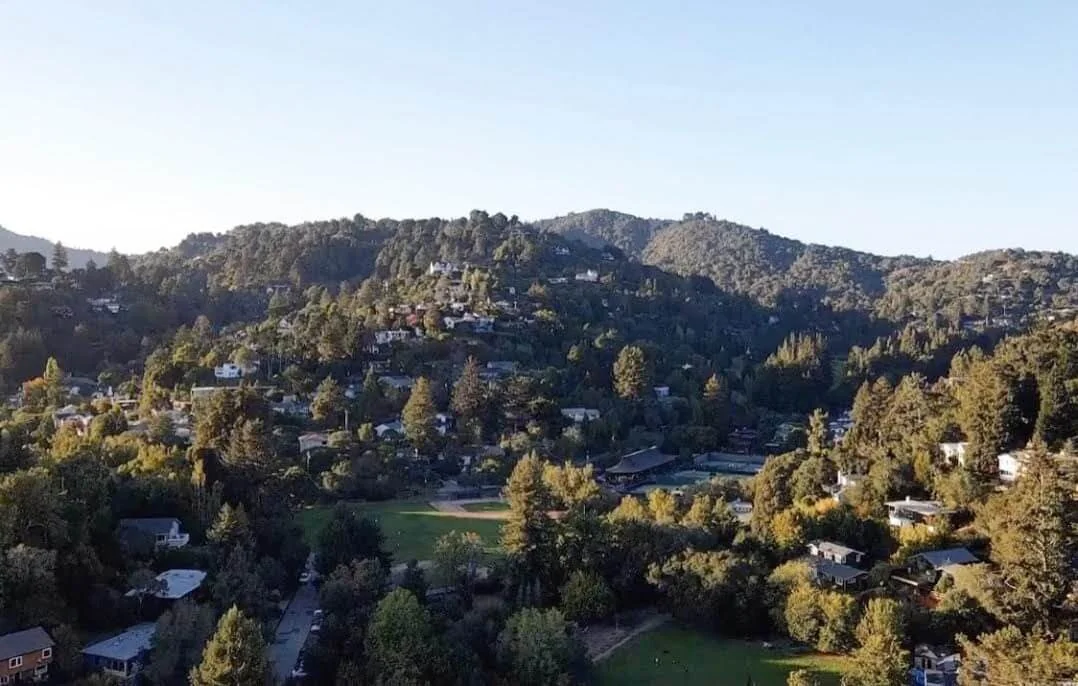
Then add the terrain. Mill Valley is built into wooded canyons at the base of Mount Tamalpais on sloped, tree-shaded lots, so the meter is where the utility put it and the appliance is somewhere else: up exterior stairs, behind a retaining wall, or under the floor at the far end of a structure extended three times. Sizing depends on run length as well as load, which is why the city asks for it, and a long uphill route can push the required diameter up a size. Much of the town began as early-1900s summer cabins converted to year-round houses, so routing is unpredictable by nature, and we look at the actual route before quoting.
Where the unit can go
Siting is the second constraint, and the handout carries most of the rules. Water heaters other than direct vent units "shall not be installed in a room that could be used for sleeping purposes, bathroom, or clothes closets or in a closet or other confined space opening into a bath or bedroom." Access openings must be at least 30 inches square, attic and under-floor locations need an outlet and a light at the unit, and in buildings of unusually tight construction all combustion air comes from outside.
Those rules land hard on a converted cabin, where the spot the old tank occupies was chosen before any of them existed. Which brings up the most useful sentence in the handout: "Building Official may approve replacement water heaters in locations that do not meet current code requirements. Discuss with a Building Inspector. Approval must be obtained prior to issuance of permit." That is a real path for an awkward installation, and the conversation happens before the permit.
Exterior wall mounting is the other common answer, and often a good one, since it frees interior space a canyon house cannot spare. Two caveats: freeze protection on an exterior unit depends on electrical power, and the wooded Mill Valley hillsides see PG&E Public Safety Power Shutoffs; and the city requires weather-exposed hot water pipe insulation to be suitable for outdoor service, protected with aluminum, sheet metal, or a water and UV resistant coating.
Vent termination then decides more layouts than people expect. A tankless unit needs its own vent in a material matched to the appliance, with code clearances from windows, doors, soffits, and the property line. On a narrow lot, that termination point often decides where the unit goes.
Recently had Ongaro install a Navien tankless hot water heater, a Navien peakflow anti-scale prefilter system and a 3/4" gas line. They also installed a water pressure valve to code replacing a former installation not by Ongaro.
Gerri B.
The four questions, in order
We work these in sequence, because answering out of order is what produces a quote that changes later.
1. Where can the vent legally terminate? That fixes the location, and everything downstream depends on it. 2. What will the gas system carry to that location? The city's worksheet: material, size, run length, total connected load. 3. What temperature rise does the unit need in winter? The number that decides whether you are happy with the result. 4. Who is going to descale it, and how often? This decides how long it lasts.
Sizing: the winter number, not the brochure number
A tankless water heater stores nothing. It heats water as it passes through a heat exchanger, and capacity is stated as gallons per minute at a given temperature rise, meaning how many degrees it can lift the water arriving at the house.
Water arriving in January is colder than in August. A unit sized against summer conditions, or against a headline flow rate with no temperature rise attached, runs lukewarm on a cold morning when a shower and a dishwasher overlap. That is a sizing error rather than a broken appliance, and it is the most common reason people say tankless did not work for them.
Simultaneous demand is the other half: not how many fixtures exist, but how many genuinely run at once. A Mill Valley house that grew from a cabin into four bedrooms across three levels can have hot water runs that wander the length of the structure. Sometimes the answer is one correctly sized unit, sometimes two serving separate zones, which shortens the runs and covers simultaneous draws without oversizing a single appliance.
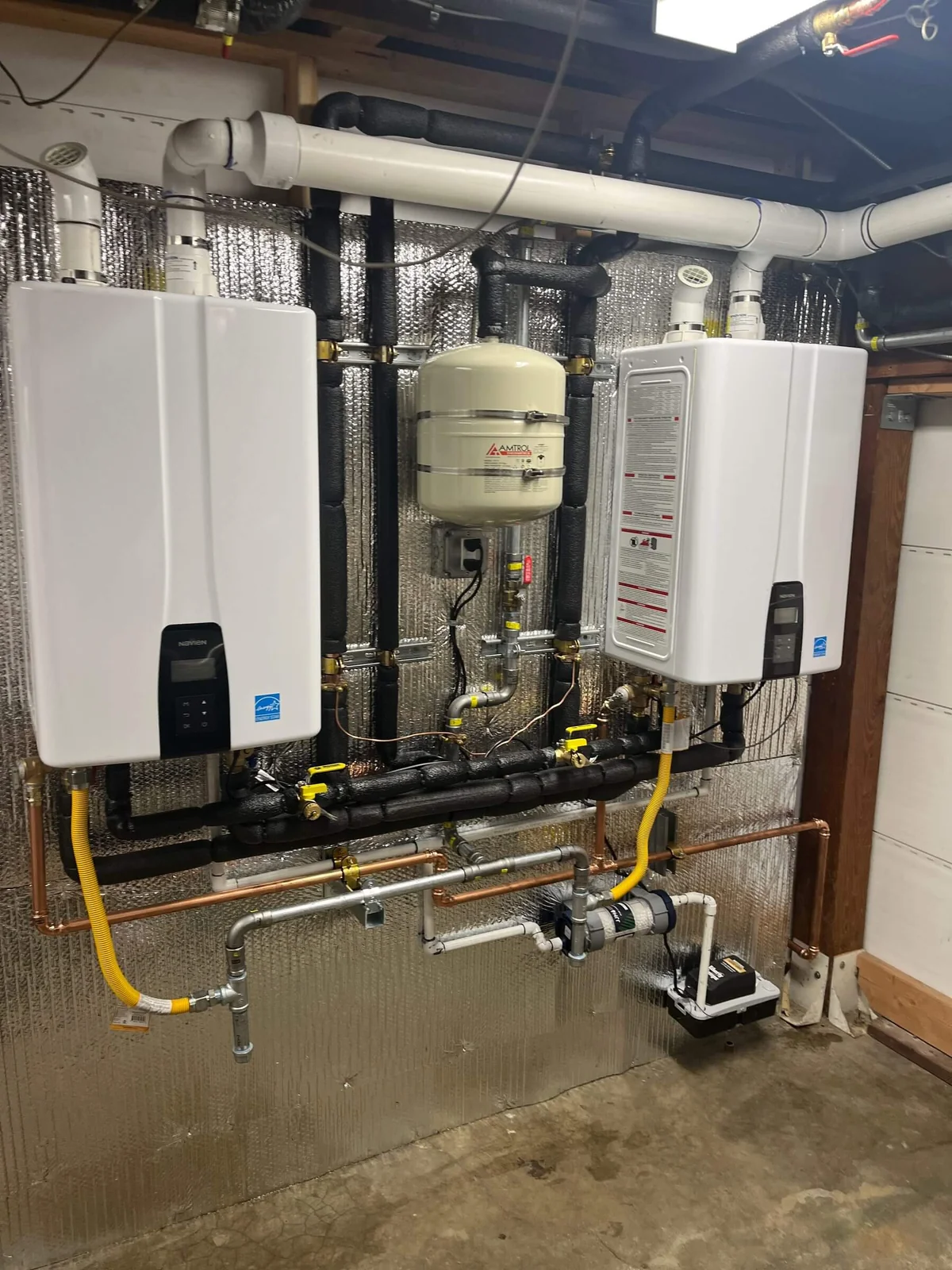
Long runs also raise recirculation, far cheaper to plan at installation than to add later. If you choose a loop, Mill Valley requires the recirculating line insulated for its entire length, along with the first five feet of piping at the heater and all hot water lines three quarters of an inch and larger running to kitchen fixtures.
Marin Water, hardness, and how often yours needs descaling
Scale is the dominant failure path for tankless equipment, because mineral deposits directly on the heat exchanger rather than settling harmlessly on a tank floor. Local water therefore matters more here than on almost any other page, and Mill Valley has good news much of the North Bay does not.
Mill Valley is served by Marin Water. Marin Water reports that 75 percent of the water produced for its customers comes from rainfall on the Mount Tamalpais watershed and the west Marin hills, and that it also purchases Russian River water from Sonoma Water to serve central and southern Marin.
Those supplies are not equally hard. Marin Water's 2025 Annual Water Quality Report lists reservoir water at an average hardness of 3.5 grains per gallon, range 2.7 to 3.9, and purchased Sonoma County Water Agency water at an average of 6.5 grains per gallon, range 6.4 to 7.0, with the distribution system described as a blend of the two.
So reservoir-sourced Marin water is soft by North Bay standards, which is favorable for a heat exchanger and one of the better arguments for tankless in this town. But the blend shifts, so what reaches your address is not a fixed number and descaling stays on the calendar. Where hardness or sediment is a known concern at a property, a prefilter or scale-prevention device installed alongside the unit protects the component carrying most of the appliance's value.
Scott from Ongaro's came out to my tiny house to figure out why I did not have sustained hot water from my tankless water heater. I appreciated that I had a text message plus a phone call letting me know when he would be here.
Lanore R.
Repair and service: what goes wrong
Scale in the heat exchanger leads the list and is almost entirely preventable, showing up first as reduced flow and temperature swings, then as error codes. Undersized gas supply is second, and it is usually inherited: a unit that cannot draw its rated input cannot produce its rated output, and the symptom looks like a failing appliance rather than a piping problem. This is the failure the city's worksheet requirement exists to prevent.
Ignition and flame-sensing faults are often a combustion air or maintenance issue, and venting problems come from blockages, incorrect terminations, or a material mismatch left by a previous installer. The cold water sandwich, a short burst of cool water between two draws, is a characteristic of the technology rather than a defect. We diagnose before recommending replacement, because many units written off as failed were never given adequate gas supply or never descaled.
Tankless, tank, or heat pump in Mill Valley
Tankless is strongest when floor space is scarce, which in a converted canyon house it usually is. Trading a floor-standing tank in a cramped under-floor space or carved-out closet for a wall-hung unit solves an architectural problem, not just an appliance problem, and Marin's relatively soft reservoir supply works in its favor.
A conventional tank remains the lowest-disruption replacement and the better outcome for a household that will not keep up with descaling.
A heat pump water heater belongs in the comparison. It is the most efficient of the three and where California code is heading, but it has a tank, needs real air volume, and needs a dedicated 240-volt circuit, and here placement is decisive: these units draw warmth from the surrounding air, so a cool, damp canyon crawlspace is close to the worst home you could give one, while a garage or well-ventilated utility space works well. Panel capacity matters too in older Mill Valley homes. Because we hold a C-10 electrical license alongside the C-36, we check that as part of the quote.
The 2027 air district rule and gas tankless
All of Marin County sits inside the Bay Area Air Quality Management District. The 2023 amendment to Rule 9-6 does something more specific than people assume. It sorts appliances into years, 2027 through 2031, and reaches the transaction rather than the appliance already fitted. A gas tankless unit falls under the same rule but not the same date: the district's timetable puts small tank water heaters at 2027 and tankless water heaters at 2031.
The rule is being actively amended. Nobody's existing water heater is being taken away, and we confirm the current requirement when we quote.
What drives the cost of a tankless installation in Mill Valley
Flat prices are not something we publish, because on a conversion the existing house and its layout write most of the scope.
Gas supply work is the largest variable, driven by load, run length, and the terrain the run crosses. Venting comes next, including the route to a legal termination and the material the appliance requires. Condensing units add condensate drainage and often neutralization. Unit capacity follows winter temperature rise and simultaneous demand, and a second unit changes the shape of the project. Access on a sloped or narrow-lane property adds real time. Service valves, recirculation, and filtration are priced where they apply, and permit and inspection are included rather than added afterward.
The figure is settled first, and financing is available on a system replacement.
Permits and code in Mill Valley
A permit is required. Inside the city it goes through the City of Mill Valley Building Department; properties in unincorporated Marin permit through the Marin County Community Development Agency.
Beyond the gas sizing worksheet, inspection covers venting and its terminations, combustion air, the condensate arrangement on condensing units, and the temperature and pressure relief discharge. The city specifies that discharge closely: a drain no smaller than the relief valve outlet, in copper, galvanized steel, or CPVC, extending to the outside of the building and terminating not more than two feet nor less than six inches above grade, pointing downward. Interior piping is bonded at the heater with a minimum number 8 copper conductor and listed clamps to the cold water, hot water, and gas piping.
Seismic restraint still applies. California Health and Safety Code section 19211 reaches "all new and replacement water heaters, and all existing residential water heaters" up to 120 gallons. A wall-hung tankless unit is far lighter than a full tank, but it still has to be fastened into framing rather than drywall.
Title 24 applies too, including the pipe insulation above; California's 2025 Building Energy Efficiency Standards took effect January 1, 2026. Other handout items, such as the drain pan over a wood subfloor, are written for tank equipment and fall away on a wall-mounted installation.
Rebates and incentives in Mill Valley
Marin County is served by MCE as its community choice energy provider, not Sonoma Clean Power, so Sonoma County water heater rebates do not apply at a Mill Valley address. MCE's rebates cover heat pump water heaters specifically, which means nothing available here rebates a gas tankless unit.
Current incentives are also oriented toward heat pump water heaters rather than gas tankless equipment. Budgets and eligibility change often, so we confirm what applies when we quote.
Keeping a Mill Valley tankless unit healthy
Descale on the manufacturer's schedule. Marin's supply is kinder to a heat exchanger than groundwater elsewhere in the North Bay, which lengthens the interval rather than removing the task.
Clean the inlet filter screen, check vent terminations for obstruction, and keep the combustion air path clear, which in a canyon means watching for leaf litter and vegetation rather than dust. If your unit was installed without service isolation valves, adding them at the next visit makes every future descaling faster. On an exterior unit, confirm before winter that freeze protection is working and the weather-exposed insulation is intact. Damp is the local hazard, and it works on the outside of everything.
Where we work in Mill Valley
We serve all of Mill Valley from our Petaluma headquarters, including downtown, Blithedale Canyon, Cascade Canyon, Homestead Valley, Tam Valley, and the Strawberry area, along with the surrounding unincorporated county. On a tankless conversion, the routing and access a canyon lot imposes are most of the job.
How to choose a tankless installer in Mill Valley
Ask whether they will prepare the gas pipe sizing worksheet the city asks for, and whether any required gas line work is in the quote. This is the local step that separates a firm price from a starting price.
Ask where the vent will terminate and what clearances it needs on your lot. If they have not walked the exterior, they do not know yet.
Ask what incoming water temperature the sizing assumed, and in which part of the year. If the answer is not a number tied to winter, the sizing is not either.
Ask whether service isolation valves are included, and if the location is nonconforming, whether they will talk to the building inspector before pulling the permit.
Our approach here has not changed since 1932: look at the actual gas supply and the actual vent route before quoting the appliance, because on a conversion those two decide the job.
Tankless and plumbing service across Mill Valley and Marin County
One company, all trades: Mill Valley plumbing, plumbing across Marin County, Mill Valley home services, Mill Valley heating and cooling, and Mill Valley electrical. Related Mill Valley services: water heaters, drain cleaning, sewer repair, heat pumps, and electrical panel upgrades.
Book tankless water heater service in Mill Valley
Book online and pick a window, or reach us during office hours and talk it through with a person. An Ongaro & Sons plumber will look at the route, the location, and your real hot water demand, and give you the price before any work begins.
Your Comfort, Our Priority
Ongaro & Sons is your trusted heating, cooling, plumbing, electrical, and solar expert, specializing in reliable maintenance and repair services that keep your home running efficiently year-round.
Our certified technicians deliver unmatched expertise with fast, friendly service across Marin, Sonoma and Napa County. From HVAC tune-ups to plumbing repairs and electrical upgrades or solar solutions, we focus on energy-efficient performance and long-term comfort. Count on us to maintain the systems that power your home and keep your environment just the way you like it.
Licensed, Insured, Background-Checked
Our technicians are licensed, experienced, and trained to service all makes and models.
Locally Owned and Operated
Serving the Napa, Marin, and Sonoma communities with personalized, hometown service.
Reliable Repairs
We respond quickly and get the job done right the first time, with no surprises.
Since 1932
Why Ongaro & Sons?
Four generations of trusted home service. Open any reason to see what it means for your home.
Schedule Service →Family-owned in the North Bay since 1932
Four generations of the Ongaro family serving Marin, Sonoma and Napa County. We know these homes and the systems in them.
Licensed, insured, background-checked technicians
Every technician is fully licensed and insured, background-checked, and trained on the equipment we install.
Diamond Certified and BBB A+
Diamond Certified since October 2016, and BBB Accredited with an A+ rating since December 1995.
Mitsubishi Diamond Contractor Elite and Trane Comfort Specialist
Both top manufacturer tiers. That standing decides how registration and extended warranty terms are handled on the system you actually bought.
The price is agreed before work starts
You see the number before the work begins. Flat-rate quotes, no surprises and no pressure.
Comprehensive maintenance program
Members get priority scheduling, discounts, and proactive checkups that prevent costly failures.

Discount
Membership
Ongaro Maintenance Plans
Annual maintenance on your home systems provides safeguards and comfort to you and your family. Members get priority scheduling, discounts, and proactive checkups that catch problems early.
Member Discounts
5% off every repair and replacement, all year long.
Peace of Mind
Proactive checkups catch issues before they become big problems.
Courtesy Reminders
We call you to schedule: never miss a seasonal service.
Value That Lasts
With Ongaro & Sons, you’re investing in quality, integrity, and service that stands the test of time. Explore our current promotions and see the difference real value makes for your HVAC, plumbing, and electrical needs.


From the Blog
 Sep 17, 2026
How Many Amps Does My House Need? Sizing Service for What You Actually Run
How many amps your house needs comes from a load calculation of what you run and plan to add. What drives the number, when existing service is enough, and more.
Read More Sep 10, 2026
Hard Water in Marin County: What Is Actually in Your Water and What It Does
Hard water in Marin County varies by provider and source. The 2025 report figures for Marin Water and NMWD, what hardness does and does not mean, and options.
Read More Sep 3, 2026
Electrical Permit Requirements in California: What Needs One and What Does Not
Find out which electrical projects commonly need permits, how to confirm local exemptions, and what to ask before work begins in Marin, Sonoma or Napa County.
Read MoreTankless water heaters in Mill Valley: frequently asked questions
Who is the best tankless water heater installer in Mill Valley?
Ongaro & Sons has served the North Bay since 1932 and is Diamond Certified, holding a C-36 plumbing license and a C-10 electrical license, with 4.8 stars across 2,756 Google reviews. We prepare the gas sizing the City of Mill Valley requires, size the unit against winter conditions, pull the permit, and give you the full price before starting.
Do I need a permit for a tankless water heater in Mill Valley?
Yes, and it is not the same permit as a tank swap. A straight water heater replacement sits on the city's express list and is issued automatically to a licensed contractor. A tankless conversion involves altering the gas line, and Mill Valley requires a gas line schematic and gas line calculations for that, which moves it to the minor-review track at a published seven to ten business days. Neither is difficult. They are simply different weeks, and a contractor who works here builds that into the schedule.
Does Mill Valley require anything extra for a tankless conversion?
Yes, and it is specific. The city's water heater replacement handout requires the applicant to check existing gas piping for adequate capacity when a demand water heater replaces a storage water heater, and to submit a gas pipe sizing worksheet showing pipe material, pipe size, run lengths, and the BTU demand of every appliance.
Will I need a bigger gas line?
Often. A tankless unit fires at a far higher input than the tank it replaces, and on a Mill Valley lot the run from the meter is frequently long and uphill, which pushes the required pipe size up. The worksheet answers this before the permit rather than on installation day.
Is Mill Valley water hard enough to damage a tankless unit?
Marin Water's 2025 report lists reservoir water at an average of 3.5 grains per gallon and purchased Russian River water at an average of 6.5, with the distribution system described as a blend of the two. That is soft by North Bay standards and favorable for a heat exchanger, though it lengthens the descaling interval rather than eliminating it.
Can I mount the unit outside?
Frequently yes, and in a canyon house short on interior space it is often the better answer. Two things to plan for. An exterior unit protects itself from freezing with electricity, and the wooded hillsides here lose power to PG&E shutoffs. And the city will not accept ordinary pipe insulation outdoors, so exposed hot water lines need a jacket rated for it.
My water heater sits in a spot that would never pass today. What happens?
The handout addresses this: the Building Official may approve replacement water heaters in locations that do not meet current code requirements, the matter is discussed with a building inspector, and approval must be obtained before the permit is issued. We handle that conversation as part of the project.
Can I reuse the vent from my old Mill Valley water heater?
No. Tankless units require dedicated venting in a material matched to the appliance, and condensing and non-condensing appliances do not share a vent specification. On a narrow canyon lot the legal termination point often decides where the unit can be mounted at all.
Why does my tankless unit run out of hot water?
Almost always because it was sized against the wrong temperature rise. Output is rated in gallons per minute at a given temperature lift, and incoming water is colder in winter, so a unit sized on summer conditions disappoints on a January morning when several fixtures run at once. An undersized gas supply produces the same complaint for a different reason.
Are there rebates for a tankless water heater in Mill Valley?
The rebate money on offer points at the electric route, not the gas one. Marin is served by MCE rather than Sonoma Clean Power, so Sonoma County rebates do not apply here, and MCE's conditions are twelve months of ownership and residency in a single-family detached home, a participating contractor filing the application, and no retroactive claims. So a gas tankless conversion in Mill Valley stands on its own merits rather than on an incentive.
Can you repair my existing tankless unit in Mill Valley rather than replace it?
Usually, and it is worth trying first. Ignition assemblies, flame sensors, flow sensors, fans and control boards are all replaceable parts on a tankless unit, and most faults that present as no hot water are one of those rather than a dead appliance. The exception is a heat exchanger that has scaled to the point of restriction or cracked, which is generally the end. That failure is almost always a maintenance history problem rather than an age problem, so descaling intervals matter here.