Tankless Water Heater Installation and Service in Napa
Ongaro & Sons installs, services, and repairs tankless water heaters in Napa and across Napa County, and we have worked in the North Bay since 1932. We are Diamond Certified and hold a C-36 plumbing license, carrying 2,756 Google reviews averaging 4.8 stars. We size the unit to your household, document the gas supply the way the city asks for it, and give you the full price before any work starts.
On this page
Napa puts the expensive part of a tankless job on a form
In most cities, the gas supply on a tankless conversion turns out to be too small after the wall is already open. Napa handles it differently, and it is worth knowing before you collect quotes.
The City of Napa Building Division publishes a Tankless Water Heater Worksheet that must be completed before a permit is issued, and the form says so directly: "We cannot issue a tankless water heater permit without this information." It asks for unit make and model, combustion air requirement, manufacturer flue size and type, clearances on four sides, gas pipe size, the unit's BTU demand, and whether the job needs a new outlet or circuit. Then comes the item that separates a real quote from a hopeful one:
That is not a formality. The whole gas system between your meter and the appliance, including every branch sharing the run, gets drawn and sized before the permit issues, so the largest variable in a tankless conversion is settled on paper rather than on installation day. That is worth knowing when you compare bids: if a number came in low and nobody walked your gas line from the meter, the piping work is not in it yet.
Water heater replacements are otherwise an over-the-counter permit here, which the city defines as "issued for projects that do not require plans," naming "furnace and water heater change-outs" as an example. Tankless is the case where the counter still wants the homework first.
What Napa's water does to a heat exchanger
A tank lets minerals settle harmlessly to the bottom. A tankless unit has no bottom. Water passes through a narrow heat exchanger at high temperature, and whatever is dissolved in it plates out onto the surface doing the heating. Descaling is the entire maintenance story for tankless equipment, which is why Napa's supply deserves its own section.
The city runs its own water system, and it runs three of them. Its 2024 Annual Water Quality Report explains that "depending on which water treatment plant is in operation," the source is Barker Slough in the Sacramento Delta via the North Bay Aqueduct, Lake Hennessey, or Lake Milliken, each with its own treatment plant.
Three sources means what arrives at your house varies through the year. The same report puts total hardness at an average of 114 ppm as calcium carbonate across a measured range of 68 to 179 ppm. On the USGS hardness scale, 61 to 120 mg/L is moderately hard and 121 to 180 mg/L is hard, so Napa's supply covers both bands depending on which plant is feeding your side of the city.
Descaling here is therefore not a schedule you can stretch in a light year, because you do not control which source you got. Properties outside the city on wells are harder again, and there we price treatment alongside the appliance rather than letting the heat exchanger absorb it.
Please provide a piping diagram of the residence from meter to tankless unit, including any branch lines on the run.
Sizing: two numbers, not one
Most tankless disappointment traces back to sizing, and sizing is a two-variable problem that brochures reduce to one.
The first variable is how much water you want moving at once. Two showers plus a kitchen sink is a different appliance than one bathroom. The second is how far the unit has to lift the incoming water temperature, and that changes with the season. Napa Valley winter mornings deliver noticeably colder water than August does, so a unit that felt generous in summer can feel thin in January. That is not a defect. It is a unit sized against summer conditions, or against a headline gallons-per-minute figure that assumed a smaller lift than your house requires.
It is also why the worksheet asks for BTU demand rather than a model number. We size against winter incoming temperature and the fixtures your household genuinely runs together.
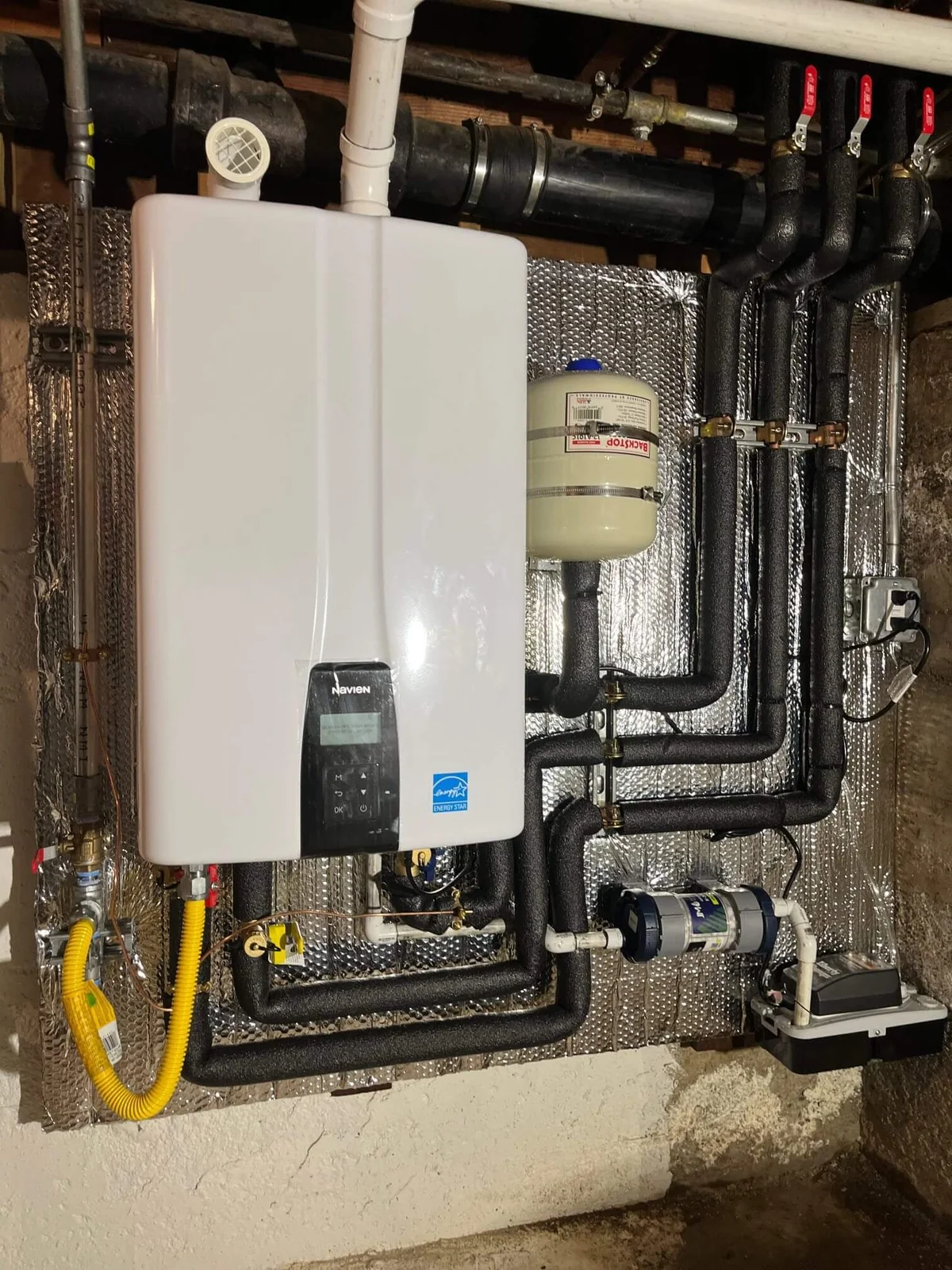
What a complete tankless installation in Napa includes
Follow the worksheet and you have most of a correct installation. What each item means in a real house:
1. Gas supply sizing, meter to unit. A tankless unit fires at several times a tank's input while running. Older downtown piping was sized for the appliances of its era, and branch lines sharing the run count against the total. 2. Dedicated venting in the right material. Tankless units need their own vent, and the vent for a condensing appliance is not the vent for a non-condensing one. The old tank flue is not reused. 3. Combustion air. A closet that suited a small tank often will not suit a tankless unit. 4. Clearances on all four sides, to the manufacturer's listing. Older Napa utility spaces are where this gets tight, and it is better found at the estimate. 5. Condensate handling on condensing models. Acidic condensate needs a proper drain and often neutralization. Skipping it quietly damages whatever it lands in. 6. Electrical. The form asks whether a new outlet or circuit is needed, because a modern tankless unit is a powered appliance. 7. Isolation valves for service. A unit that cannot be isolated cannot be descaled easily. Fitting them now is the difference between simple maintenance and an awkward job every time. 8. Recirculation, if you want it. There is a short delay before hot water reaches a distant fixture. A loop or integrated pump solves it, and planning it now costs far less than adding it later.
The power question, which matters more in Napa than in most places
A gas tankless water heater is an electrical appliance. Electronic ignition, electronic controls, and on most models a combustion fan all run on 120 volts. Cut the power and the unit does not fire. A conventional tank at least holds what it already heated. A tankless unit holds nothing.
That is a general fact about the technology, and around Napa's hills and rural edges it stops being academic. PG&E calls a Public Safety Power Shutoff when low humidity, forecast high winds, dry fuel, vegetation near powerlines, and Red Flag conditions line up, the same pattern behind the 2017 Atlas Fire and the 2020 Glass Fire in this county. If your address has lost power in one of those events, losing hot water during the next one belongs in the decision rather than being discovered at the time.
A backup generator answers it, and we are a Certified Generac Generator installer, so it can be scoped in the same conversation rather than through a second contractor. A battery paired with solar answers it as well. Holding a C-10 electrical license alongside the C-36 means the outlet or circuit the worksheet asks about is our work too.
What goes wrong with a tankless unit, in the order we find it
Scale in the heat exchanger comes first and accounts for most service calls. It shows up as reduced flow, then temperature swings, then error codes, and on Napa water a kept descaling schedule prevents nearly all of it. Behind it sit ignition and flame-sensing faults, often a combustion air or maintenance problem dressed up as a component failure and worth diagnosing before anyone quotes a control board.
Undersized gas supply is the next layer, and it arrives as a complaint about performance rather than a fault code. A unit that cannot draw its rated input cannot deliver its rated output, and no servicing fixes a pipe that is too small. Venting problems follow: blockages, incorrect terminations, or a material mismatch left by a previous installer.
Two more get mistaken for defects: the cold water sandwich, a short burst of cooler water between draws that is characteristic of the technology, and freeze exposure on exterior units, real even in a mild valley winter because built-in freeze protection depends on the unit having power.
Randy Schultz came out to do the second annual service, two years after our new tankless water heater was installed yea team of relatively young plumbers...
Elizabeth M.
Is tankless the right call for your Napa home?
It is a strong fit when your household draws hot water in bursts across a long day, when floor space in a tight downtown closet is worth recovering, when you plan to stay long enough to benefit from the longer service life, and when the descaling will actually get done.
It is a weaker fit when the gas run from the meter is long or shared enough that upsizing dominates the project, when several fixtures run at once and the required capacity climbs accordingly, or when nobody will maintain it. A well-chosen tank beats a neglected tankless unit, and we would rather say so at the estimate.
The third option belongs on the table. If efficiency is your reason for considering tankless, a heat pump water heater is more efficient still and is where the current incentives sit. It has a tank, needs air volume around it, and needs a dedicated 240-volt circuit, so panel capacity joins the conversation. It also sits with where the code is heading: all of Napa County is inside the Bay Area Air Quality Management District, whose Regulation 9, Rule 6 requires zero-NOx residential water heaters from 2027 for small tank units, while tankless water heaters sit on the district's later 2031 date.
What drives the cost of a tankless installation in Napa
A flat price would be fiction here. What the building already has, rather than which appliance is chosen, decides most of the work.
Gas work is usually the largest variable, and in downtown Napa's early-1900s housing it is the line that moves most. Venting comes next, driven by the route available and the material the appliance requires. Condensate drainage and neutralization apply on condensing units. Capacity follows from your winter temperature rise and simultaneous demand, so the sizing conversation is also a pricing conversation. Service valves, recirculation, and treatment are added where they apply, and the permit sits inside the number rather than after it.
Access is the quiet one: a garage or exterior wall in a south or east Napa subdivision is a straightforward day, and a basement or converted closet downtown is not. You approve the cost before the work, and financing exists for the bigger jobs.
Permits and code
Inside city limits, tankless work permits through the City of Napa Building Division with the worksheet above. Unincorporated properties permit through Napa County Planning, Building and Environmental Services, which accepts residential water heater replacement applications through its online permit center.
Inspection covers the gas sizing you documented, the venting system and its terminations, combustion air, clearances, the condensate arrangement on condensing units, the relief discharge, and Title 24 energy requirements including pipe insulation. California's 2025 Building Energy Efficiency Standards took effect January 1, 2026.
Seismic restraint still applies. Health and Safety Code section 19211 reaches "all new and replacement water heaters, and all existing residential water heaters" up to 120 gallons. A wall-hung tankless unit is a far smaller mass than a full tank, a genuine advantage in this county, but it still has to be fastened into framing.
Unpermitted work does not save money. It becomes a disclosure problem at resale and removes the independent check that a high-input gas appliance was vented correctly.
Rebates: what applies to a Napa address and what does not
Napa's community choice energy provider is MCE, not Sonoma Clean Power, so a Sonoma Clean Power water heater rebate does not reach a Napa address. The incentives that do exist here point at heat pump water heaters rather than gas tankless equipment.
MCE heat pump rebates are available to "MCE customers who own and have lived in their single-family detached homes for at least 12 months in MCE's service area," and MCE requires that "a project must be installed by a participating contractor who will process the rebate application paperwork on your behalf." MCE also sets a sequencing rule that catches people in fire country: existing solar or EV charging must have been in place at least 12 months, and no other electrification project, solar and battery storage included, can go in for 12 months afterward.
Budgets and eligibility change, so we confirm what applies at the time of your quote.
Keeping a Napa tankless unit healthy
Descale on the manufacturer's schedule, and on a supply that swings between moderately hard and hard, treat that schedule as the floor rather than the ceiling. A unit descaled reliably outlasts a tank. One that is never descaled underperforms for years, fails early, and leaves its owner blaming the technology instead of the maintenance.
The rest is short. Clean or replace the inlet filter screen, check vent terminations for obstruction after a windy stretch, and keep the combustion air path clear, which in a closet means not storing things against the unit. If yours has no isolation valves, adding them at the next service makes every future descaling faster.
Where we work in Napa
We serve the city of Napa and the surrounding county from our Petaluma headquarters: downtown's older housing where gas line upsizing is common, Alta Heights and Browns Valley, the newer subdivisions across south and east Napa, and rural properties on wells where treatment and power shutoffs both enter the conversation. On a tankless conversion, knowing what is likely behind the wall before it is opened is worth real money to whoever is paying.
How to choose a tankless installer in Napa
Ask whether they have drawn the gas piping from the meter. Inside city limits that is a permit requirement, not a preference, and a contractor who has not done it does not yet know what your job costs.
Ask which temperature rise they worked to, and whether it was a summer figure or a winter one. If the answer is not specific, the sizing is not either.
Ask whether service isolation valves are included, because that one decision governs how easy the appliance is to maintain for its whole life. And ask what happens to your hot water during a power shutoff.
That is how we have worked since 1932. We look at the house rather than the phone, we say what we found, we price it before starting, and we build to code. Diamond Certified, BBB A+ rated.
Tankless and plumbing service across Napa and Napa County
One company, all trades: Napa plumbing, plumbing across Napa County, Napa home services, Napa heating and cooling, and Napa electrical. Related Napa services: water heaters, drain cleaning, sewer repair, and electrical panel upgrades.
I requested an estimate for a tankless water heater. Gregory came to our home, assessed the viability of a tankless system, then gave us his candid opinion. A tankless system does not make sense for us today, but if things change Ongaro will have the job.
Michael F.
Book tankless water heater service in Napa
Book online at any hour, or speak to someone during office hours if the situation needs describing. An Ongaro & Sons plumber will size the unit against your real demand, walk the gas line from the meter, explain what the installation involves, and give you the price before any work begins.
Your Comfort, Our Priority
Ongaro & Sons is your trusted heating, cooling, plumbing, electrical, and solar expert, specializing in reliable maintenance and repair services that keep your home running efficiently year-round.
Our certified technicians deliver unmatched expertise with fast, friendly service across Marin, Sonoma and Napa County. From HVAC tune-ups to plumbing repairs and electrical upgrades or solar solutions, we focus on energy-efficient performance and long-term comfort. Count on us to maintain the systems that power your home and keep your environment just the way you like it.
Licensed, Insured, Background-Checked
Our technicians are licensed, experienced, and trained to service all makes and models.
Locally Owned and Operated
Serving the Napa, Marin, and Sonoma communities with personalized, hometown service.
Reliable Repairs
We respond quickly and get the job done right the first time, with no surprises.
Since 1932
Why Ongaro & Sons?
Four generations of trusted home service. Open any reason to see what it means for your home.
Schedule Service →Family-owned in the North Bay since 1932
Four generations of the Ongaro family serving Marin, Sonoma and Napa County. We know these homes and the systems in them.
Licensed, insured, background-checked technicians
Every technician is fully licensed and insured, background-checked, and trained on the equipment we install.
Diamond Certified and BBB A+
Diamond Certified since October 2016, and BBB Accredited with an A+ rating since December 1995.
Mitsubishi Diamond Contractor Elite and Trane Comfort Specialist
Both top manufacturer tiers. That standing decides how registration and extended warranty terms are handled on the system you actually bought.
The price is agreed before work starts
You see the number before the work begins. Flat-rate quotes, no surprises and no pressure.
Comprehensive maintenance program
Members get priority scheduling, discounts, and proactive checkups that prevent costly failures.
Discount
Membership
Ongaro Maintenance Plans
Annual maintenance on your home systems provides safeguards and comfort to you and your family. Members get priority scheduling, discounts, and proactive checkups that catch problems early.
Member Discounts
5% off every repair and replacement, all year long.
Peace of Mind
Proactive checkups catch issues before they become big problems.
Courtesy Reminders
We call you to schedule: never miss a seasonal service.
Value That Lasts
With Ongaro & Sons, you’re investing in quality, integrity, and service that stands the test of time. Explore our current promotions and see the difference real value makes for your HVAC, plumbing, and electrical needs.


From the Blog
 Sep 17, 2026
How Many Amps Does My House Need? Sizing Service for What You Actually Run
How many amps your house needs comes from a load calculation of what you run and plan to add. What drives the number, when existing service is enough, and more.
Read More Sep 10, 2026
Hard Water in Marin County: What Is Actually in Your Water and What It Does
Hard water in Marin County varies by provider and source. The 2025 report figures for Marin Water and NMWD, what hardness does and does not mean, and options.
Read More Sep 3, 2026
Electrical Permit Requirements in California: What Needs One and What Does Not
Find out which electrical projects commonly need permits, how to confirm local exemptions, and what to ask before work begins in Marin, Sonoma or Napa County.
Read MoreTankless water heaters in Napa: frequently asked questions
Who is the best tankless water heater installer in Napa?
Ongaro & Sons has served the North Bay since 1932 and is Diamond Certified, holding a C-36 plumbing license and a C-10 electrical license, with 4.8 stars across 2,756 Google reviews. For tankless work in Napa we size against winter conditions, size the gas supply from the meter as the city's worksheet requires, pull the permit, and give you the full price before starting.
What does the City of Napa require to permit a tankless water heater?
A completed Tankless Water Heater Worksheet. The form states that "we cannot issue a tankless water heater permit without this information," and asks for the unit's make, model, combustion air requirement, flue size and type, clearances, gas pipe size and BTU demand, and a piping diagram "of the residence from meter to tankless unit, including any branch lines on the run."
Do I need a bigger gas line for a tankless water heater in Napa?
Often, particularly downtown where the piping was sized for the appliances of its era. A tankless unit fires at several times a tank's input, and branch lines sharing the run count against the total. Inside city limits this gets calculated before the permit is issued rather than discovered mid-installation.
Will a tankless water heater work during a power outage?
No. Modern gas tankless units use electronic ignition, electronic controls, and usually a combustion fan, all needing 120-volt power. During a Public Safety Power Shutoff you would have no hot water at all, where a tank would still hold what it had already heated. Backup power solves it, and as a Certified Generac Generator installer we can scope that alongside the water heater.
How hard is Napa's water, and how often will my unit need descaling?
The city's 2024 water quality report puts total hardness at an average of 114 ppm as calcium carbonate, ranging from 68 to 179 ppm, spanning the moderately hard and hard bands on the USGS scale. Because the city draws from three sources through three treatment plants, what reaches your house varies. Follow the manufacturer's schedule and treat it as a minimum.
Can I reuse the vent from my old Napa water heater?
No, and this is the assumption behind most conversions that grow after the quote. A tankless unit needs its own vent in the material the manufacturer specifies, and condensing and non-condensing models do not vent alike either. An old tank flue was built for a different appliance running at a different temperature. Napa does not leave it to interpretation: the city worksheet asks for the manufacturer's flue size and type by name before it will issue the permit.
Why did my tankless water heater run out of hot water?
Almost always sizing. Output is rated in gallons per minute at a given temperature rise, and incoming water is colder in a Napa winter than in August. A unit sized on summer conditions will disappoint on a cold morning with two fixtures running. Undersized gas supply produces the same symptom for a different reason, so both get checked.
Do I need a permit outside Napa city limits?
Yes. Unincorporated properties permit through Napa County, which handles building permits digitally through its Online Permit Center and states plainly that a submittal missing required documents, or missing the required bookmarks in its document files, will be delayed or rejected. Permits for properties inside a city are handled by that city directly. We file it either way and meet the inspector.
Are there rebates for a tankless water heater in Napa?
Not for a gas tankless unit. The incentive money in California is written around electrification, so it points at heat pump water heaters rather than gas equipment of any kind, however efficient. Napa is served by MCE rather than Sonoma Clean Power, so the Sonoma County programs homeowners read about do not apply at this address either. If incentive money is a deciding factor, that pushes the comparison toward a heat pump unit rather than tankless, and the panel becomes part of the question.
Will the 2027 air district rule affect a gas tankless unit in Napa?
All of Napa County is inside the Bay Area Air Quality Management District, whose Regulation 9, Rule 6 requires zero-NOx residential water heaters on dates arriving by size and equipment type across 2027 and 2031, reaching equipment at replacement rather than what is already fitted. Tankless sits on the 2031 date, not the 2027 one that covers small tanks.
Inside or outside on a Napa house?
Both work in this climate. Exterior mounting frees interior space and simplifies venting, which is attractive in an older downtown home with no good closet, but its freeze protection depends on power, so it interacts with the shutoff question. Interior installations need combustion air and the clearances the worksheet asks about.
What is the cold water sandwich, and does it happen in Napa?
A short burst of cooler water between two draws, caused by the brief lag while the unit fires. It is characteristic of the technology rather than a fault, normally addressed with a small buffer tank or a recirculation arrangement rather than by replacing anything.
Can you repair my existing tankless unit in Napa rather than replace it?
Usually. Scale, ignition and flame-sensing faults, venting problems, and undersized gas supply are all addressable, and a large share of units described as failed were simply never descaled or were installed short on gas. We diagnose before recommending replacement. Where a unit is genuinely finished we say so, and the reason is usually a heat exchanger that has scaled beyond recovery rather than a fault in the controls.
Does a tankless water heater need to be seismically restrained?
Yes. Health and Safety Code section 19211 covers residential water heaters up to 120 gallons and requires them to be braced, anchored, or strapped per the California Plumbing Code. A wall-hung unit is a much smaller mass than a full tank, but it still has to be fastened into framing rather than drywall.