Tankless Water Heaters in San Rafael
Ongaro & Sons installs, converts, and services tankless water heaters across San Rafael, and we have worked in the North Bay since 1932. We are Diamond Certified, we hold a C-36 plumbing license and a C-10 electrical license, and we carry 2,756 Google reviews averaging 4.8 stars. We size the gas before we quote, pull the permit, and give you a complete number before we begin.
On this page
San Rafael has two tankless permits, and which one you need changes the project
Most cities treat a water heater as a water heater. San Rafael draws a line, and it falls directly across tankless work.
The City of San Rafael Building Division, part of the Community and Economic Development department, publishes a minor permits list for work that generally does not require plan review. A changeout of an existing tankless water heater is on it, alongside conventional water heater changeouts of 100 gallons and under.
Putting a tankless unit where there has never been one is a different project, and the city says so on that same page. A new tankless installation requires a gas schematic submitted with the permit for review, and in the city's own words, "This permit will not be issued until a review of your plans has been completed."
That is the most useful sentence a San Rafael homeowner can read before starting a tank-to-tankless conversion. The gas piping design has to exist on paper, sized correctly, and be accepted before a permit issues, so a contractor who has not measured the run from your meter cannot give you a real timeline either. Since February 23, 2026 new applications go through the city's OpenGov portal, which replaced eTRAKiT, as noted on the Building Division page. Unincorporated Marin permits through Building and Safety at the Marin County Community Development Agency.

Your water is two different waters, and that sets the descaling clock
A tank water heater tolerates scale by burying it on the tank floor. A tankless unit has nowhere to put it. Everything passes through a narrow heat exchanger, so mineral content is the variable that decides how long the unit stays efficient.
San Rafael is served by Marin Water, and the district's 2025 Annual Water Quality Report says something a general statement about Marin water never could. Roughly 75 percent of supply originates as rainfall on 22,000 acres of protected Mt. Tamalpais watershed and the hills of west Marin. The district supplements that with water purchased from the Sonoma County Water Agency, drawn from the Russian River system, which the report says is "blended with the District's reservoir water within its distribution system."
The two sources do not test alike. The reservoir supply averages 59 mg/L of hardness, about 3.5 grains per gallon, and the Sonoma County Water Agency supply averages 112 mg/L, about 6.5 grains per gallon. On the USGS hardness scale, where 0 to 60 mg/L is soft and 61 to 120 is moderately hard, one supply sits right at the soft line and the other is close to twice as mineral-rich.
So there is no single correct descaling interval here. The water reaching your heat exchanger is a blend that moves, and an interval set by looking at your actual exchanger beats one copied off a generic chart.
The air district calendar, and what it means for gas tankless
All of Marin County sits inside the Bay Area Air Quality Management District, so there is none of the boundary ambiguity that exists in parts of Sonoma County.
In 2023 the district amended Regulation 9, Rule 6 to set zero-NOx requirements for residential water heaters. In practice that means electric heat pump equipment, because gas models cannot currently meet the standard.
The rule is not settled.
Here is the part that belongs on a tankless page rather than a tank page. A gas tankless unit heats on demand instead of over an hour, so its input rating sits well above a comparable storage tank's, which puts most residential tankless equipment outside the small-unit band now under discussion. What that means for tankless is not decided, and we are not going to guess at a board vote in front of you. Nobody's gas water heater is banned today, and we confirm the current requirement at the time of your project.
Great working with Gerald! We were very happy with the prompt and quality service.
Conor G.
What fails, and what each symptom means
Tankless failures arrive in a predictable order, and almost none start with the heat exchanger giving out.
Scale comes first. Deposits build inside the exchanger passages and the unit fires harder for the same output. You feel it as a shower that starts hot and cools off partway through. Descaling reverses it. Waiting does not.
Gas supply comes second, and it is the failure most often misdiagnosed as a broken appliance. A tankless heater on a line that cannot deliver its rated input will light, run, then falter under real demand, especially when a range or dryer is also running. It looks like an equipment defect and is not. This is exactly why San Rafael reviews a gas schematic before issuing a permit on a new installation.
After that the list is mundane. The inlet filter screen clogs, showing up as reduced pressure at hot taps only. The flame rod and igniter foul, producing an error code that clears on reset and returns. The flow sensor drifts and the unit stops responding to small draws. On condensing models the condensate line blocks or the neutralizer media is spent, and you find water under the unit. Venting problems appear as nuisance shutdowns, usually from a terminal obstructed by landscaping.
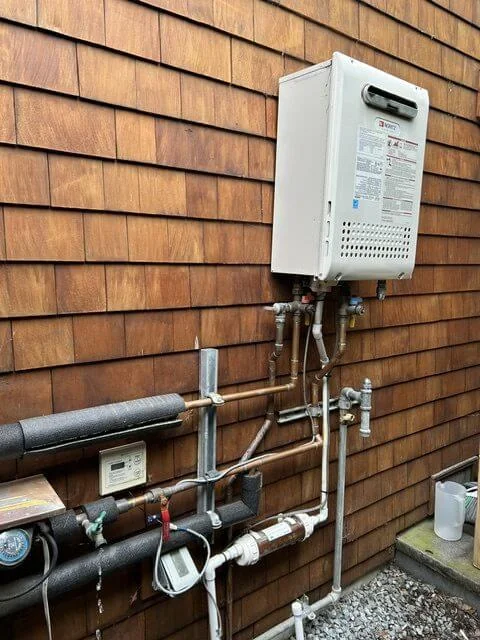
Five things a San Rafael tankless retrofit has to pass
Every conversion we quote here is checked against the same five things. If one fails, we say so before you spend anything.
Gas. Line size and length from the meter, total connected load, and whether the meter itself has capacity. Older San Rafael homes were piped for a tank, a range, and a dryer. This step produces the schematic the city reviews.
Vent path. A modern tankless unit is sealed combustion with its own dedicated vent and cannot share a flue with a furnace. Termination has to clear windows, doors, and walkways by the manufacturer's listed distances: straightforward on a two-story house with an exterior wall to work with, much less so in a single-story post-and-beam home with no attic.
Condensate. A condensing unit produces acidic condensate needing a drain and, usually, neutralization before it reaches the waste system. On slab-on-grade housing, finding a legitimate drain near the unit is sometimes the hardest problem in the job.
Distribution. How long do you wait for hot water at the farthest fixture now? A tankless unit does not shorten that wait. The answer is a recirculation strategy, either a dedicated return line or a crossover valve at the far fixture, chosen at design time rather than retrofitted later.
Service access. Isolation and service valves turn a future descaling into a routine service visit instead of a plumbing project. We fit them as standard.
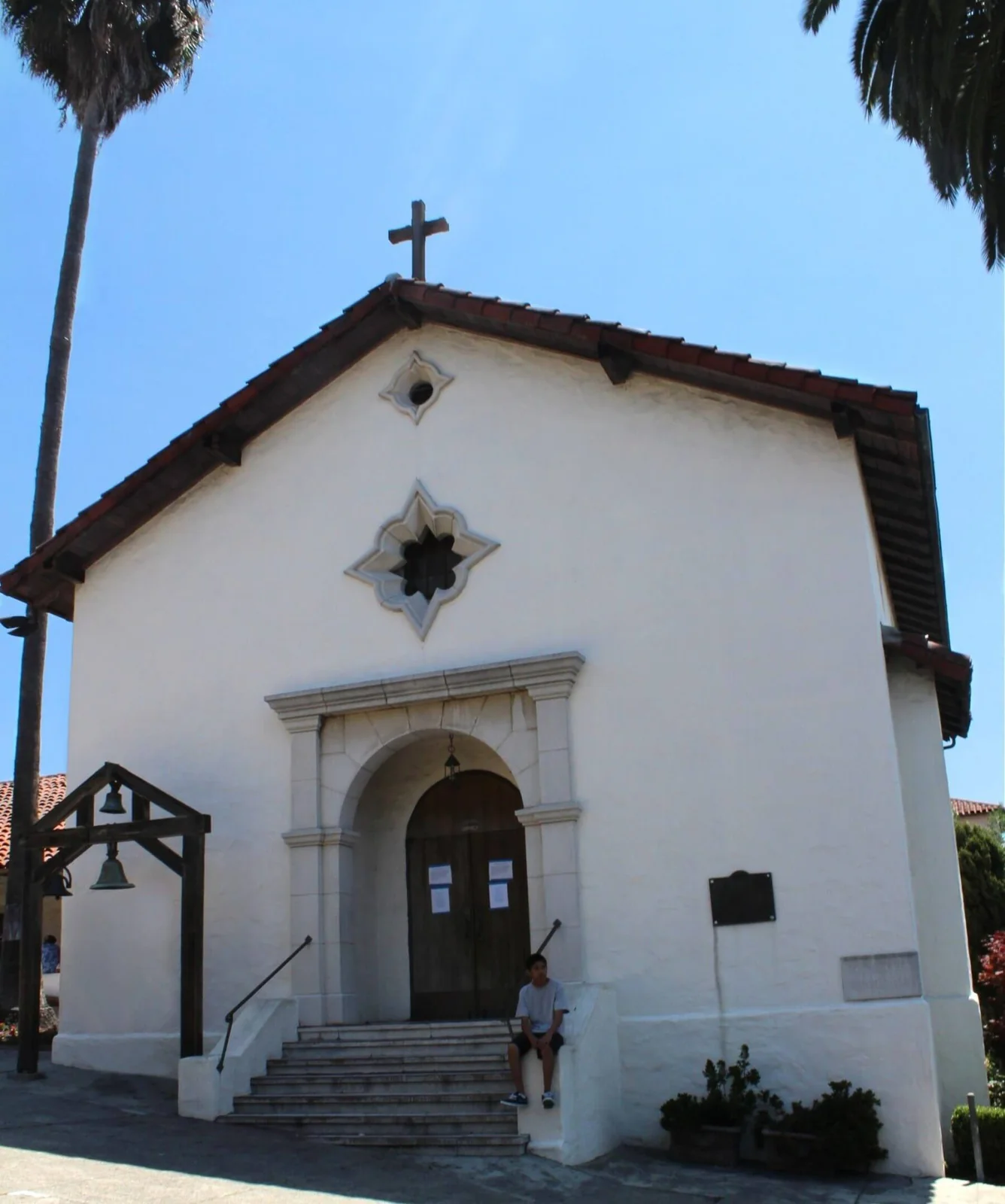
Eichlers, Terra Linda, and Lucas Valley
San Rafael holds one of the largest concentrations of Eichler homes anywhere, in Terra Linda and Lucas Valley, and they change the tankless conversation more than any other housing type in Marin.
Original Eichlers were heated by hot water circulating through tubing embedded in a concrete slab. So a homeowner asking about a water heater may be asking two questions: what heats the water at the taps, and what drives the radiant floor. Sometimes one appliance serves both. We map the system before quoting rather than assuming.
The warning worth stating plainly: a domestic tankless water heater and an appliance rated to drive a radiant heating loop are not the same product. Substituting one for the other is how a slab-heated house ends up with equipment that short-cycles and a warranty written for a use case that does not match the installation. Combination units exist and are sometimes right, but that is a specification decision, not a swap.
The building adds constraints: no attic to route a vent through, a low-slope roof, limited mechanical space by design, and a slab with no convenient condensate drain. Elsewhere, older bayside and hillside neighborhoods bring stairs, tight side yards, and long gas runs.
Tankless, tank, or heat pump in San Rafael
Tankless is genuinely good at three things: it does not run out of hot water, it gives back the space a tank occupies, and a maintained unit has a long service life. Its costs are front-loaded, since the gas work, dedicated venting, condensate route, and plan review all land at the start. Then maintenance discipline has to hold, because a tankless unit installed and never serviced will underperform a cheap tank. A conventional gas tank remains the lowest-disruption replacement available, limited by the calendar rather than by the equipment.
A heat pump water heater is the most efficient option, carries the current incentives, and matches where the code is heading. It needs a dedicated 240-volt circuit, enough surrounding air volume, and tolerance for the noise it makes while running. In a garage that is usually straightforward. In a tight interior closet, or an Eichler with limited mechanical space, it takes a proper look first.
Whole-house electric tankless draws far more current than either, enough that in most San Rafael homes it becomes a service upgrade project first. Plenty of 1950s and 1960s homes here have little free capacity once a range, a dryer, and an EV charger are accounted for. We check panel capacity as part of the quote, and because we hold both a C-36 plumbing and a C-10 electrical license, any electrical work that proves necessary happens inside the same project.
Very impressed by the courtesy of the office and field employees.
Carlos Z.
What drives the cost of a tankless project in San Rafael
We do not publish flat prices, because two San Rafael houses receiving the same appliance are two different jobs. What moves the number:
- Whether it is a changeout or a new installation. One is a minor permit. The other requires a gas schematic and plan review before issuance.
- Gas line length, size, and the load already on the meter. The largest single variable on most conversions.
- The vent route and where it can legally terminate, decided by the building rather than by preference.
- The condensate route, and whether a slab home has a usable drain near the unit.
- Recirculation. A dedicated return line and a crossover valve are different projects with different results.
- Access. A garage wall is a straightforward day. A hillside home with stairs or an Eichler mechanical space is not.
- Permit, inspection, and any water treatment, all in the quote rather than added later.
You see a full price rather than a starting price, and replacements can be financed.
Rebates and incentives for San Rafael homeowners
Marin County is served by MCE as its community choice energy provider. That matters because much of the North Bay rebate content online is written about Sonoma County. If you have read about a Sonoma Clean Power heat pump water heater rebate, it does not apply to a San Rafael address.
Nothing on offer here rebates a gas tankless unit. The local program is MCE's heat pump rebates, which cover heat pump water heaters specifically. If a lower running cost is the reason you are considering tankless, the rebate arithmetic points at the other technology, and that is worth weighing before the gas line is resized.
One straight point about tankless: the active programs here are written around heat pump water heaters, so a gas tankless conversion is generally not what that money is aimed at. We say so up front rather than letting a rebate quietly disappear from the math later.
Code, and what the inspector checks
Anchoring comes first. California Health and Safety Code section 19211 requires "all new and replacement water heaters, and all existing residential water heaters" up to 120 gallons to be braced, anchored, or strapped against earthquake displacement. A wall-hung tankless unit is not outside that; the method just changes, from two straps to structural fastening with the manufacturer's hardware.
From there the inspector follows the hazards: gas piping against the sizing submitted with the permit, venting for listed material and termination clearances, combustion air, and condensate neutralization on condensing units. Title 24 adds energy requirements including pipe insulation, and California's 2025 Building Energy Efficiency Standards took effect January 1, 2026. Unpermitted work becomes a disclosure problem at resale and removes the one independent check that the appliance went in safely.
Keeping a San Rafael tankless unit healthy
- Descale on an interval set by your unit, not a generic chart. Marin's blended supply moves.
- Clean the inlet filter screen at every service. Cheapest fix on the appliance, most often skipped.
- Check the condensate neutralizer media on a condensing unit and replace it when spent.
- Confirm the vent terminal is clear of landscaping, fencing, or stored items.
- Have gas pressure verified at service, because low pressure imitates an equipment fault convincingly.
- Remember the unit needs power. Controls, ignition, and fan stop when the electricity does, worth planning for in hillside neighborhoods where PG&E Public Safety Power Shutoffs are a routine part of fire season.
Where we work in San Rafael
We serve all of San Rafael from our Petaluma headquarters, including downtown, the bayside neighborhoods, Terra Linda, Lucas Valley, Peacock Gap, Sun Valley, and the surrounding unincorporated county. Hillside properties bring access and routing considerations that flat-lot work does not, and Terra Linda and Lucas Valley bring a housing type that rewards knowing it in advance.
How to choose a tankless installer in San Rafael
Ask which permit your project needs. A changeout and a new installation are different applications here, and a contractor who cannot tell you which applies has not read the requirement.
Ask whether they have sized the gas line and can produce the schematic the city reviews. If the answer is that they will check on the day, you do not have a price yet.
Ask where the vent terminates and how far that is from the nearest window or walkway. Ask where the condensate goes on a slab, how you will get hot water at the farthest fixture, and whether service valves are included. And if someone quotes a Sonoma Clean Power rebate for a San Rafael address, they are reading the wrong county's program.
That is how we have worked since 1932. We look at the house rather than the phone, we say what we found, we price it before starting, and we build to code. We are Diamond Certified, and hold a BBB A+ rating.
Tankless and plumbing service across San Rafael and Marin County
One company, all trades: San Rafael plumbing, plumbing across Marin County, San Rafael home services, San Rafael heating and cooling, and San Rafael electrical. Related San Rafael services: water heater repair and replacement, drain cleaning, sewer repair, and electrical panel upgrades. If your house is a mid-century post-and-beam, start with the Eichler home services guide.
Book tankless water heater service in San Rafael
Book online at any hour, or speak to someone during office hours if the situation needs describing. An Ongaro & Sons plumber will look at your gas, your venting, your space, and your hot water demand, explain what the project involves, and give you the price before any work begins.
Your Comfort, Our Priority
Ongaro & Sons is your trusted heating, cooling, plumbing, electrical, and solar expert, specializing in reliable maintenance and repair services that keep your home running efficiently year-round.
Our certified technicians deliver unmatched expertise with fast, friendly service across Marin, Sonoma and Napa County. From HVAC tune-ups to plumbing repairs and electrical upgrades or solar solutions, we focus on energy-efficient performance and long-term comfort. Count on us to maintain the systems that power your home and keep your environment just the way you like it.
Licensed, Insured, Background-Checked
Our technicians are licensed, experienced, and trained to service all makes and models.
Locally Owned and Operated
Serving the Napa, Marin, and Sonoma communities with personalized, hometown service.
Reliable Repairs
We respond quickly and get the job done right the first time, with no surprises.
Since 1932
Why Ongaro & Sons?
Four generations of trusted home service. Open any reason to see what it means for your home.
Schedule Service →Family-owned in the North Bay since 1932
Four generations of the Ongaro family serving Marin, Sonoma and Napa County. We know these homes and the systems in them.
Licensed, insured, background-checked technicians
Every technician is fully licensed and insured, background-checked, and trained on the equipment we install.
Diamond Certified and BBB A+
Diamond Certified since October 2016, and BBB Accredited with an A+ rating since December 1995.
Mitsubishi Diamond Contractor Elite and Trane Comfort Specialist
Both top manufacturer tiers. That standing decides how registration and extended warranty terms are handled on the system you actually bought.
The price is agreed before work starts
You see the number before the work begins. Flat-rate quotes, no surprises and no pressure.
Comprehensive maintenance program
Members get priority scheduling, discounts, and proactive checkups that prevent costly failures.
Discount
Membership
Ongaro Maintenance Plans
Annual maintenance on your home systems provides safeguards and comfort to you and your family. Members get priority scheduling, discounts, and proactive checkups that catch problems early.
Member Discounts
5% off every repair and replacement, all year long.
Peace of Mind
Proactive checkups catch issues before they become big problems.
Courtesy Reminders
We call you to schedule: never miss a seasonal service.
Value That Lasts
With Ongaro & Sons, you’re investing in quality, integrity, and service that stands the test of time. Explore our current promotions and see the difference real value makes for your HVAC, plumbing, and electrical needs.


From the Blog
 Sep 17, 2026
How Many Amps Does My House Need? Sizing Service for What You Actually Run
How many amps your house needs comes from a load calculation of what you run and plan to add. What drives the number, when existing service is enough, and more.
Read More Sep 10, 2026
Hard Water in Marin County: What Is Actually in Your Water and What It Does
Hard water in Marin County varies by provider and source. The 2025 report figures for Marin Water and NMWD, what hardness does and does not mean, and options.
Read More Sep 3, 2026
Electrical Permit Requirements in California: What Needs One and What Does Not
Find out which electrical projects commonly need permits, how to confirm local exemptions, and what to ask before work begins in Marin, Sonoma or Napa County.
Read MoreTankless water heaters in San Rafael: frequently asked questions
Who is the best tankless water heater company in San Rafael?
Ongaro & Sons has served the North Bay since 1932, is Diamond Certified, holds a C-36 plumbing license and a C-10 electrical license, and averages 4.8 stars across 2,756 Google reviews. On tankless work we size the gas line, produce the schematic the city requires for a new installation, pull the permit, fit service valves, and price the job before starting.
Do I need a permit for a tankless water heater in San Rafael?
Yes, and which one depends on the work. The city's minor permits list treats a changeout of an existing tankless unit as work that generally does not need plan review. A new installation is treated differently. For an address in unincorporated Marin, Building and Safety at the Marin County Community Development Agency issues the permit.
Does a new tankless installation need plan review in San Rafael?
Yes. The city states that a new tankless water heater installation requires a gas schematic submitted with the permit for review, and that "This permit will not be issued until a review of your plans has been completed." That is why a tank-to-tankless conversion here is a planned project rather than a same-day swap.
How hard is San Rafael's water, and how often should a tankless be descaled?
Marin Water blends two supplies. Its 2025 report puts reservoir water at 59 mg/L of hardness, about 3.5 grains per gallon, and Sonoma County Water Agency supply at 112 mg/L, about 6.5 grains per gallon. One sits at the soft line on the USGS scale and the other well up the moderately hard band, so set the interval from what your exchanger looks like at first service.
Will I still be able to install a gas tankless water heater in San Rafael?
For now, yes. All of Marin sits inside the Bay Area Air Quality Management District, which amended Regulation 9, Rule 6 in 2023 to set zero-NOx requirements for residential water heaters, with implementation beginning in 2027 and 2031 depending on size and equipment type.
Can I put a tankless water heater in an Eichler?
Often yes, with real planning. The constraints are a low-slope roof with no attic for venting, limited mechanical space, a slab with no convenient condensate drain, and long runs to distant fixtures. The larger question is whether the appliance you are replacing also drives radiant floor heat, because that is a different product.
Does my gas line need to be upsized for a tankless water heater?
Frequently. A tankless unit heats on demand, so its input rating is higher than the tank it replaces, and the line that fed the tank is often not sized for it. Diameter, run length, and everything else on the meter all matter, and the meter's own capacity sometimes becomes the limit.
Why does my hot water go cold for a few seconds partway through?
That is the cold water sandwich, and it is not a fault. A draw stops and restarts, leaving a slug of unheated water between the unit and the fixture. Recirculation, either a dedicated return line or a crossover valve at the far fixture, is the fix, and it works better designed in than added later.
How long does a tankless water heater last in San Rafael?
Longer than a storage tank, and the gap is the main argument for one. A well maintained tankless unit commonly outlasts a tank by a wide margin, because there is no glass-lined vessel sitting full of hot water waiting to corrode from the inside. The condition on that is descaling. Left unserviced in water like San Rafael's, which Marin Water reports as a blend running between roughly 3.5 and 6.5 grains per gallon depending on the mix, the heat exchanger scales up and the advantage disappears.
Are there rebates for a tankless water heater in San Rafael?
The active program here is aimed at heat pump water heaters rather than gas tankless. Marin is served by MCE, so Sonoma Clean Power's rebate does not apply, and MCE's conditions are twelve months of ownership and residency in a single-family detached home, a participating contractor filing the application, and no retroactive claims. So a gas tankless conversion here is judged on its own merits rather than on an incentive.
Does a tankless water heater work during a power outage?
No. Controls, ignition, and fan all need electricity, so the unit stops when the power does. In hillside neighborhoods where PG&E Public Safety Power Shutoffs are part of fire season, some homeowners pair a tankless install with backup power. We are a Certified Generac Generator installer, so that side is handled by the same company.
Should I get a tankless or a heat pump water heater?
Tankless wins on unlimited hot water, reclaimed space, and long service life, and costs more up front in gas, venting, and plan review. A heat pump unit is the most efficient option and carries the current incentives, but needs a 240-volt circuit, adequate air volume, and tolerance for operating noise.
Does a tankless water heater have to be earthquake anchored?
Yes, though not the way a tank is. California Health and Safety Code section 19211 requires residential water heaters up to 120 gallons to be braced, anchored, or strapped against earthquake displacement, and a wall-hung tankless unit falls inside that. In practice it is fastened to structural framing with the manufacturer's hardware.
Can you service the tankless unit I already have?
Yes. We descale, repair, and replace tankless units across the major brands, including ones we did not install, and we can add isolation and service valves where a previous installer left them out. If your unit is throwing a code, tell us the code when you book.