AC Repair in Napa
Ongaro & Sons, founded in 1932, works in Marin, Sonoma and Napa counties and repairs air conditioning across all three. We are Diamond Certified, a Mitsubishi Diamond Contractor Elite and a Trane Comfort Specialist, we hold a C-20 HVAC license, and we carry 2,756 Google reviews averaging 4.8 stars. We diagnose the whole system before naming a part, and you see the price before any work begins.
On this page
Why AC repair in Napa is its own problem
Napa looks like the rest of the North Bay on a map and behaves differently on paper. Nearly everything governing a cooling job here answers to a Napa institution rather than a Sonoma one.
Napa County sits inside the Bay Area air district in full. The Bay Area Air Quality Management District regulates nine counties, and its own description of its jurisdiction lists Napa whole, alongside "southwestern Solano" and "southern Sonoma," which are inside only in part. Sonoma County homeowners genuinely have to check which district covers their address. Napa homeowners do not.
That matters because the district is phasing appliance rules over time. A furnace rule lands on a cooling page for a mechanical reason: in most Napa homes the air conditioner is half of a split system, and the other half is an evaporator coil sitting on the gas furnace, sharing a blower cabinet and ductwork. When the outdoor unit fails on equipment that is already fifteen years old, the furnace question arrives with it. Nothing is banned today, the details are still being developed, and we confirm current requirements with the district at project time.
The rebate map differs too. Napa's community choice energy provider is MCE, not the Sonoma County provider, so every incentive conversation on this side of the county line runs through different rules. And the counter is Napa's own, with the City of Napa Community Development Department permitting inside city limits and Napa County Planning, Building and Environmental Services handling everything outside them. The city even runs its own water system, drawing on Lake Hennessey and State Water Project supply.
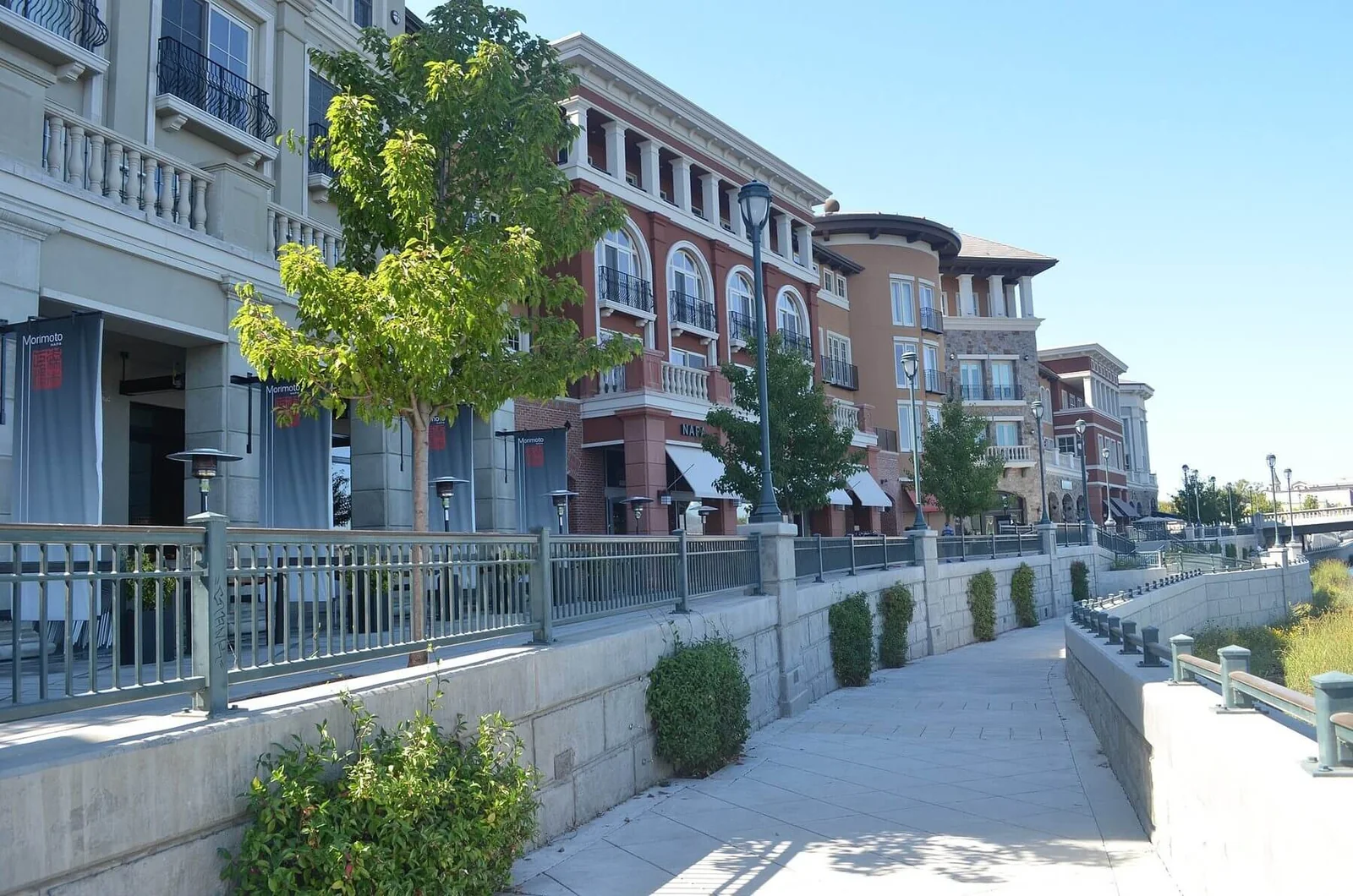
Then there is the heat and the housing. Napa runs hot through summer, cooler than up-valley St. Helena but well above the coast, so cooling here is working equipment rather than a comfort accessory. Downtown holds Victorian and early-twentieth-century homes where cooling arrived long after the house did, and the ductwork, where it exists, was threaded through a building never designed to carry it. South and east Napa run newer subdivisions with conventional ducted systems and attic runs. The same failed capacitor is a routine call in one and a scheduling puzzle in the other.
Reading what your air conditioner is telling you
Air conditioners rarely quit without warning. They degrade, and the degradation is legible if you know the order it happens in. These run roughly from earliest to most serious.
It runs but never catches up. Fine in June, three degrees short on the first hot week. That is capacity loss: a slow refrigerant leak, a coil loaded with dust, or airflow that has dropped since installation.
It cools, stops short, then restarts. Short cycling means the system trips a limit before finishing the job. Low charge, a restricted filter, a weak capacitor, or an oversized system in a house that has since been insulated. It is hard on a compressor, so chase it early.
The air is not cold. If the outdoor fan spins but the air is near room temperature, the compressor probably is not running or the charge is severely low. A silent outdoor unit usually points at something electrical.
Ice on the line set or indoor coil. Ice is a symptom, never a cause. Something drove the coil below freezing, meaning low refrigerant or restricted airflow. Melting it and walking away guarantees a second visit.
Water where it should not be. A wet spot near the air handler, a stain on the ceiling below an attic unit, or a system shutting itself down on hot days usually means a plugged condensate drain and a float switch doing its job.
Noise from the outdoor unit. A hum without rotation, a clunk on startup, a grinding bearing. Each points at a different part, and the sound narrows the diagnosis considerably.
The bill moved before the comfort did. Efficiency loss often shows up on a statement a full season before anyone notices it in the house.
On the hottest week of a Napa summer, the systems that fail are almost always the ones that showed one of these signs in June.
What fails, and what it means for the repair
The run capacitor. The most common no-cool call in this trade, and Napa summers deliver the heat that kills them. Symptoms are a compressor that hums without starting or a condenser fan that needs a push. A system that has eaten several in a few seasons is telling you something else is wrong.
The contactor. The relay switching high voltage to the compressor and fan. Contacts pit, weld, or chatter. Another modest repair worth ruling out before anyone quotes a compressor.
The condenser fan motor. When it fails, head pressure climbs and the system trips out or runs hot enough to damage the compressor. Motor and blade have to be matched, not approximated.
The compressor. The most expensive component in the system, and one of two failures that turns a service call into a decision. They die from age, from running under low charge, from repeated hard starts, and from acid contamination after an earlier burnout nobody cleaned up.
Refrigerant leaks. Brazed joints, service valves, a line set rubbing framing, and formicary corrosion inside copper evaporator coils. Adding refrigerant without finding the leak is the most common shortcut in this trade and the least useful thing a homeowner can pay for. We locate it, show it to you, and price the actual repair.
The metering device. A thermostatic expansion valve or fixed orifice controls flow into the evaporator. When it restricts, symptoms mimic low charge closely enough that anyone skipping the measurements will misdiagnose it.
The evaporator coil. The second expensive failure, because a leaking coil means opening the sealed circuit. On older equipment the coil, the refrigerant, and the age have to be weighed together.
Airflow and controls. Blower motors, ECM modules, blower wheels packed with dust, condensate drains, float switches, transformers, boards, and thermostat wiring chewed by rodents. Cheap parts mostly, and finding which one is at fault is most of the work.
Annual inspection of room ac went flawless quick great, thank you
Gil H.
The indoor half, and why older Napa homes complicate it
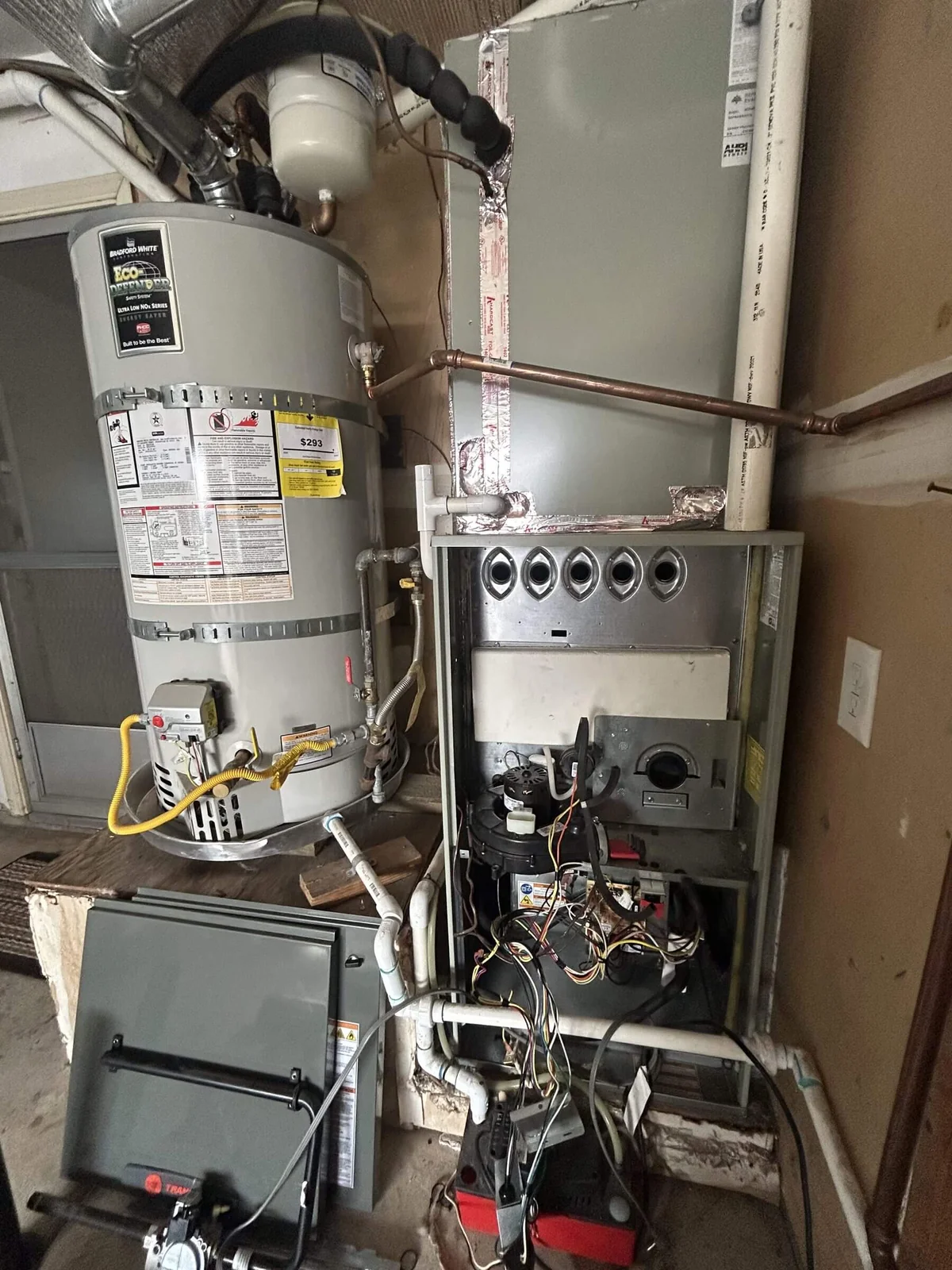
In many Napa houses, particularly downtown and in the older blocks, the furnace, the evaporator coil, and the water heater share one tight closet framed for a single appliance long before any of them existed in their current form. That drives a surprising share of cooling complaints. A closet with no return path starves the blower. A coil with insufficient clearance cannot be cleaned, so it loads with dust and loses capacity year over year. A condensate pan with no accessible drain becomes a ceiling stain.
None of that shows on a thermostat. It shows up as a system that has never quite cooled the back bedrooms, which the household eventually stops mentioning. On an older Napa home we look at the closet and the return path before the outdoor unit.
Repair or replace
We work the same four questions in the same order on every cooling call, so the recommendation is traceable rather than a hunch.
What class of failure is it? Capacitors, contactors, motors, boards, thermostats, and drain lines are repairs. A failed compressor or leaking evaporator coil is a different category, because both require opening the sealed circuit and both represent a large share of what the equipment is worth.
What refrigerant does it use? The question that decides more Napa calls than any other, covered below.
How old is it, and what has it been through? A well-maintained split system generally gives fifteen to twenty years, less when it has run long valley summers on a restricted filter or a low charge. Age alone does not condemn a system. Age plus a sealed-system failure usually does.
Does the rest of the system still fit the house? Ducts, capacity, the furnace sharing the cabinet, and whether the house has changed. Added rooms, new windows, and better insulation all move the load calculation. Replacing a condenser to match ductwork that was never right buys the same complaint with newer equipment.
When all four point the same way the answer is obvious. When they disagree we lay out both paths with the numbers and you decide.
Refrigerant is the factor that decides most of these calls
R-22. Production and import into the United States ended in 2020, so remaining supply is reclaimed or previously stockpiled. Electrical components, motors, and small repairs are perfectly sensible on a pre-2010 R-22 system that is otherwise sound. A large refrigerant loss is where the calculation changes, because you are paying to fill a system with a refrigerant whose supply only shrinks. That single fact resolves a large share of repair-versus-replace questions on older Napa equipment.
R-410A. The refrigerant in most systems installed over the last fifteen years or so. It is being phased down under the AIM Act, and new equipment is moving to lower global warming potential refrigerants, because newly manufactured residential and light commercial equipment has to sit under a 700 GWP limit. The part worth stating clearly: an existing R-410A system does not need to be replaced. A phasedown of new production is not a deadline on your equipment, and anyone using it to sell you a system today is selling, not diagnosing.
Charge accuracy matters more than most homeowners are told. Overcharge and undercharge both cut efficiency and shorten compressor life, which is why the state treats refrigerant charge as a verifiable item on qualifying alterations.
Ducts, attics, and the Napa capacity problem
In the south and east Napa subdivisions the ducts usually run through the attic. On a hot valley afternoon an attic sits far above outdoor air temperature, and every foot of leaky or under-insulated duct up there bleeds capacity at exactly the hour you need it. Homeowners in these neighborhoods often describe a system that cannot keep up and assume the condenser is undersized. Frequently the equipment is fine and the delivery is not. Duct leakage is measurable, which makes it both fixable and a code item on qualifying alterations.
Downtown, the problem inverts. Older homes may have retrofit ducts squeezed through closets and soffits, or no usable duct path at all. Ductless mini-splits are the practical answer in many of those houses, and as a Mitsubishi Diamond Contractor Elite we install and service them regularly. Ductless also lets you cool the rooms that need it rather than conditioning a whole floor to fix one hot bedroom.

We are in the process of updating and relocating our hot water heater, AC and furnace. Ongaro & Sons have been extremely professional, responsive, courteous, and competitive with their prices.
Vicki G.
What drives the cost of AC repair in Napa
We do not publish flat repair prices, because the same symptom in two Napa houses is two different jobs. What moves the number:
Which component failed. An electrical part and a compressor are different jobs, not two points on one scale.
Whether the sealed circuit has to be opened. Recovery, leak repair, evacuation, and recharge is a different scope from a part swap outside the system.
Refrigerant type and how much was lost. R-22 availability alone changes the calculus on older equipment.
Access. A side-yard condenser with clear working space is straightforward. An attic air handler behind a pull-down ladder is not.
What else the diagnosis turns up. A failure caused by a plugged drain, a collapsed flex duct, or an undersized return needs the cause addressed or the repair does not hold.
Code items on a replacement. Field verification, duct sealing, disconnect and circuit corrections, condensate routing, and equipment support are inspection requirements, not upsells.
We price the job before we touch it, and financing covers replacement work.
Permits, code, and inspection in Napa
Replacing a condensing unit, an air handler, or an evaporator coil is permitted work in California. Inside city limits it goes through the City of Napa Community Development Department, which issues over-the-counter permits for projects that do not require plans and lists "electrical service change-outs; furnace and water heater change-outs; roofing" among its own examples. Mechanical change-outs sit in that same family, and the city asks that you confirm the review path for your specific project with the Building Division before submitting. Addresses outside city limits permit through Napa County Planning, Building and Environmental Services.
The code side is where a permitted job separates itself. California's 2025 Building Energy Efficiency Standards took effect January 1, 2026, and a cooling alteration is evaluated against them. Depending on scope that brings field verification and diagnostic testing into the project, most commonly duct leakage testing and refrigerant charge verification. Those provisions changed: effective January 1, 2026 the state's Home Energy Rating System program "no longer supports an Energy Code compliance demonstration program," and "the field verification and diagnostic testing provisions now appear in the Energy Code." They are administered through the Energy Code Compliance Program, which applies "when the scope of the project includes features that must be tested to qualify its Energy Code compliance."
An inspector also looks at the disconnect and its location relative to the unit, circuit sizing and overcurrent protection, condensate routing, clearances, and how the equipment is supported. Skipping the permit leaves a defect that surfaces during a sale and removes the independent check that the work was done correctly.
Rebates and incentives for Napa homeowners
Napa's community choice energy provider is MCE, serving the City of Napa, unincorporated Napa County, and other communities in the county. That is the biggest practical difference between a Napa incentive conversation and a Sonoma County one.
MCE heat pump rebates. MCE offers rebates for heat pump heating and cooling systems and for heat pump water heaters. Its own program page describes eligibility as "MCE customers who own and have lived in their single-family detached homes for at least 12 months in MCE's service area," and rebates require working "with a licensed contractor from MCE's list of professionals." This is the program to look at if a failed air conditioner has you weighing a heat pump instead of a like-for-like replacement, since a heat pump covers cooling and heating from one system.
Smoke season and what it does to a Napa cooling system
The hills around Napa faced the 2017 Atlas Fire and the 2020 Glass Fire, and smoke has become a normal part of the late-summer calendar. It affects cooling equipment three ways.
The outdoor coil loads up. Ash and fine particulate settle into the condenser fins, and a loaded coil cannot reject heat. Head pressure rises, efficiency drops, and the compressor works harder for the same output. A gentle rinse from the inside out, power off, clears most of it.
Filtration becomes a tradeoff. A higher-efficiency filter captures more and costs more static pressure. The wrong one in an undersized return starves the blower, drops capacity, and can freeze the coil. Match the filter to what your blower can move, and where air quality is the priority, use a properly sized media cabinet rather than a thicker filter forced into a slot built for something else.
Recirculation adds hours. Running continuously through a smoke event puts real hours on the blower and loads filters fast. A system that struggles every September is usually reporting a filter and coil problem, not a compressor problem.
Power shutoffs and cooling in the Napa hills
The hills around Napa see PG&E Public Safety Power Shutoffs, and an outage during a hot stretch is the scenario homeowners here plan for. Cooling is one of the largest electrical loads in a house and will not run off a small portable generator without deliberate planning.
Two paths work. A properly sized standby generator can carry cooling along with the rest of the house, and we are a Certified Generac Generator installer. Solar paired with battery storage is the other route, and it suits a variable-capacity heat pump that modulates rather than cycling at full draw. Because we hold a C-10 electrical license alongside the C-20, panel capacity, circuits, and backup power get scoped inside the same project.
Keeping a Napa air conditioner healthy
- Replace the filter before the first warm stretch, and note the size and type.
- Run the system in cooling for a full cycle in March or April. A fault found in spring is an appointment. The same fault found in July is a wait.
- Rinse the outdoor coil gently with the power off, working from the inside out.
- Clear vegetation and stored items to at least two feet around the condenser.
- Flush the condensate drain line before the season loads it.
- Book the cooling inspection. Charge, superheat and subcooling, amp draw, capacitor value, temperature split, and drain condition are all worth measuring before the equipment is under load.
- Check the filter monthly during heavy use, and again after any smoke event.
- Keep supply and return registers open. Closing vents to save energy raises static pressure and works against the blower.
- If the system ices up, shut it off, run the fan to thaw the coil, and have it diagnosed rather than restarting it on ice.
- Rinse ash off the outdoor coil after smoke season and change the filter again.
- Have the heating side checked, especially where furnace and coil share a cabinet.
Where we work in Napa
We serve all of Napa from our Petaluma headquarters, including downtown Napa, Alta Heights, and Browns Valley, along with the surrounding valley properties and the hillside neighborhoods where shutoffs are a routine consideration. Ongaro & Sons, founded in 1932, works across Marin, Sonoma, and Napa County.
The scheduling advice for this city is simple. Napa's cooling season arrives with a first hot week that fills every HVAC calendar in the valley at once. Work booked in spring gets the appointment you want.
How to choose an AC repair company in Napa
Ask what they measured. A cooling diagnosis should include refrigerant pressures with superheat or subcooling, amp draw on the compressor and fan, capacitor value under load, temperature split across the coil, and airflow. A compressor quoted without those measurements is a guess.
Ask what refrigerant your system uses and what that means. If the answer is vague, or if the R-410A phasedown is offered as a reason your working system must be replaced, get a second opinion.
Ask whether they pull the permit and whether the job triggers field verification. Both answers should come immediately.
Ask what they intend to do about the ducts. A replacement quoted with no reference to the delivery system is a quote for equipment, not for comfort.
Ask who holds the electrical license. If a panel or circuit turns out to be part of the job, you want that inside one company rather than between two.
We are Diamond Certified, we hold a BBB A+ rating, and we have answered questions like these the same way since 1932: look at the actual house, measure before recommending, price it before we start, and do the work to code.
AC repair and home services across Napa and Napa County
One company, all trades: Napa heating and cooling, HVAC across Napa County, Napa home services, Napa plumbing, and Napa electrical. Related Napa services: furnace repair, heat pump installation, electrical panel upgrades, solar and battery storage, and EV charger installation.
Book AC repair in Napa
Book online any time, or call during office hours and talk it through with a person first. An Ongaro & Sons technician will measure the system, show you what failed, explain the repair-or-replace picture, and give you the price before any work begins.
Your Comfort, Our Priority
Ongaro & Sons is your trusted heating, cooling, plumbing, electrical, and solar expert, specializing in reliable maintenance and repair services that keep your home running efficiently year-round.
Our certified technicians deliver unmatched expertise with fast, friendly service across Marin, Sonoma and Napa County. From HVAC tune-ups to plumbing repairs and electrical upgrades or solar solutions, we focus on energy-efficient performance and long-term comfort. Count on us to maintain the systems that power your home and keep your environment just the way you like it.
Licensed, Insured, Background-Checked
Our technicians are licensed, experienced, and trained to service all makes and models.
Locally Owned and Operated
Serving the Napa, Marin, and Sonoma communities with personalized, hometown service.
Reliable Repairs
We respond quickly and get the job done right the first time, with no surprises.
Since 1932
Why Ongaro & Sons?
Four generations of trusted home service. Open any reason to see what it means for your home.
Schedule Service →Family-owned in the North Bay since 1932
Four generations of the Ongaro family serving Marin, Sonoma and Napa County. We know these homes and the systems in them.
Licensed, insured, background-checked technicians
Every technician is fully licensed and insured, background-checked, and trained on the equipment we install.
Diamond Certified and BBB A+
Diamond Certified since October 2016, and BBB Accredited with an A+ rating since December 1995.
Mitsubishi Diamond Contractor Elite and Trane Comfort Specialist
Both top manufacturer tiers. That standing decides how registration and extended warranty terms are handled on the system you actually bought.
The price is agreed before work starts
You see the number before the work begins. Flat-rate quotes, no surprises and no pressure.
Comprehensive maintenance program
Members get priority scheduling, discounts, and proactive checkups that prevent costly failures.
Discount
Membership
Ongaro Maintenance Plans
Annual maintenance on your home systems provides safeguards and comfort to you and your family. Members get priority scheduling, discounts, and proactive checkups that catch problems early.
Member Discounts
5% off every repair and replacement, all year long.
Peace of Mind
Proactive checkups catch issues before they become big problems.
Courtesy Reminders
We call you to schedule: never miss a seasonal service.
Value That Lasts
With Ongaro & Sons, you’re investing in quality, integrity, and service that stands the test of time. Explore our current promotions and see the difference real value makes for your HVAC, plumbing, and electrical needs.


From the Blog
 Sep 17, 2026
How Many Amps Does My House Need? Sizing Service for What You Actually Run
How many amps your house needs comes from a load calculation of what you run and plan to add. What drives the number, when existing service is enough, and more.
Read More Sep 10, 2026
Hard Water in Marin County: What Is Actually in Your Water and What It Does
Hard water in Marin County varies by provider and source. The 2025 report figures for Marin Water and NMWD, what hardness does and does not mean, and options.
Read More Sep 3, 2026
Electrical Permit Requirements in California: What Needs One and What Does Not
Find out which electrical projects commonly need permits, how to confirm local exemptions, and what to ask before work begins in Marin, Sonoma or Napa County.
Read MoreAC repair in Napa: frequently asked questions
Who is the best AC repair company in Napa?
Judge that on record rather than on adjectives. Ongaro & Sons has been fixing cooling equipment in this valley since the company started in 1932, is Diamond Certified with a BBB A+ Rating, and holds C-20 alongside C-10 and C-36 on one license. We average 4.8 stars across 2,756 Google reviews, diagnose the full system rather than a single part, pull the permit on replacements, and give you the price before work begins.
What does AC repair cost in Napa?
It depends on what failed. A capacitor, contactor, or condensate drain is a modest repair. A refrigerant leak, condenser fan motor, metering device, or compressor is progressively more, and anything requiring the sealed circuit to be opened is a different scope. We diagnose first, give the exact price, and say plainly when a repair is not worth making on an aging system.
Why is my Napa air conditioner running but not cooling?
Most often a failed run capacitor leaving the compressor unable to start, low refrigerant from a leak, a condenser coil loaded with dust or ash, or airflow that has dropped because of a filter, a blower, or the ducts. The outdoor fan spinning tells you very little on its own.
Why does my air conditioner freeze up?
Ice means the coil dropped below freezing, which happens for two reasons: not enough refrigerant, or not enough airflow across it. Shut the system off, run the fan to thaw it, and have it diagnosed before running it again, because operating a compressor against a frozen coil damages it.
Should I repair or replace my Napa air conditioner?
We work four questions in order: the class of failure, the refrigerant, the age and condition, and whether the rest of the system still fits the house. Electrical parts and motors on a system with years left are repairs. A compressor or leaking evaporator coil on an older R-22 system usually favors replacement. We show you both paths rather than deciding for you.
My system uses R-22. Can it still be repaired?
Often, yes. Production and import of R-22 into the United States ended in 2020, so remaining supply is reclaimed or stockpiled, but electrical components, motors, and small repairs remain sensible on a system that is otherwise sound. A large refrigerant loss is where the calculation changes. Separately, if your system uses R-410A, the AIM Act phasedown applies to new production and is not a reason to replace working equipment.
Do I need a permit to replace an air conditioner in Napa?
Yes. Inside city limits it goes through the City of Napa Community Development Department, which issues over-the-counter permits for projects that do not require plans and lists electrical service change-outs and furnace and water heater change-outs among its examples, asking that you confirm the review path for your project with the Building Division first. Outside city limits, the permit is issued by Napa County Planning, Building and Environmental Services. We handle the permit and inspection as part of the job.
Will my Napa AC replacement need energy code testing?
It can, depending on scope. Duct leakage testing and refrigerant charge verification are the two field-verified items that come up most often. California's 2025 Building Energy Efficiency Standards took effect January 1, 2026, and those provisions now sit in the Energy Code, administered through the Energy Code Compliance Program, which applies "when the scope of the project includes features that must be tested to qualify its Energy Code compliance."
Are gas furnaces or air conditioners being banned in Napa?
No. Napa County sits entirely inside the Bay Area Air Quality Management District, which is phasing appliance rules over time: Rule 9-6 for residential water heaters carries a 2027 compliance date and Rule 9-4 for fan-type residential central furnaces carries a 2029 compliance date, with implementation details still being developed. Air conditioners are not the subject of those rules. If your cooling system is failing and its furnace is the same age, the timing is worth discussing.
What rebates are available for a heat pump or AC replacement in Napa?
Napa is served by MCE, which offers heat pump rebates for heating and cooling systems and for water heaters, limited to MCE customers who own and have lived in their single-family detached home for at least 12 months, with work performed by a contractor from MCE's list.
Does wildfire smoke damage an air conditioner?
It degrades performance more than it destroys parts. Ash loads the outdoor condenser coil, which raises head pressure and cuts efficiency, and smoke seasons load indoor filters far faster than normal. A gentle coil rinse with the power off and a filter matched to what your blower can move handle most of it.
Will my air conditioning run during a Public Safety Power Shutoff?
Not without backup power. Cooling is one of the largest loads in a house and a small portable generator will not carry it. A properly sized standby generator will, and we are a Certified Generac Generator installer. Solar with battery storage is the other route, and it works well with a variable-capacity heat pump that modulates instead of cycling at full draw. We hold a C-10 electrical license, so the panel work and backup power are part of the same project.
How long should an air conditioner last in Napa?
Generally fifteen to twenty years for a well-maintained split system, and less for one that has run long valley summers on a restricted filter or a low refrigerant charge. Filter changes, annual coil cleaning, and catching a slow leak early separate the top of that range from the bottom.
Can you add cooling to an older downtown Napa home with no ducts?
Yes. Ductless mini-split systems are built for that situation, and they let you cool the rooms that need it rather than conditioning an entire floor to fix one hot bedroom. As a Mitsubishi Diamond Contractor Elite we install and service them regularly. Where a home has partial or retrofit ductwork, a small-duct or hybrid approach is sometimes better.